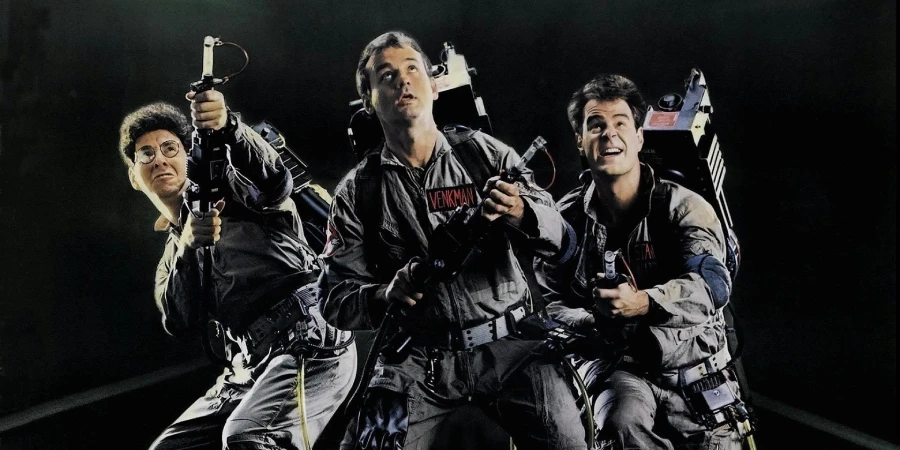

Few films define 1980s pop culture like Ghostbusters (1984). Directed by the brilliantly eccentric Ivan Reitman and starring a dream team of comedy legends, this supernatural comedy became an instant classic. It blends deadpan humor, paranormal chaos, and surprisingly clever world-building into one of the most endlessly rewatchable films of its era.
Detailed Summary
The Library Ghost: The Birth of an Idea
The film opens at the New York Public Library, where a librarian encounters a terrifying apparition. Cut to three parapsychologists at Columbia University:
- Bill Murray as Dr. Peter Venkman
- Dan Aykroyd as Dr. Raymond Stantz
- Harold Ramis as Dr. Egon Spengler
They investigate the ghost, panic spectacularly, and get fired from the university shortly afterward. Faced with unemployment and Egon’s delightfully reckless optimism, they decide to go into business.
Thus, Ghostbusters is born.
“Who You Gonna Call?” – Building the Business
The trio mortgage Stantz’s childhood home, buy a converted firehouse in Manhattan, and invest in dangerously untested proton-pack technology. Soon after, they hire Winston Zeddemore (played by Ernie Hudson), a pragmatic fourth member who joins purely for the paycheck.
Their first major capture, the gluttonous green specter known as Slimer, establishes them as legitimate ghost removers. Business booms. Montage. Theme song. Cultural immortality.
Dana Barrett, Zuul, and the Gatekeeper
Enter Dana Barrett (Sigourney Weaver), who begins experiencing supernatural events in her apartment building. Her fridge opens into a demonic temple-like dimension. Her neighbor Louis Tully (Rick Moranis) soon suffers a similar fate.
They become possessed by entities known as Zuul (Gatekeeper) and Vinz Clortho (Keymaster), servants of an ancient Sumerian god: Gozer.
Walter Peck and the Containment Crisis
Meanwhile, EPA official Walter Peck, played by William Atherton, suspects the Ghostbusters’ containment system is unsafe. In one of the film’s most satisfying escalations, Peck forces a shutdown of the containment unit.
The result? Every ghost the team has captured is unleashed across New York City.
Chaos ensues.
Gozer the Gozerian Appears
The supernatural activity reaches apocalyptic levels. The Ghostbusters climb to the top of Dana’s building, revealed to be a mystical conduit designed to summon Gozer.
They encounter Gozer the Gozerian, who demands they choose “the form of the Destructor.” Despite Ray’s attempt to clear his mind, he accidentally thinks of the Stay Puft Marshmallow Man.
And so, New York is attacked by a 100-foot-tall smiling marshmallow mascot.
Because of course it is.


Movie Ending
The final battle takes place atop the skyscraper temple as Gozer unleashes destruction upon the city.
After conventional proton streams prove ineffective, Egon suggests the unthinkable: crossing the streams. Earlier in the film, Egon warned that crossing streams could cause catastrophic total protonic reversal — essentially ending reality.
With no alternative, the team crosses the streams deliberately, directing the energy toward the interdimensional portal. The combined proton blast destabilizes the gateway, destroys Gozer’s manifestation, and collapses the portal to its dimension.
The rooftop temple explodes in a massive blast. The building partially implodes but does not fully collapse. Dana and Louis are freed from possession and survive.
The Ghostbusters emerge from the rubble victorious, greeted by cheering New Yorkers. The city is saved. The business is validated. Peter and Dana embrace.
It’s triumphant, slightly absurd, and completely earned.
Are There Post-Credits Scenes?
No. Ghostbusters (1984) does not include a post-credits scene. Once the film ends and the theme song reprises, that’s it. The era of Marvel-style stingers was still decades away.
Type of Movie
Ghostbusters is a supernatural comedy that blends science fiction, horror, and workplace satire. It balances deadpan humor with genuinely eerie moments, creating a tone that is both absurd and surprisingly grounded.
Cast
- Bill Murray – Dr. Peter Venkman
- Dan Aykroyd – Dr. Raymond Stantz
- Harold Ramis – Dr. Egon Spengler
- Ernie Hudson – Winston Zeddemore
- Sigourney Weaver – Dana Barrett
- Rick Moranis – Louis Tully
- William Atherton – Walter Peck
Film Music and Composer
The film score was composed by Elmer Bernstein, delivering orchestral themes that cleverly support both horror and comedy tones.
The iconic theme song “Ghostbusters” was written and performed by Ray Parker Jr. and became a global hit, earning an Academy Award nomination.


Filming Locations
Primary filming took place in New York City and Los Angeles.
The firehouse exterior is Hook & Ladder Company 8 in Manhattan, which became an instant pop-culture landmark. The interior firehouse scenes were shot in Los Angeles.
Dana’s apartment building exterior is 55 Central Park West, which was modified with a temple-like rooftop set to represent the gateway structure.
New York’s gritty early-80s aesthetic plays a crucial role in grounding the absurdity. The city feels lived-in and real, which makes the supernatural escalation more impactful.
Awards and Nominations
At the Academy Awards, the film received nominations for:
- Best Original Song
- Best Visual Effects
It won the BAFTA Award for Best Original Song and received multiple Saturn Award nominations.
Behind the Scenes Insights
- Dan Aykroyd’s original script was far more ambitious, featuring interdimensional travel and massive ghost armies. It was scaled down significantly for budget reasons.
- Bill Murray’s dry improvisational style reshaped much of the dialogue on set.
- Slimer was inspired by the spirit of John Belushi.
- The Stay Puft Marshmallow Man suit weighed over 75 pounds.
- The rooftop temple set was built entirely on a soundstage.
Inspirations and References
The concept originated from Dan Aykroyd’s fascination with paranormal research and his family’s history with spiritualism.
The final film was shaped into a modern Manhattan setting rather than a futuristic sci-fi landscape, making it feel grounded and relatable.
Alternate Endings and Deleted Scenes
Several early concepts involved:
- Multiple Gozer transformations
- A much larger-scale apocalypse across New York
- Extended scenes with Louis Tully
Most were trimmed to maintain pacing and budget constraints.
Memorable Scenes and Quotes
Key Scenes
- The team’s first capture of Slimer
- The containment unit explosion
- The rooftop confrontation with Gozer
- The Stay Puft Marshmallow Man marching through Manhattan
Iconic Quotes
- “Don’t cross the streams.”
- “We came, we saw, we kicked its ass.”
- “There is no Dana, only Zuul.”
- “He slimed me.”

Easter Eggs and Hidden Details
- Slimer resembles John Belushi, Aykroyd’s late friend and collaborator.
- Gozer’s and Zuul’s names come from Mesopotamian mythology inspirations.
- The firehouse number “8” appears repeatedly in promotional materials.
- The “Twinkie” speech is a metaphor for escalating supernatural energy levels.
Trivia
- The film was released in the same summer as Indiana Jones and the Temple of Doom and Gremlins.
- It was the second highest-grossing film of 1984.
- The proton pack sounds were created using a slowed-down recording of a lion’s growl.
- The script was completed in just a few months before shooting began.
Why Watch?
Because it’s lightning in a bottle. The chemistry between the leads is effortless. The humor is still sharp. The special effects, while dated, are charmingly practical. Most importantly, it proves that big concept sci-fi can coexist beautifully with dry, adult comedy.
It’s not just a comedy classic. It’s a cultural cornerstone.
Director’s Other Works
Directed by Ivan Reitman:
- Stripes (1981)
- Ghostbusters II (1989)
- Kindergarten Cop (1990)
- Dave (1993)
Recommended Films for Fans
If you love Ghostbusters, try: