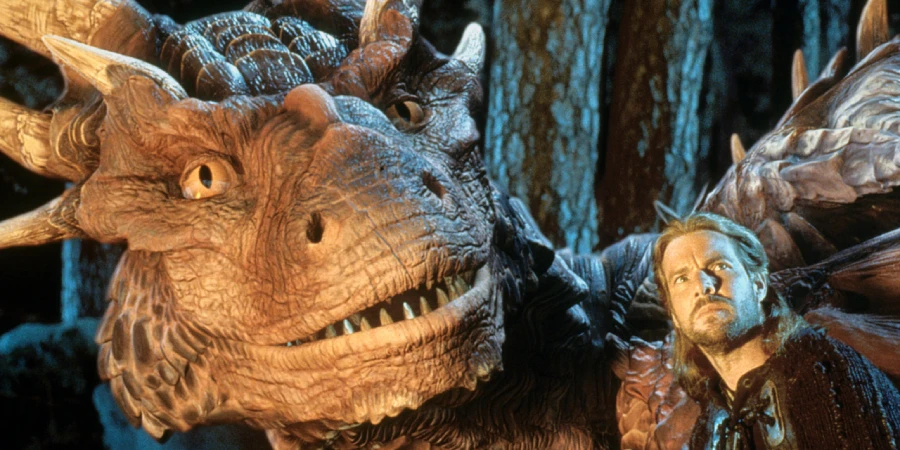

Dragonheart (1996) is one of those fantasy films that quietly becomes a classic. It mixes medieval adventure, moral questions, and an emotionally charged friendship between a knight and a dragon. Beneath its family-friendly surface lies a surprisingly thoughtful story about power, responsibility, and sacrifice.
Detailed Summary
A Kingdom Ruled by Hope
The story begins in a medieval kingdom ruled by King Einon. After the king is mortally wounded during a peasant revolt, his young son Prince Einon is saved through an extraordinary act: half of a dragon’s heart is transplanted into him. The dragon, Draco, believes this will create a wiser and more compassionate ruler.
Unfortunately, that hope quickly dies.
Bowen’s Broken Faith
Bowen, a former knight and mentor to Einon, watches in horror as the prince grows into a cruel and tyrannical king. Feeling personally responsible for Einon’s corruption, Bowen abandons knighthood and vows to kill all dragons, believing their magic created the monster Einon became.
This inner guilt is one of the film’s emotional backbones and gives Bowen far more depth than a typical fantasy hero.
The Dragon and the Dragon-Slayer
Bowen eventually encounters Draco, one of the last living dragons. Instead of killing each other, they form a clever scam: Draco pretends to terrorize villages, Bowen pretends to slay him, and they split the reward money.
Their partnership evolves into a genuine friendship, filled with humor, philosophical debates, and mutual respect. Draco is wise, sarcastic, and deeply aware that dragons are nearing extinction.
The Rise of Rebellion
Meanwhile, Einon’s cruelty sparks a rebellion led by Kara, a young woman whose father was executed by the king. Bowen is drawn back into the fight, torn between his desire for peace and his responsibility to stop Einon.
As the rebellion grows, a devastating truth is revealed: Draco and Einon share the same heart. If Einon dies, Draco dies with him.
The Moral Dilemma
This revelation forces Bowen and Draco into an impossible choice. To save the kingdom, Einon must die. But killing him will also kill Draco, the last dragon and Bowen’s closest friend.
The film slows down here, allowing the weight of this decision to fully settle. It is not about defeating a villain anymore; it is about choosing what kind of world deserves to survive.

Movie Ending
The final act is tragic, heroic, and deeply emotional.
Einon confronts the rebels and reveals his belief that cruelty and fear are the only ways to rule. Draco finally accepts that his attempt to save Einon was a mistake born from misplaced hope. He acknowledges that true goodness cannot be forced through magic.
In a heartbreaking decision, Draco allows himself to be killed so that Einon can be defeated. Bowen delivers the fatal blow to Einon, knowing it will also end Draco’s life. As Draco dies, he asks Bowen to remember him not as a mistake, but as proof that goodness once existed.
Draco ascends into the night sky, becoming a constellation among the stars, symbolizing the eternal spirit of dragons. Bowen, finally free from his guilt, reclaims his role as a knight and becomes a storyteller, passing on Draco’s legend so the world will never forget him.
The ending is deliberately bittersweet: evil is defeated, but at a great cost, and the age of dragons truly comes to an end.
Are There Post-Credits Scenes?
No. Dragonheart does not have any post-credits or mid-credits scenes. The story ends definitively with Draco’s ascension and Bowen’s narration.
Type of Movie
Dragonheart is a fantasy adventure film with strong dramatic elements. It blends medieval action with moral philosophy and emotional storytelling, making it appealing to both younger audiences and adults.
Cast
- Dennis Quaid as Bowen
- Sean Connery as the voice of Draco
- David Thewlis as King Einon
- Dina Meyer as Kara
- Pete Postlethwaite as Brother Gilbert
Film Music and Composer
The score was composed by Randy Edelman, whose sweeping and emotional soundtrack became one of the most memorable aspects of the film. The main theme is often cited as one of the most iconic fantasy scores of the 1990s and plays a huge role in amplifying the film’s emotional weight.
Filming Locations
The movie was filmed primarily in:
- Slovakia
- Czech Republic
- United Kingdom studios
The castles, mountains, and open landscapes were essential in grounding the fantasy in a believable medieval world. Real locations helped balance the heavy use of early CGI, especially for Draco.
Awards and Nominations
- Saturn Award nomination for Best Fantasy Film
- Widely praised for Sean Connery’s voice performance
- Not nominated for major Oscars, but frequently recognized for its music and visual ambition
Behind the Scenes Insights
- Draco was one of the most advanced CGI characters of the 1990s
- Sean Connery recorded all dialogue separately; the actors never interacted with him on set
- The filmmakers struggled to balance realism and emotion in Draco’s facial expressions
- Early test audiences reacted strongly to the ending, confirming the decision to keep it tragic
Inspirations and References
- Medieval dragon mythology
- Arthurian legends
- Classic fantasy literature focusing on moral dilemmas rather than simple hero-villain dynamics
Alternate Endings and Deleted Scenes
- Early drafts featured a more hopeful ending where dragons might return
- Several extended philosophical conversations between Bowen and Draco were cut for pacing
- No officially released alternate ending exists, but scripts suggest a slightly less tragic tone was considered
Book Adaptations and Differences
The film was not based on a novel but later inspired novelizations and expanded lore in sequel films. The core story remains unique to the movie and its screenplay.
Memorable Scenes and Quotes
Key Scenes
- Bowen meeting Draco for the first time in the dragon’s lair
- The staged dragon-slaying scams
- Draco revealing the shared heart connection
- Draco’s final flight into the stars
Iconic Quotes
- Draco: “To the stars, Bowen. To the stars.”
- Bowen: “I am the last of the old knights.”
- Draco: “A world without dragons is a world without magic.”
Easter Eggs and Hidden Details
- Draco’s constellation resembles a traditional medieval dragon drawing
- Religious imagery subtly contrasts dragon mythology throughout the film
- Draco’s dialogue often mirrors Bowen’s inner doubts
Trivia
- Sean Connery considered Draco one of his favorite non-Bond roles
- The film spawned five direct-to-video sequels
- Randy Edelman’s score is frequently reused in fantasy trailers
Why Watch?
Dragonheart is worth watching for its emotional core, not just its fantasy spectacle. It asks meaningful questions about leadership, responsibility, and sacrifice, wrapped in a story that is accessible yet surprisingly profound.