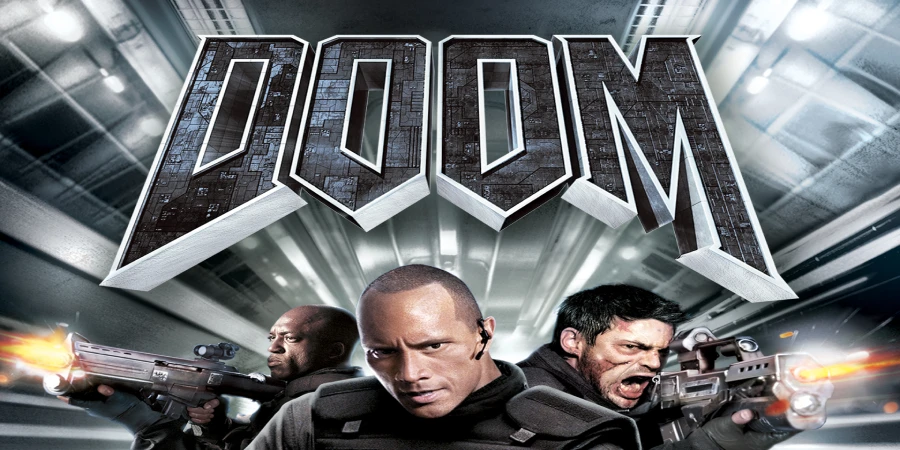

Nobody asked for a video game movie set on Mars, but Doom (2005) delivered one anyway, complete with a first-person shooter sequence that somehow remains the most talked-about two minutes in the film’s entire runtime. Based on the legendary id Software franchise, this Andrzej Bartkowiak-directed action horror film took liberties with its source material, swapped demonic invasion for genetic mutation, and still managed to carve out a cult following. It is gloriously loud, frequently absurd, and far more entertaining than its critical reception suggested.
Detailed Summary
The Opening: A Research Station in Chaos
Doom opens on the Olduvai Research Facility on Mars, where something has gone catastrophically wrong. Scientists are dead, communication is down, and whatever caused the carnage is still very much present. This chaotic cold open sets a tone that mixes survival horror with military action.
The Rapid Response Killer Squad Arrives
A military unit called RRTS (Rapid Response Tactical Squad) deploys through the Ark, a teleportation device linking Earth to the Mars facility. Sergeant Asher “Sarge” Mahonin, played by Dwayne Johnson, leads the team with iron-fisted authority. John “Reaper” Grimm, played by Karl Urban, joins the squad alongside a colorful cast of soldiers, each one a walking archetype.
Reaper has a personal connection to Olduvai: his sister, Dr. Samantha Grimm, works there as a scientist. That connection immediately adds emotional stakes to what could have been a purely mechanical action setup.
Exploring the Facility and First Encounters
As the squad explores the facility, they encounter mutilated bodies, panicked survivors, and increasingly aggressive creatures. These monsters are not demons from hell; they are genetically mutated humans. Scientists at Olduvai discovered a 24th chromosome in ancient Martian DNA, one that either enhances humans with extraordinary physical capability or transforms them into savage, murderous monsters depending on the host’s existing moral nature.
This is a significant departure from the game’s demonic lore. However, it functions as a workable sci-fi concept within the film’s own logic. Samantha explains the science to Reaper, and the film takes a moment to breathe before plunging back into carnage.
The Squad Falls Apart
Squad members start dying one by one as the creatures pick them off in the dark corridors of the facility. Meanwhile, Sarge grows increasingly ruthless, ordering the squad to shoot any survivor who might be infected, regardless of whether they pose an immediate threat. His moral compass deteriorates rapidly as the body count rises.
Portman, one of the more reprehensible soldiers, meets a particularly gory end. Goat, a religiously devout soldier, becomes infected after an encounter with a creature and ultimately slits his own throat. Each death raises the tension and narrows the group further.
Reaper Gets Injected and Transforms
In a pivotal moment, Reaper is critically wounded and near death. Samantha makes the desperate decision to inject him with the C24 chromosome. Because Reaper is fundamentally a good person, the chromosome enhances him rather than mutating him into a monster. He becomes superhuman: faster, stronger, and nearly unkillable.
This sequence effectively transforms Reaper into the game’s iconic protagonist. His recovery is rapid and visceral, and it sets up the film’s explosive final act.
The First-Person Shooter Sequence
Perhaps the most celebrated segment of the film is a roughly five-minute first-person sequence that directly mimics the video game’s perspective. Reaper moves through corridors, shotgun in hand, blasting creatures in a continuous chain of stylized carnage. For fans of the source material, this sequence is pure fan service executed with real technical craft.
Notably, the sequence uses practical sets and camera work rather than heavy CGI, giving it a kinetic, grounded feel. Bartkowiak clearly understood that this moment needed to feel tactile, not animated.



Movie Ending
Sarge fully descends into villainy in the final act. After injecting himself with the C24 chromosome, he transforms, not into a superhuman hero, but into a monstrous killing machine, confirming the film’s thesis that the chromosome amplifies whatever is already inside a person. Sarge, corrupted by violence and obsession, becomes the final monster Reaper must face.
Reaper and Sarge clash in a brutal, physically intense battle inside the facility. Reaper, now operating at superhuman capacity, manages to overpower Sarge and ultimately sends him into a trash compactor, killing him. It is a satisfying if somewhat blunt conclusion that rewards the film’s central moral argument: good people become heroes, corrupt people become monsters.
Samantha and Reaper escape back through the Ark to Earth. Reaper leaves Sarge’s fate sealed within the facility, and the two siblings survive. For a film that killed off nearly every supporting character, this ending carries genuine emotional relief rather than feeling unearned.
Audiences often wonder whether Sarge’s transformation into a full creature was intentional from the start or a spontaneous reaction to the chromosome. The film strongly implies it was always a latent outcome, given that Sarge’s capacity for cruelty was present long before the injection. His arc is less a sudden twist and more a slow revelation of who he always was.
Are There Post-Credits Scenes?
Doom (2005) contains no post-credits scenes. Once the credits roll, the film is definitively over. Audiences who stayed in their seats hoping for a tease found nothing waiting for them.
Type of Movie
Doom occupies a specific corner of the action horror genre, blending military sci-fi with creature feature elements. Its tone shifts between tense survival sequences and full-throttle action set pieces. In contrast to many horror films of its era, it leans heavily into its action roots rather than committing fully to either horror or drama.
Fans of late 1990s and early 2000s action cinema will recognize its DNA immediately. It is bombastic, self-aware at moments, and unapologetically populist.
Cast
- Karl Urban – John “Reaper” Grimm
- Dwayne Johnson – Asher “Sarge” Mahonin
- Rosamund Pike – Dr. Samantha Grimm
- Razaaq Adoti – Duke
- Ben Daniels – Goat
- Deobia Oparei – Destroyer
- Richard Brake – Portman
- Al Weaver – The Kid
- Yao Chin – Mac
- Robert Russell – Pinky
- Brian Steele – Hell Knight / Imp (creature performer)
Film Music and Composer
Clint Mansell composed the score for Doom, bringing his distinctive blend of electronic textures and orchestral weight to the project. Mansell, already celebrated for his iconic work on Requiem for a Dream and Pi, brought genuine craft to what many dismissed as a disposable genre film. His score amplifies the tension in the facility sequences and gives the action beats a propulsive energy.
Furthermore, the score incorporates heavy, industrial-influenced sounds that echo the game’s own sonic identity. Mansell understood that the music needed to feel like it belonged in a dark, pressurized corridor on Mars.



Filming Locations
Doom was filmed primarily at Barrandov Studios in Prague, Czech Republic. Producers chose the location for its cost efficiency and the studio’s ability to construct large-scale interior sets. The Mars facility corridors, laboratories, and the Ark chamber were all built there.
Shooting on constructed sets rather than real locations gave the production complete control over lighting and atmosphere. Consequently, the facility feels claustrophobic and labyrinthine in a way that outdoor or location shooting rarely achieves. That sense of confinement is central to the film’s horror elements working at all.
Awards and Nominations
Doom did not receive notable awards recognition or significant nominations during its release cycle. Critics largely dismissed it, and awards bodies followed suit. It did, however, receive attention at the Razzie Awards for negative recognition, fitting company for a film that critics treated as an easy target.
Behind the Scenes Insights
- Director Andrzej Bartkowiak pushed for the first-person shooter sequence after recognizing it as the film’s most unique selling point. He reportedly insisted it be shot practically rather than relying on digital augmentation.
- Dwayne Johnson was originally considered for the role of Reaper, the hero, before producers recast him as Sarge, the villain. This decision gave the film a genuine twist, since audiences in 2005 were primed to root for Johnson as a protagonist.
- Karl Urban performed many of his own physical sequences during production. His commitment to the role extended to extensive physical training prior to filming.
- Rosamund Pike accepted the role early in her career, shortly after her breakthrough in Die Another Day. She later described the shoot as a physically demanding but professionally valuable experience.
- Creature performers, particularly Brian Steele, wore full prosthetic suits during filming, a choice that gave the monsters a tangible physical presence on set and helped actors react authentically.
- Producers secured the rights to adapt the Doom game franchise years before production began, and the project went through multiple script rewrites before arriving at the chromosome-based storyline.
Inspirations and References
Doom draws its foundational concept from the id Software video game series, first released in 1993, which defined the first-person shooter genre. The film openly borrows the game’s setting, key weapons (including the iconic BFG), and its Mars-based horror premise.
Moreover, the film’s creature design and facility atmosphere draw clear inspiration from Aliens (1986), particularly in its military unit structure and the way soldiers are systematically overwhelmed by a superior threat. In addition, the genetic mutation storyline echoes films like The Thing (1982), where the horror lies in not knowing who among the group has already been compromised.
Alternate Endings and Deleted Scenes
No officially released alternate ending exists for Doom. However, the home video release included deleted and extended scenes that provided additional character development for several squad members. These cuts suggest an earlier version of the script spent more time building the ensemble before the carnage began.
Specifically, additional scenes featuring Portman were trimmed, which in retrospect may have softened the impact of his death. Producers clearly prioritized pace over character depth in the theatrical cut.
Book Adaptations and Differences
Doom (2005) is not based on a book. It adapts the Doom video game franchise directly. A novelization of the film was released alongside the theatrical version, but the film itself draws from the game rather than any literary source.



Memorable Scenes and Quotes
Key Scenes
- The first-person shooter sequence, in which Reaper moves through the facility in an unbroken, game-accurate perspective, blasting creatures with shotguns and the BFG.
- Reaper’s transformation after Samantha injects him with the C24 chromosome, showing his wounds healing at accelerated speed and his physical capabilities surging beyond human limits.
- The final confrontation between Reaper and Sarge, a superhuman brawl that brings the film’s moral argument about the chromosome to a visceral, physical conclusion.
- Goat’s death scene, in which the infected soldier, overcome by whatever the chromosome awakens in him, takes his own life in a moment of genuine shock.
- The arrival through the Ark, an early sequence that establishes the teleportation technology with satisfying visual flair and sets the film’s sci-fi credentials clearly.
Iconic Quotes
- “I’m not supposed to die.” (Reaper, spoken with the particular brand of action-hero certainty that the film earns by the end)
- “Semper Fi, motherf*er.” (Sarge, delivering the film’s most blunt expression of his character)
- “Whatever it is, it’s not human anymore.” (used as a recurring refrain throughout the facility sequences as the nature of the threat becomes clear)
Easter Eggs and Hidden Details
- The weapon designated the BFG appears in the film and retains its full name from the game, a direct and knowing nod to longtime fans.
- Several creature designs closely mimic specific enemy types from the original game, including the Imp and the Hell Knight, despite the film recontextualizing their origins as genetic mutations rather than demons.
- The Ark teleportation device visually echoes the portal technology from the game, designed with circular geometric architecture that fans of the source material will recognize immediately.
- Facility signage and environmental details throughout the set reference locations and designations from the original Doom game maps, rewarding attentive viewers who know the game well.
- Reaper’s real name, John Grimm, is a clear nod to the game’s protagonist, who in various materials carries the name John or simply exists as a nameless marine.
Trivia
- Doom (2005) arrived over a decade after the game first launched, following years of development struggles and multiple abandoned script attempts.
- Dwayne Johnson has publicly acknowledged that subverting audience expectations by playing the villain was a deliberate and bold career choice at that stage of his Hollywood ascent.
- The film’s first-person sequence took several days to shoot and required meticulous choreography to maintain the illusion of a continuous, unbroken camera perspective.
- Despite poor critical reception, Doom developed a strong cult following on home video, particularly among fans of the game and late-night action cinema enthusiasts.
- Karl Urban has spoken positively about the film in later interviews, expressing genuine affection for the project and for the game franchise that inspired it.
- The film was rated R in the United States, allowing it to lean into graphic violence in a way that a softer rating would have prevented.
- A reboot, Doom: Annihilation, was released in 2019 directly to home video, receiving even harsher critical notices than the 2005 film and failing to generate comparable cultural traction.
Why Watch?
If you want a film that commits fully to its ridiculous premise and delivers genuine spectacle along the way, Doom is a reliable ninety-minute ride. Dwayne Johnson’s villain turn and Karl Urban’s understated heroism make for an unexpectedly compelling dynamic. Furthermore, the first-person shooter sequence alone justifies the runtime for fans of the game.
Director’s Other Movies
- Romeo Must Die (2000)
- Exit Wounds (2001)
- Cradle 2 the Grave (2003)
Recommended Films for Fans
- Aliens (1986)
- The Thing (1982)
- Event Horizon (1997)
- Resident Evil (2002)
- Soldier (1998)
- Pandorum (2009)
- Ghosts of Mars (2001)