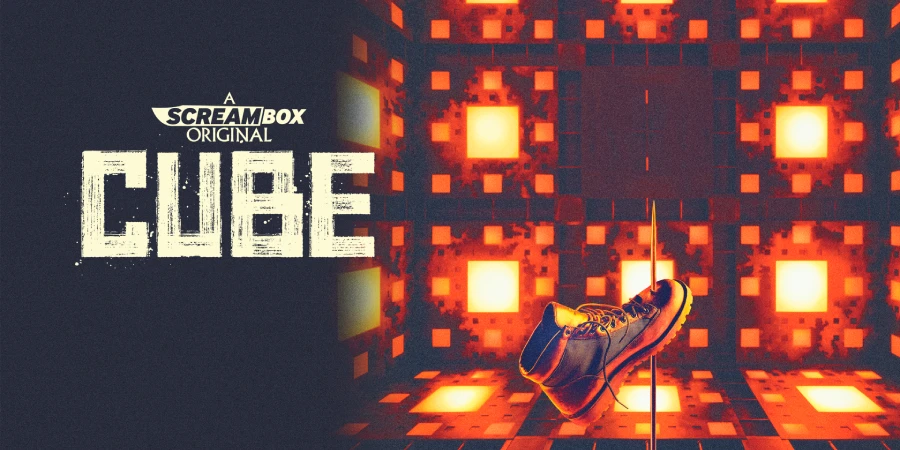

Confined spaces turn human nature into a jagged weapon within this clinical reimagining of a cult classic. Six strangers wake up in a lethal geometric labyrinth with no memory of how they arrived. Yasuhiko Shimizu directs this 2021 remake, injecting modern social anxiety into the cold, industrial bones of the original concept.
Detailed Summary
The Awakening
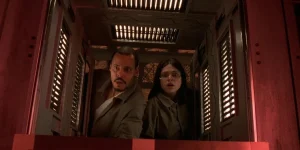
Yuichi Goto wakes up in a cube-shaped room with metallic walls and glowing hatches. He soon encounters other survivors who are equally confused and terrified. Specifically, they discover that some rooms contain lethal traps triggered by sound, heat, or movement.
The group includes a cynical engineer, a young woman, a mild-mannered man, and a volatile teenager. Each person brings a different perspective to their survival strategy. Consequently, they quickly realize that cooperation is their only hope for escaping the shifting maze.
Decoding the Numbers
Shinji Ochi, the oldest member, notices engraved numbers on the thresholds of each room. Yuichi uses his mathematical skills to analyze these digits. He determines that the numbers indicate whether a room contains a trap. However, the complexity of the prime number calculations creates tension and leads to fatal errors early in the journey.
Survival depends on identifying prime numbers, but the system proves more rigged than they initially suspected. Tension rises as Hiroshi Ichikawa, a corporate worker, becomes increasingly aggressive. This shift in group dynamics underscores the psychological toll of their imprisonment.
Descent into Madness
As the survivors reach the inner layers of the structure, Hiroshi loses his grip on reality. He begins to view the others as obstacles rather than allies. Meanwhile, Hiroshi attacks the younger members, believing that only the strong should survive. This internal conflict proves more dangerous than the mechanical traps surrounding them.
Blood is shed when Hiroshi kills another participant during a frantic struggle. Yuichi and Asako, the mysterious woman, must navigate both the shifting rooms and a literal killer in their midst. Therefore, the physical maze becomes a backdrop for an intense battle of morality and willpower.
Movie Ending
The final survivors reach the outer edge of the massive structure where a single exit hatch appears. Hiroshi attempts to prevent anyone else from leaving because he believes the world outside is equally cruel and meaningless. During the final confrontation, Hiroshi falls to his death as the room shifts unexpectedly. This leaves only Yuichi and Asako standing before a blinding white light.
Asako reveals that she is actually an observer, or perhaps an advanced artificial intelligence, embedded within the experiment. She remains behind while Yuichi steps through the portal into an unknown urban landscape. Despite his escape, the film suggests that the cycle of the Cube will never truly end. Notably, Asako resets the system and prepares for a new group of victims to enter the deadly game.
Are There Post-Credits Scenes?
This film does not feature a traditional mid-credits or post-credits scene. Once the credits finish rolling, the story concludes entirely. Viewers should focus on the final visual cues before the screen fades to black.
Type of Movie
This production functions as a psychological sci-fi thriller. It emphasizes suspense and character decomposition over pure action elements. The tone remains bleak, cold, and claustrophobic throughout the entire runtime.
Cast
- Masaki Suda – Yuichi Goto
- Anne Watanabe – Asako Kai
- Masaki Okada – Shinji Ochi
- Hikaru Tashiro – Chino Uno
- Takumi Saito – Hiroshi Ichikawa
- Kotaro Yoshida – Shigehisa Ando
Film Music and Composer
Yutaka Yamada composed the haunting, atmospheric score for the film. He utilizes industrial sounds and low-frequency drones to heightening the sense of impending doom. Interestingly, the music often mimics the mechanical grinding of the rooms shifting position.

Filming Locations
The entire movie was shot on a specially constructed soundstage in Japan. Because the setting is an enclosed, artificial environment, controlled studio sets were necessary to manage lighting and camera angles. These sets allowed the crew to create a sense of infinite, repetitive space without leaving the facility.
Awards and Nominations
The film received limited attention on the international awards circuit. It primarily focused on technical achievements in sound design and visual effects within domestic Japanese film circles.
Behind the Scenes Insights
- The production team built a fully functional Cube set that could change colors using LED panels.
- Actors reported feeling genuine claustrophobia during the weeks of filming inside the cramped metallic boxes.
- Director Yasuhiko Shimizu worked closely with Vincenzo Natali, the director of the original 1997 film, who served as an executive producer.
- The traps were designed to look more organic and terrifying than those in the 1990s version.
Inspirations and References
This movie serves as an official remake of the 1997 Canadian film Cube. It draws inspiration from existentialist literature and social experiments regarding group behavior. Furthermore, it incorporates modern Japanese cultural anxieties regarding corporate pressure and social isolation.
Alternate Endings and Deleted Scenes
There are no widely released alternate endings for this version. Some rumors suggest longer sequences of the outside world were filmed but ultimately cut to maintain mystery. These deleted moments likely clarified the fate of the survivors but were removed to preserve the bleak tone.
Book Adaptations and Differences
This film is not based on a book. It is a cinematic reimagining of an existing movie franchise. Consequently, there are no literary source materials to compare against the screenplay.



Memorable Scenes and Quotes
Key Scenes
- The opening sequence where a prisoner is sliced into geometric pieces by a laser trap.
- The intense mathematical debate while the group balances on a vibrating floor.
- The final revelation of Asako standing motionless in the center of the resetting room.
Iconic Quotes
- “This place is just a mirror reflecting who we really are.”
- “Numbers don’t lie, but people do.”
- “The exit isn’t just a door; it is a choice to keep living.”
Easter Eggs and Hidden Details
- The room numbers contain patterns that link back to the prime factorings used in the original 1997 film.
- Quick glances at Asako’s eyes occasionally reveal a digital shimmer, foreshadowing her identity.
- One of the traps features a design similar to a puzzle piece from a previous installment in the franchise.
Trivia
- Masaki Suda actually learned complex prime number sequences to make his performance more authentic.
- The film was one of the first major Japanese productions to resume after pandemic restrictions.
- Each color of the room lighting signifies a different psychological state for the characters.
Why Watch?
This film offers a sleek, modern update to a classic survival premise. Fans of escapology and high-stakes puzzles will appreciate the intricate trap designs. Ultimately, the strong performances elevate a familiar story into a gripping psychological study.
Director’s Other Movies
- Vise (2019)
- Distance (2020)
- Hello World (2019)
Recommended Films for Fans
- Cube (1997)
- Escape Room (2019)
- The Platform (2019)
- Saw (2004)