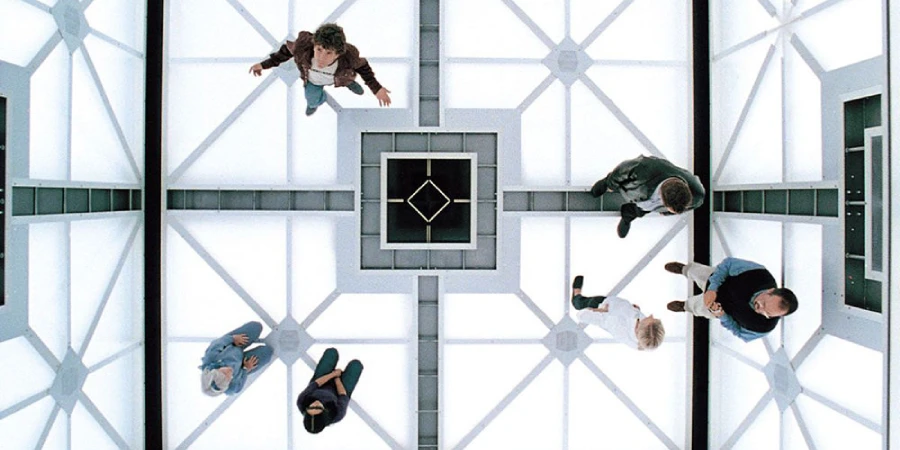

Eight strangers wake up in a surreal, white environment composed of interconnected cubic rooms. This sequel abandons the industrial rust of its predecessor for a sleek, high-tech nightmare. Gravity shifts and time flows inconsistently as the prisoners struggle to survive a collapsing four-dimensional tesseract.
Detailed Summary
Waking Up in the Tesseract
Each individual arrives in the cube without knowing how they got there. They soon realize the rooms do not move in a linear fashion. Instead, the environment exists outside the normal laws of physics.
The group includes a diverse range of professionals. Simon is a private investigator, while Kate is an empathetic psychotherapist. Jerry builds clocks and Sasha is a blind girl who seems strangely familiar with the surroundings.
They quickly discover that some rooms contain lethal traps. However, these hazards involve advanced physics rather than mechanical blades. One room features a shifting gravitational field that crushes anyone inside. Meanwhile, others contain crystalline shards that expand at lethal speeds.
The Reality of Izon
Most of the captives share a secret connection to a massive defense contractor named Izon. This shadowy organization built the Hypercube for a mysterious purpose. Paley, a woman suffering from dementia, constantly mentions the company during her clearer moments.
Simon begins to grow increasingly paranoid and violent toward the others. Furthermore, he suspects that someone among them is a corporate spy. His aggression creates a secondary threat that is just as dangerous as the shifting rooms.
Mathematical Chaos
Characters soon witness multiple versions of themselves in different rooms. This phenomenon occurs because the Hypercube occupies a theoretical space where parallel realities intersect. For instance, Kate sees her own corpse in several different timelines.
Jerry attempts to use his technical knowledge to map their progress. Unfortunately, the four-dimensional geometry makes traditional navigation impossible. The rooms are not just moving; they are folding into one another constantly.
Movie Ending
Kate realizes the entire structure is beginning to collapse inward on itself. This phenomenon, known as the big crunch, means all points in the Hypercube will eventually occupy a single coordinate. She manages to escape the violent Simon and finds herself at the center of the implosion.
Sasha reveals her true identity as Alex Trusk, a genius hacker who once worked for Izon. She possesses the critical data the company wants to protect at all costs. Consequently, Kate decides to kill Simon to ensure her own survival as the void consumes the remaining survivors.
The protagonist leaps into a dark portal as the tesseract disappears into a singularity. Notably, she wakes up in an industrial facility surrounded by soldiers. She hands over a digital storage device containing the secret information stolen by Alex.
An executive thanks her for the successful mission before a soldier shoots her in the head. This ruthless act cleans up the last remaining witness of the experiment. Ultimately, Izon retains its secrets while the Hypercube project reaches its cold, calculated conclusion.
Are There Post-Credits Scenes?
No extra footage appears after the credits roll in this film. The story concludes definitively with the death of the protagonist. Viewers can safely stop watching once the screen turns black.
Type of Movie
This film belongs to the science fiction horror genre. It focuses heavily on mathematical concepts and philosophical dread. The tone is sterile, claustrophobic, and deeply cynical.
Cast
- Kari Matchett – Kate Filmore
- Geraint Wyn Davies – Simon Grady
- Grace Lynn Kung – Sasha / Alex Trusk
- Matthew Ferguson – Max Reisman
- Neil Crone – Jerry Whitehall
- Barbara Gordon – Mrs. Paley
- Lindsey Connell – Julia
- Greer Kent – Becky Young
Film Music and Composer
Norman Orenstein composed the original score for this production. He emphasized synthesized textures to match the high-tech visual aesthetic. The music lacks traditional melodies, opting instead for ambient dread and sharp, metallic sounds.

Filming Locations
The entire production took place in Toronto, Ontario. The crew used soundstages to create the repetitive, white rooms of the tesseract. This controlled environment allowed the filmmakers to manipulate lighting and camera angles without external interference.
Awards and Nominations
The film received a nomination for Best DVD Release at the Saturn Awards in 2003. It did not win any major international film festival prizes.
Behind the Scenes Insights
- Director Andrzej Sekula previously served as the cinematographer for Pulp Fiction.
- The production team built only a single room on the soundstage. They changed the lighting and wall panels to make each chamber look unique.
- Actors often struggled with the bright white walls, which caused significant eye strain throughout the shoot.
Inspirations and References
The script draws heavily from quantum mechanics and the concept of the tesseract. It references the work of Edwin Abbott, specifically the book Flatland. Specifically, the idea of higher-dimensional beings observing lower dimensions plays a major role in the narrative.
Alternate Endings and Deleted Scenes
An alternate version of the ending exists on some home media releases. In this variant, Kate does not die immediately after exiting the cube. Instead, she finds herself in a field before the soldiers arrive to intercept her. This version makes the final betrayal feel slightly more drawn out.
Book Adaptations and Differences
This film is not based on any specific book. It serves as a direct sequel to the original screenplay by Vincenzo Natali. Therefore, it exists as a standalone cinematic universe without a literary source.


Memorable Scenes and Quotes
Key Scenes
- The discovery of the multiple reality room where Simon watches himself eat.
- The time-distorted scene where Kate watches a version of herself die of old age in seconds.
- The final collapse where the walls of the cube disintegrate into a digital void.
Iconic Quotes
- “The numbers. They’re all the same.”
- “Gravity is a matter of perspective in here.”
- “You are part of the system now.”
Easter Eggs and Hidden Details
- The numbers appearing on the walls are actually coordinates in four-dimensional space.
- One of the characters shares a name with a prominent theoretical physicist in the real world.
- The logo for Izon appears subtly on the clothing of several prisoners before they realize their connection.
Trivia
- This film features significantly more CGI than the original 1997 movie.
- The cast had to perform many of their own stunts due to the low budget.
- It was released directly to video in many international markets.
Why Watch?
Fans of mind-bending concepts will appreciate the unique visual style. It expands the lore of the franchise while providing plenty of tension. This movie offers a rare look at four-dimensional horror that remains distinct today.
Director’s Other Movies
- The Pleasure Drivers (2006)
Recommended Films for Fans
- Cube (1997)
- Cube Zero (2004)
- Exam (2009)
- The Platform (2019)
- Circle (2015)