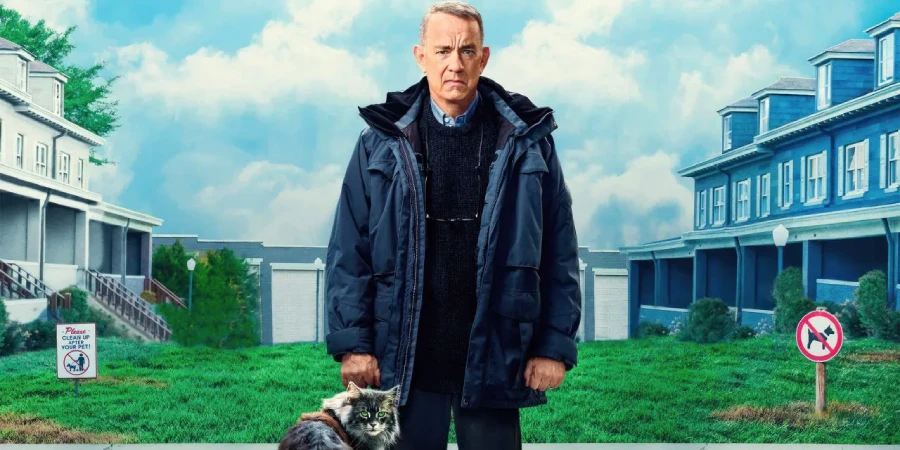

A Man Called Otto is the American adaptation of the beloved Swedish novel and film about grief, routine, and the quiet power of human connection. Directed by Marc Forster and starring Tom Hanks, the film balances dry humor with deeply emotional moments. Yes, it will probably make you cry. And yes, you’ll laugh five minutes later.
The movie is based on the 2012 novel A Man Called Ove by Fredrik Backman and is a remake of the 2015 Swedish film A Man Called Ove.
Detailed Summary
Otto’s Isolated Routine
Otto Anderson is a widower in Pittsburgh who lives by rules, routines, and quiet resentment. He patrols his neighborhood like a self-appointed HOA sheriff, correcting recycling mistakes and enforcing parking rules with military precision.
We quickly understand something crucial: his anger is a shield for deep grief. His beloved wife Sonya has passed away, and without her, he sees no purpose in continuing.
Failed Attempts and Unexpected Interruptions
Otto repeatedly attempts to end his life. Each attempt is interrupted—by neighbors, by practical mishaps, by fate. These interruptions aren’t played for shock but rather for uncomfortable dark humor and humanity.
The biggest interruption comes in the form of his new neighbors: Marisol, Tommy, and their daughters. Marisol, in particular, refuses to let Otto isolate himself. She’s persistent, warm, blunt, and unintimidated by his grumpiness.
The Growing Bond
Marisol slowly pulls Otto into her family’s orbit. He teaches her to drive. He helps with practical problems. He bonds with the children. He even rescues a stray cat (despite loudly insisting he doesn’t want it).
Through flashbacks, we see Otto’s love story with Sonya—how they met, fell in love, and built a life shaped by loyalty and quiet devotion. These scenes are the emotional backbone of the film. Otto was not always bitter. He was once deeply tender.
Confronting the Past
We learn about a betrayal by Otto’s former best friend and a corporate housing development threatening to displace longtime residents. Otto’s moral code—rigid but sincere—pushes him to defend his neighbors.
The story gradually shifts from “man trying to die” to “man rediscovering purpose.”
Movie Ending
In the final stretch of the film, Otto’s health begins to deteriorate. We learn he has a serious heart condition. Importantly, this isn’t framed as sudden tragedy but as something quietly looming in the background.
Otto finalizes his will and prepares for death—not through self-harm this time, but through acceptance. He leaves his house to Marisol and her family, entrusting them with what he values most: community.
One night, Otto dies peacefully in his sleep from heart failure.
The final scenes show the neighborhood coming together for his funeral. The once-irritating, rule-obsessed man is revealed to have been the glue holding everything together. His small acts of integrity and kindness had lasting impact.
Marisol reads Otto’s letter aloud. In it, he acknowledges that she “saved” him—not by fixing his pain, but by forcing him to live again. The film ends not in despair, but in warmth. The stray cat sits near his grave.
The takeaway is clear: Otto didn’t lose his love for Sonya. He expanded it to include others. His story ends in peace, not loneliness.
Are There Post-Credits Scenes?
No. There are no post-credits or mid-credits scenes. Once the credits roll, the story is complete.
Type of Movie
A Man Called Otto is a comedy-drama with strong themes of grief, loneliness, and community. It blends dark humor with heartfelt emotional storytelling, creating a film that is both heavy and life-affirming.
Cast
- Tom Hanks as Otto Anderson
- Mariana Treviño as Marisol
- Rachel Keller as Sonya
- Manuel Garcia-Rulfo as Tommy
- Cameron Britton as Jimmy
Notably, young Otto in flashbacks is played by Truman Hanks, Tom Hanks’ real-life son.
Film Music and Composer
The score was composed by Thomas Newman. His music subtly reinforces the emotional beats—melancholic but never manipulative. The piano-driven themes especially enhance the flashback sequences with Sonya.
Filming Locations and Their Importance
The film is set in Pittsburgh, Pennsylvania, but was primarily shot in the Pittsburgh area and parts of Ohio.
The suburban neighborhood setting is crucial. It represents:
- Routine and order (Otto’s comfort zone)
- Community tension
- Gradual emotional thaw
The physical closeness of the houses visually reinforces the theme that no one is ever truly alone—even when they try to be.
Awards and Nominations
While not a major awards juggernaut, the film received:
- Academy Award nomination for Best Original Song (“Applause”)
- Several Critics’ Choice and regional nominations
- Strong audience reception and box office success
Behind the Scenes Insights
- Tom Hanks was personally involved in developing the American adaptation.
- The film shifts the setting from Sweden to the U.S., altering some cultural nuances.
- Truman Hanks’ casting as young Otto added emotional authenticity to the flashbacks.
- Marc Forster aimed to balance the darker themes carefully to avoid glamorizing suicide.
- Mariana Treviño’s performance was widely praised for bringing warmth and energy that anchors the film.
Inspirations and References
The primary source material is:
- The novel A Man Called Ove by Fredrik Backman
- The Swedish film adaptation A Man Called Ove
The American version modernizes certain elements (social services, corporate housing issues) but maintains the novel’s emotional core.
Alternate Endings and Deleted Scenes
There are no publicly released alternate endings. However, early drafts reportedly explored:
- A more ambiguous health outcome for Otto
- Extended flashbacks of Sonya’s teaching career
- Additional neighborhood subplots that were trimmed for pacing
The theatrical ending was chosen to emphasize emotional closure.
Book Adaptation and Differences
Key differences between the novel and the 2022 film:
- Setting moved from Sweden to the United States
- Cultural humor adapted for American audiences
- Some side characters simplified
- The tone is slightly softer in the U.S. version
However, the emotional arc—grief transforming into connection—remains intact.


Memorable Scenes and Quotes
Key Scenes
- Otto teaching Marisol how to drive
- The first time Otto reluctantly helps the neighbors
- Flashbacks of Otto meeting Sonya
- The final reading of Otto’s letter
Iconic Quotes
- “There’s no one who needs me.”
- “You don’t get to give up just because life got hard.”
These lines summarize the film’s emotional thesis.
Easter Eggs and Hidden Details
- The stray cat represents Otto’s resistance to connection—then acceptance.
- Otto’s meticulous toolbox symbolizes control in a chaotic emotional world.
- The train imagery mirrors the moment Otto met Sonya and the accident that later shaped their lives.
- The neighborhood’s gradual warmth reflects Otto’s internal thaw.
Trivia
- Tom Hanks has described Otto as one of his most emotionally demanding roles.
- The film was a surprise box office success, especially among older audiences.
- Marc Forster intentionally avoided excessive sentimentality in the final act.
- The original Swedish film was nominated for two Academy Awards.
Why Watch?
Because it reminds you—without being preachy—that community can save people in ways therapy, money, and pride cannot. It’s a film about grief, but more importantly, it’s about staying.
If you appreciate character-driven stories with emotional payoff, this one delivers.
Director’s Other Works (Marc Forster)
- Monster’s Ball (2001)
- Finding Neverland (2004)
- Quantum of Solace (2008)
- World War Z (2013)
- Christopher Robin (2018)