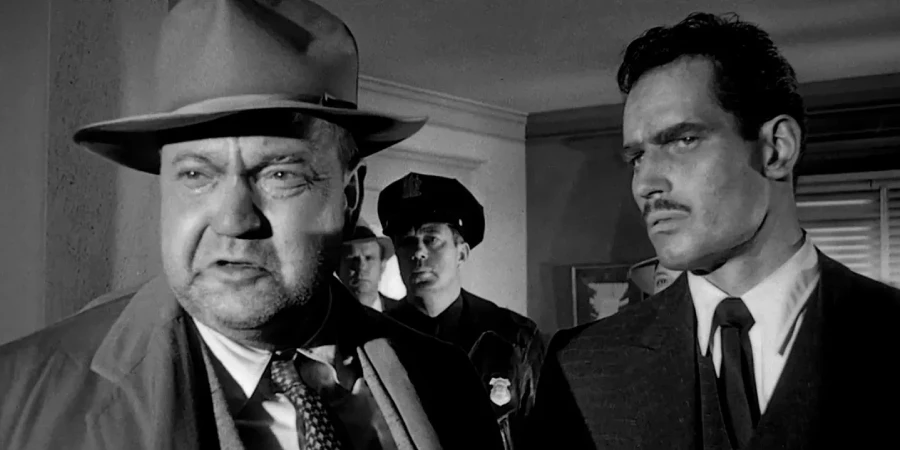

Orson Welles’s final Hollywood film begins with one of cinema’s most legendary shots. Consequently, it drags audiences into a grimy border town where morality is as murky as the Rio Grande. The film is a masterclass in mood and cinematic technique. Ultimately, Touch of Evil paints a cynical, unforgettable portrait of corruption.
Detailed Summary
The Bombing and Two Detectives
The film opens on the U.S.-Mexico border. A ticking bomb is placed in the trunk of a car. Mexican narcotics agent Miguel “Mike” Vargas (Charlton Heston) and his new American wife, Susie (Janet Leigh), are strolling nearby. Just as they cross into the U.S., the car explodes, killing its occupants, a wealthy builder named Rudy Linnekar and his companion. In response, local American police captain Hank Quinlan (Orson Welles), a gruff, obese detective with a limp, arrives to take charge. Vargas, despite being on his honeymoon, decides to observe the investigation, which immediately creates friction with the territorial Quinlan.
A Corrupt Investigation
Quinlan and his loyal sergeant, Pete Menzies (Joseph Calleia), quickly identify a suspect. They focus on a young Mexican man named Manolo Sanchez, who was secretly married to Linnekar’s daughter. During a search of Sanchez’s apartment, Quinlan’s “intuition” conveniently leads him to a shoebox filled with dynamite. However, Vargas had briefly left the apartment and, upon returning, insists the shoebox was empty just moments before Menzies “found” it. Therefore, Vargas openly accuses the legendary Quinlan of planting evidence. This accusation infuriates Quinlan, who now sees Vargas as a dangerous enemy.
Susie’s Nightmare
Meanwhile, Susie is targeted by the Grandi crime family. Vargas previously put their leader behind bars, so his brother, “Uncle Joe” Grandi (Akim Tamiroff), wants revenge. Sensing an opportunity, Grandi allies with Quinlan to discredit Vargas. They conspire to terrorize Susie. First, Grandi’s thugs menace her at her remote motel. Later, they move her to a different motel owned by Grandi, where they drug her and stage a compromising scene. Quinlan then appears and murders Grandi, leaving his body in the room with the unconscious Susie to frame her for the murder.
The Takedown
Vargas, frantic about his missing wife, eventually finds her drugged and disoriented. Realizing Quinlan is behind the setup, he seeks help from Menzies. At first, Menzies fiercely defends his partner. However, Vargas shows him evidence that Quinlan’s famous cane, a key part of his persona, was left at the scene of Grandi’s murder. This forces a devastated Menzies to accept that his friend and mentor is a murderer. As a result, Menzies agrees to help Vargas expose Quinlan by wearing a wire.


Movie Ending
The finale is a tense, shadowy confrontation by a desolate oil field. An increasingly drunk Quinlan confesses his history of framing criminals to Menzies, unaware that Vargas is recording them with a hidden microphone. Quinlan admits to planting evidence for years, believing the ends justified the means. He even confesses to murdering Grandi. However, the recording device creates feedback, and Quinlan realizes he has been betrayed. In a rage, he shoots Menzies. Before Quinlan can kill Vargas, the dying Menzies musters his last strength and shoots Quinlan. Quinlan stumbles backward and falls to his death in a pool of filthy water. In the end, Assistant District Attorney Schwartz arrives and confirms that the dynamite was indeed planted, vindicating Vargas and proving Sanchez was innocent all along. Tanya, a madame and Quinlan’s old friend, delivers his epitaph: “He was some kind of a man. What does it matter what you say about people?”
Are There Post-Credits Scenes?
No, there are no post-credits scenes in Touch of Evil. The practice was not common in Hollywood filmmaking during the 1950s. The film concludes after the final shot and Tanya’s memorable last line.
Type of Movie
Touch of Evil is the quintessential film noir. It features many hallmarks of the genre, including a cynical worldview, deep-focus cinematography with stark shadows, and a morally ambiguous anti-hero in Hank Quinlan. Moreover, the film acts as a crime thriller, driven by the tense cat-and-mouse game between Vargas and Quinlan. Its tone is overwhelmingly dark, sweaty, and claustrophobic, reflecting the corrupt world it depicts.
Cast
- Charlton Heston – Ramon Miguel “Mike” Vargas
- Janet Leigh – Susan Vargas
- Orson Welles – Police Captain Hank Quinlan
- Joseph Calleia – Pete Menzies
- Akim Tamiroff – “Uncle Joe” Grandi
- Marlene Dietrich – Tanya
- Dennis Weaver – The Night Manager
Film Music and Composer
The film’s innovative score was composed by Henry Mancini. Breaking from traditional orchestral scores, Mancini crafted a soundscape that blends jazz, Latin rhythms, and early rock and roll. The music often pours diegetically from radios and jukeboxes, directly immersing the audience in the chaotic border-town environment. Notably, the restored version of the film’s opening tracking shot features only this source music, as Orson Welles originally intended, rather than the studio-imposed score and opening credits.

Filming Locations
Despite being set in the fictional Mexican border town of Los Robles, Touch of Evil was filmed almost entirely in Venice, California. The decaying canals, crumbling colonnades, and oil derricks of Venice provided the perfect dilapidated and sleazy atmosphere Welles sought. For instance, the location gave the film a uniquely sleazy, off-kilter feel that a more authentic desert location might have lacked. The choice proved artistically brilliant, contributing significantly to the film’s grimy, expressionistic look.
Awards and Nominations
Upon its initial release, Touch of Evil received little to no major awards recognition in the United States and was largely dismissed as a B-movie. However, European critics, particularly at the 1958 Brussels World’s Fair, praised the film. Over time, its reputation has grown immensely. In 1993, for example, the United States Library of Congress selected it for preservation in the National Film Registry for being “culturally, historically, or aesthetically significant.”
Behind the Scenes Insights
- Orson Welles was originally hired only to act as Hank Quinlan. However, star Charlton Heston misunderstood and thought Welles was also directing. Heston then told the studio he would only do the film if Welles directed it.
- After Universal-International executives re-cut the film without his consent, Welles wrote an impassioned 58-page memo detailing his original vision and desired changes. This memo later became the blueprint for the 1998 restoration.
- Marlene Dietrich agreed to play Tanya for very little pay as a favor to her friend Orson Welles. She even created her own costume from her personal wardrobe.
- Dennis Weaver, famous for his role in Gunsmoke, plays the eccentric motel night manager. Welles encouraged him to perform the role with an over-the-top, nervous energy that became one of the film’s most memorable elements.
- Janet Leigh broke her left arm about a third of the way through filming. For the rest of the production, her arm was in a cast, which was cleverly hidden with clothing, props, and strategic camera angles.
Inspirations and References
The film is based on the 1956 novel Badge of Evil by Whit Masterson, a pseudonym for the writing duo Robert Wade and Bill Miller. Orson Welles adapted the source material, but he made significant changes to the characters and themes. Consequently, he shifted the focus from a straightforward mystery to a complex character study.
Alternate Endings and Deleted Scenes
The history of Touch of Evil is famously complicated by studio interference. The original theatrical cut was re-edited by Universal, with new scenes shot by director Harry Keller to make the plot easier to follow. In 1998, producer Rick Schmidlin and editor Walter Murch used Welles’s detailed 58-page memo to create a “restored” version that hewed as closely as possible to the director’s original vision. Key changes include removing the opening credits and Henry Mancini’s score from the opening shot, and cross-cutting more frequently between Vargas’s investigation and Susie’s ordeal at the motel, thereby increasing the parallel tension as Welles had intended.
Book Adaptations and Differences
Touch of Evil significantly alters its source material, the novel Badge of Evil. The most profound change is the protagonist’s ethnicity; in the book, he is a white assistant district attorney named Mitch Holt. By contrast, Welles changed the character to a Mexican narcotics agent, Miguel Vargas. This change immediately introduces themes of racism and border tension underdeveloped in the novel. Furthermore, Welles greatly expanded the role and complexity of Hank Quinlan, transforming him from a simple corrupt cop into a tragic, Shakespearean figure.

Memorable Scenes and Quotes
Key Scenes
- The Opening Shot: A nearly three-and-a-half-minute continuous tracking shot that follows a car with a bomb in its trunk across the border, establishing the setting, main characters, and central conflict without a single cut.
- The Interrogation: Quinlan’s intense, claustrophobic interrogation of Sanchez in his small apartment, culminating in the “discovery” of the planted dynamite. The scene is a masterclass in using wide-angle lenses to create distortion and unease.
- The Final Confession: The climactic scene where a paranoid Quinlan, goaded by Menzies, confesses his crimes into Vargas’s hidden recorder, all set against the eerie backdrop of pumping oil derricks.
Iconic Quotes
- “He was some kind of a man. What does it matter what you say about people?” – Tanya’s final words about Quinlan.
- “A policeman’s job is only easy in a police state.” – Vargas, arguing with Quinlan about legal methods.
- “Your future is all used up.” – Tanya, giving Quinlan a chilling tarot card reading.
- “Come on, read my future for me.” – Quinlan / “You haven’t got any.” – Tanya
Easter Eggs and Hidden Details
- Several of Orson Welles’s friends and collaborators from his Mercury Theatre days make uncredited cameo appearances. For instance, Joseph Cotten appears as a detective at the end, and Mercedes McCambridge is the gang leader who terrorizes Susie at the motel.
- The name of the murdered builder, Rudy Linnekar, is a subtle nod to the film’s source material. In the novel Badge of Evil, the victim is named Starke, but Welles changed it, possibly as a private joke.
- Throughout the film, Welles uses mirrors to reflect characters’ dual natures and hidden corruption, a classic film noir motif. Quinlan, in particular, is often seen as a distorted reflection.
Trivia
- The film was initially released in the U.S. as the B-picture on a double bill with the heist film The Female Animal.
- The entire film was shot in just 39 days, an impressively fast schedule for such a complex production.
- Orson Welles claimed he never read the source novel, Badge of Evil. He reportedly threw the book away and rewrote the script from scratch in a few weeks.
- Charlton Heston is playing a Mexican character. This casting choice, known as “brownface,” was common in Hollywood at the time but is viewed as problematic by modern standards.
Why Watch?
This film is a cinematic landmark. Its technical bravado, from the breathtaking opening shot to its shadowy cinematography, is simply astounding. Furthermore, it offers a powerful and timeless exploration of corruption, justice, and moral decay, anchored by an unforgettable performance from Welles himself.
Director’s Other Movies
- Citizen Kane (1941)
- The Magnificent Ambersons (1942)
- The Lady from Shanghai (1947)
- F for Fake (1973)
- The Trial (1962)