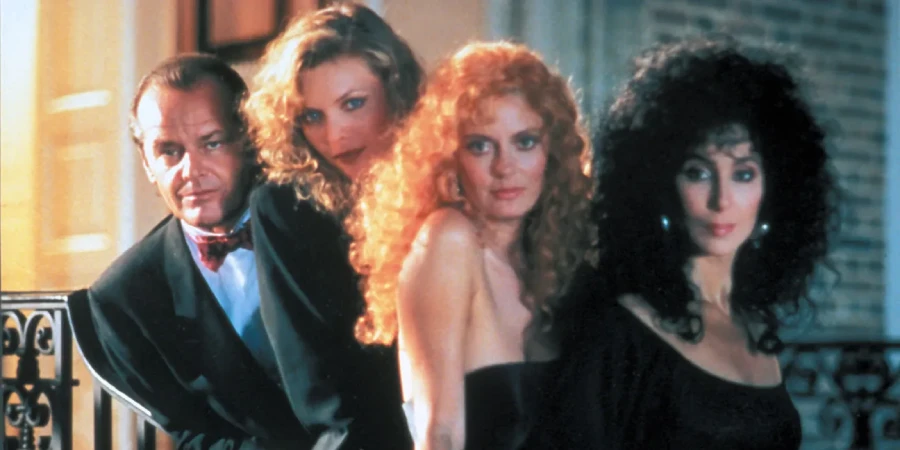

The Witches of Eastwick is a darkly comedic supernatural fantasy that blends seduction, feminism, horror, and satire into a uniquely mischievous package. Directed by George Miller and powered by iconic performances, the film has aged into a cult classic that’s far stranger—and smarter—than it first appears.
Detailed Summary
Life in Eastwick: Three Women, One Wish
The story is set in the quiet, conservative town of Eastwick, Rhode Island. Alex Medford, Jane Spofford, and Sukie Ridgemont are three divorced women stuck in unsatisfying lives. They are intelligent, creative, and emotionally restless, but the town feels too small for them. Their friendship is their refuge.
One stormy night, half-joking and half-desperate, they wish aloud for the perfect man—someone who understands them completely, excites them intellectually and sexually, and shakes their world.
The Arrival of Daryl Van Horne
Shortly after, Daryl Van Horne arrives in town, purchasing the long-abandoned Lennox mansion. He is wealthy, charming, vulgar, magnetic, and immediately disruptive. The women are drawn to him almost against their will.
As Daryl seduces each woman individually and then together, they begin to experience strange changes. Their desires intensify, their confidence grows, and latent supernatural powers awaken—telekinesis, manipulation of reality, and uncanny intuition.
Power, Pleasure, and Corruption
Initially, Daryl appears to empower the women, encouraging them to embrace their independence and sensuality. However, it becomes clear that his influence is not liberating but controlling. He pits the women against one another, amplifies their insecurities, and feeds on chaos.
The town itself begins to unravel. People behave irrationally, social order collapses, and religious hypocrisy surfaces—most notably through Felicia Alden, a moral crusader whose own repressed desires curdle into cruelty and madness.
Realization and Resistance
The witches eventually realize that Daryl is not just a man but the Devil himself, thriving on division, ego, and domination. More importantly, they understand that their power does not come from him—it comes from their unity.
This realization marks a turning point: the women stop competing and begin cooperating.
Movie Ending
In the final act, Alex, Jane, and Sukie fully embrace their identity as witches and confront Daryl together. Using their combined powers, they turn Daryl’s manipulative tricks back on him, exposing his vulnerabilities.
They humiliate him psychologically, strip him of control, and force him into a mortal, helpless state. In a symbolic reversal of power, they use magic to kill Daryl, ending his reign over them and the town. His death is not glamorous or heroic—it is degrading, intentional, and final.
However, the film adds an unsettling epilogue. Months later, the women are living peacefully together, raising Alex’s child (whose father is implied to be Daryl). One night, Daryl briefly appears at the door, suggesting that evil never truly disappears—it only changes form.
The ending leaves viewers with questions about legacy, temptation, and whether power can ever be fully contained.
Are There Post-Credits Scenes?
No. The Witches of Eastwick does not include a post-credits or mid-credits scene. The story concludes entirely within the film’s final moments.
Type of Movie
The Witches of Eastwick is a supernatural dark comedy with strong fantasy and horror elements, wrapped in a satirical critique of gender roles, desire, and social repression.
Cast
- Jack Nicholson as Daryl Van Horne
- Cher as Alex Medford
- Michelle Pfeiffer as Sukie Ridgemont
- Susan Sarandon as Jane Spofford
- Veronica Cartwright as Felicia Alden
Film Music and Composer
The score was composed by John Williams, who delivers a playful yet ominous soundtrack. Unlike his heroic orchestral work, this score leans into seduction, irony, and menace, perfectly matching the film’s tone.
Filming Locations
- Cohasset, Massachusetts – Used to represent Eastwick
- Warner Bros. Studios – Interior and controlled exterior shots
The small-town New England setting is essential. Its conservative, repressed atmosphere contrasts sharply with the chaos and sensual freedom Daryl introduces, reinforcing the film’s themes.
Awards and Nominations
- Academy Award Nominee – Best Original Score (John Williams)
- BAFTA Nominee – Best Special Visual Effects
While not a major awards contender, the film gained recognition for its technical and musical achievements.
Behind the Scenes Insights
- Jack Nicholson improvised many of Daryl’s most outrageous moments
- George Miller encouraged the actresses to develop real chemistry, often rehearsing scenes as group discussions
- The studio initially feared the film was “too feminist” and “too strange”
- Nicholson later described Daryl as one of his most liberating roles
Inspirations and References
The film is based on the novel The Witches of Eastwick by John Updike. It also draws from:
- Classic European witch folklore
- Biblical representations of the Devil as a trickster
- 1970s feminist literature exploring autonomy and desire
Alternate Endings and Deleted Scenes
Early drafts included a darker ending where Daryl’s influence lingered more explicitly over the town. Several deleted scenes expanded Felicia Alden’s descent into madness, but these were cut to maintain pacing and tone.
Book Adaptations and Differences
Compared to Updike’s novel, the film:
- Softens the ending and moral consequences
- Makes Daryl more overtly supernatural
- Places greater emphasis on female solidarity, whereas the novel is more cynical
Memorable Scenes and Quotes
Key Scenes
- The stormy wish-making scene that summons Daryl
- The shared tennis match turning into supernatural chaos
- The final confrontation where the witches reclaim control
Iconic Quotes
- Daryl Van Horne: “Be the envy of every woman, and the desire of every man.”
- Jane Spofford: “He’s not a man. He’s something else.”
Easter Eggs and Hidden Details
- Daryl’s mansion mirrors classic depictions of Mephistopheles’ lairs
- Church imagery subtly warps as Daryl’s influence grows
- The witches’ costumes gradually shift from muted to vibrant colors
Trivia
- Jack Nicholson was paid over $10 million for the role
- Cher won critical acclaim despite initial skepticism about her casting
- The film was one of the earliest mainstream movies to blend feminism with supernatural satire
Why Watch?
If you enjoy smart genre films that hide sharp social commentary beneath entertainment, this movie is for you. It’s provocative, funny, unsettling, and anchored by unforgettable performances—especially Nicholson at his most unhinged.
Director’s Other Works (Movies)
- Mad Max (1979)
- Mad Max 2: The Road Warrior (1981)
- Mad Max: Fury Road (2015)
- Happy Feet (2006)
Recommended Films for Fans
- Practical Magic (1998)
- Death Becomes Her (1992)
- The Devil’s Advocate (1997)
- The Craft (1996)