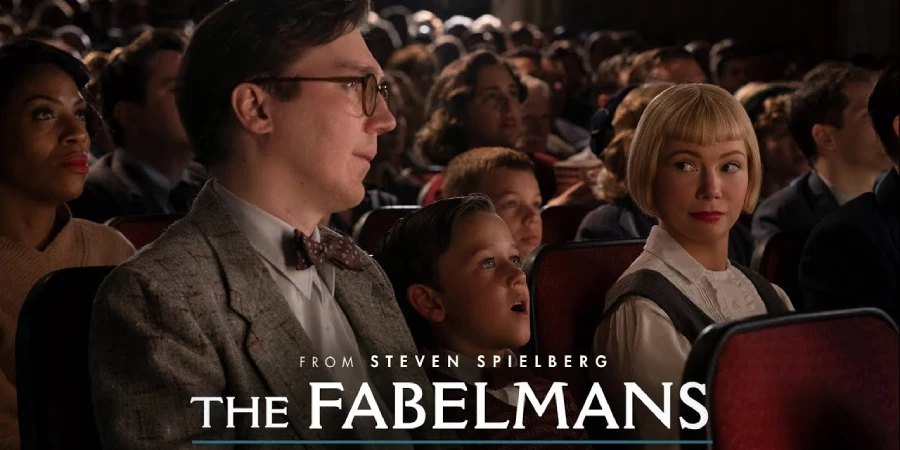

The Fabelmans is Steven Spielberg’s semi-autobiographical coming-of-age drama, a love letter to cinema, family, and the complicated emotional terrain between passion and responsibility. It is intimate, reflective, and quietly devastating in places—less about spectacle, more about why we feel compelled to tell stories at all.
Detailed Summary
A Child Discovers the Magic (and Fear) of Movies
The film opens in post–World War II America, where young Sammy Fabelman is taken to see The Greatest Show on Earth. A train crash terrifies and fascinates him at the same time. Instead of repressing that fear, Sammy recreates it using his toy trains and a camera. This moment defines the movie’s emotional core: cinema as a way to process reality.
Family Dynamics: Love, Art, and Tension
Sammy grows up in a loving but increasingly strained household. His mother Mitzi is a gifted pianist with a playful, artistic soul, while his father Burt is a brilliant engineer who values logic and stability. From early on, it becomes clear that Sammy inherits his mother’s artistic sensitivity and his father’s discipline, creating an inner conflict that drives the story.
The family relocates several times due to Burt’s job, and each move disrupts Sammy’s sense of belonging but fuels his filmmaking. He begins making increasingly ambitious home movies, war films, and Westerns with neighborhood kids.
Adolescence, Identity, and Outsider Status
As Sammy enters high school in California, he faces antisemitic bullying and social alienation. Despite this, his filmmaking skills earn him reluctant admiration from classmates. One of the film’s most unsettling arcs emerges here: Sammy’s camera captures truths he does not consciously want to see.
Through editing family footage, Sammy uncovers a quiet but painful emotional reality involving his mother and his father’s best friend, Bennie. The discovery is not explosive but deeply internal, showing how cinema can reveal truths the heart isn’t ready to accept.
The Cost of Seeing Too Clearly
Sammy’s realization creates emotional distance between him and his mother. He becomes burdened by knowledge, unsure whether art has helped or harmed him. His father eventually senses the truth as well, leading to a restrained but heartbreaking dissolution of the family unit.
This section of the film emphasizes that art is not neutral—it can illuminate, but it can also wound.


Movie Ending
After his parents separate, Sammy is at a crossroads. His mother chooses a life that allows her emotional freedom, while his father prioritizes stability and responsibility. Sammy sides emotionally with his mother but understands his father’s sacrifices.
Sammy moves to Los Angeles with his mother. Uncertain about his future, he takes a meeting at a television studio. There, he encounters legendary director John Ford. Ford gives Sammy a blunt, memorable lesson about visual storytelling, explaining how horizon lines affect composition. The advice is curt but profound, reinforcing the idea that learning cinema is about seeing differently.
The film ends with Sammy literally adjusting the horizon line of the camera frame, visually signaling that he has accepted his path. The ending does not promise fame or happiness, but it confirms purpose. Sammy chooses cinema, fully aware of its costs, and the final shot gently breaks the fourth wall with humor and hope.
Are There Post-Credits Scenes?
No. The Fabelmans does not include a post-credits or mid-credits scene. The story ends definitively with its final shot.
Type of Movie
The Fabelmans is a semi-autobiographical drama and coming-of-age film. It blends family drama with an intimate exploration of creativity, memory, and emotional truth.
Cast
- Gabriel LaBelle as Sammy Fabelman
- Michelle Williams as Mitzi Fabelman
- Paul Dano as Burt Fabelman
- Seth Rogen as Bennie Loewy
- Judd Hirsch as Uncle Boris
- David Lynch as John Ford
Film Music and Composer
The score was composed by John Williams, marking his final collaboration with Spielberg. The music is subtle and restrained, supporting emotion rather than overwhelming it. Williams’ themes underscore nostalgia, loss, and wonder with remarkable restraint.


Filming Locations
- Los Angeles, California: Used for the later stages of Sammy’s life and the Hollywood ending.
- Arizona and California suburbs: Represent the family’s relocations and emotional displacement.
- Soundstages replicating 1950s interiors: Carefully designed to evoke postwar American domestic life.
These locations ground the film in realism and memory, reinforcing its autobiographical tone.
Awards and Nominations
- Academy Awards (2023): Nominated for Best Picture, Best Director, Best Actress, Best Supporting Actor, Best Original Screenplay, Best Production Design, Best Original Score
- Golden Globe Awards (2023): Won Best Motion Picture – Drama, Best Director
- BAFTA Awards: Multiple nominations including Best Film and Best Director
Behind the Scenes Insights
- Spielberg co-wrote the script with Tony Kushner, drawing directly from his childhood.
- Many scenes are recreations of real events from Spielberg’s life.
- David Lynch’s John Ford scene was filmed in a single day and largely improvised.
- Spielberg has stated this was the most emotionally difficult film he has ever made.
Inspirations and References
- Steven Spielberg’s own upbringing
- Classic Hollywood cinema of the 1940s and 1950s
- The idea that filmmaking is both therapy and confession
- Spielberg’s earlier reflections on childhood seen in films like E.T.
Alternate Endings and Deleted Scenes
No alternate ending has been officially released. Some deleted scenes reportedly expanded on Sammy’s school life and early romantic experiences but were removed to maintain narrative focus and emotional pacing.
Book Adaptations and Differences
The Fabelmans is not based on a book. It is an original screenplay inspired by Spielberg’s life, though names and specific events were fictionalized for emotional clarity rather than factual precision.

Memorable Scenes and Quotes
Key Scenes
- Sammy recreating the train crash with his camera
- The camping trip where Mitzi dances by the fire
- Sammy editing footage and realizing a painful truth
- Uncle Boris’s monologue about art and family
- The final meeting with John Ford
Iconic Quotes
- “Art will give you crowns in heaven and laurels on earth, but it will tear your heart out.” – Uncle Boris
- “Movies are dreams that you never forget.”
Easter Eggs and Hidden Details
- Sammy’s early films mirror Spielberg’s real childhood shorts.
- The high school war movie echoes Saving Private Ryan visually.
- John Ford’s office includes real replicas of Ford’s paintings.
- The name “Fabelman” subtly suggests fable and storytelling.
Trivia
- This was John Williams’ final film score.
- Spielberg avoided directing from monitors to stay emotionally present.
- The film includes multiple subtle references to Spielberg’s earlier movies.
- Many family arguments were filmed in long takes to heighten realism.
Why Watch?
Watch The Fabelmans if you care about why artists create, how families shape us, and how love can coexist with disappointment. It’s not Spielberg’s loudest film, but it may be his most honest.
Director’s Other Works (with Year)
- Jaws (1975)
- Close Encounters of the Third Kind (1977)
- E.T. the Extra-Terrestrial (1982)
- Jurassic Park (1993)
- Schindler’s List (1993)
- Saving Private Ryan (1998)
- Minority Report (2002)
- Lincoln (2012)
Recommended Films for Fans
- Cinema Paradiso (1988)
- Belfast (2021)
- Boyhood (2014)
- Almost Famous (2000)
- The Artist (2011)
- Roma (2018)