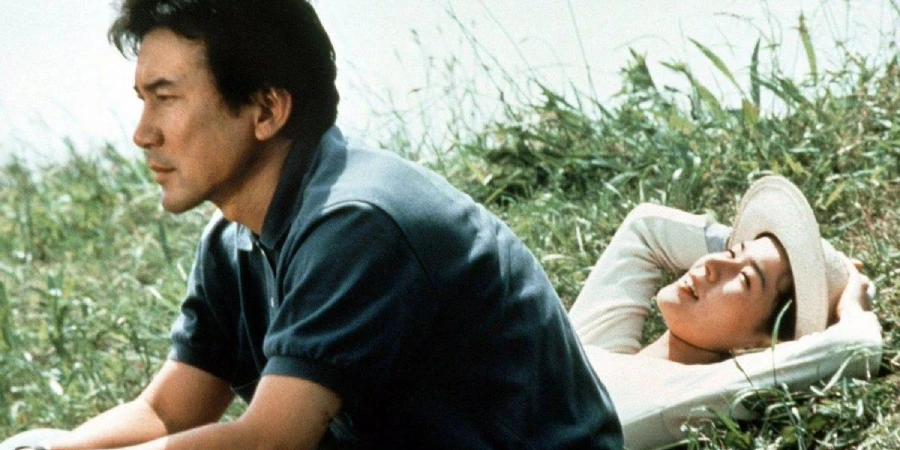

A man, a woman, and a pet eel walk into a barbershop. That sounds like the setup for a bad joke, but for director Shohei Imamura, it is a profound meditation on crime, punishment, and the bizarre path to redemption. The Eel is a story that begins with brutal violence. However, it ultimately finds its soul in quiet observation and strange companionship.
Detailed Summary
A Crime of Passion
Takuro Yamashita, a quiet salaryman, receives an anonymous letter. A note inside claims his wife is having an affair while he is away on a fishing trip. He returns home early and, consequently, discovers his wife in bed with another man.
In a fit of cold, shocking rage, Yamashita stabs her to death. Afterward, he calmly pedals his bicycle to the police station and turns himself in, covered in blood.
Prison and a Pet
Yamashita serves eight years in prison. During his incarceration, he remains withdrawn and isolated from other inmates. His only companion becomes a pet eel he catches in the prison river, which he keeps in a small tank.
He talks to the eel exclusively, confiding his thoughts and feelings to the silent creature. This one-sided relationship becomes his sole emotional outlet, a way to process his trauma without engaging with other people.
Parole and the Barbershop
Upon his release on parole, Yamashita settles in a sleepy, riverside town in Chiba Prefecture. He renovates a dilapidated building and opens the “Barber Yamashita.” His pet eel remains his only friend, living in a prominent tank inside the shop.
He is quiet and keeps to himself, attracting a few quirky but kind locals. For instance, a UFO-obsessed man and a Buddhist priest who moonlights as a garbage collector become his regulars.
Meeting Keiko
One day, Yamashita discovers an unconscious woman, Keiko Hattori, near the riverbank. She has attempted suicide by overdose after a series of personal and financial crises. He saves her life and, feeling a strange sense of responsibility, offers her a job at his barbershop.
Keiko’s presence slowly begins to thaw Yamashita’s frozen exterior. Her bright and cheerful personality contrasts sharply with his own, and despite his resistance, he starts to develop feelings for her.
A Tangled Past
Keiko, however, has baggage of her own. Her abusive ex-boyfriend, a local yakuza thug named Joji, begins harassing her for money. Moreover, her estranged, wealthy mother attempts to control her life from afar.
Yamashita finds himself entangled in Keiko’s problems. His parole officer warns him to stay away from trouble. His violent past, nonetheless, makes it difficult for him to stand by idly.
The Final Confrontation
Joji’s harassment escalates, culminating in him and his gang cornering Yamashita and Keiko. Reminded of his own past trauma and protective of Keiko, Yamashita finally snaps. He brutally beats Joji, but this time, he stops himself from killing the man.
This act of controlled violence is a major turning point. Instead of giving in to rage, he exerts will. Afterward, Yamashita finally confesses the full story of his crime to Keiko, who accepts him.
Movie Ending
The ending of The Eel is one of quiet, hopeful resolution. After his confrontation with Joji, Yamashita knows he has violated his parole by committing assault. He decides to turn himself in to the authorities once again.
Before leaving, he goes to the river and releases his pet eel back into the water. This symbolic act represents him letting go of the guilt and isolation that have defined him for nearly a decade. The eel was his prison confidant; by freeing it, he is freeing himself to face the future. Keiko, having learned the truth about his past, promises to wait for him. Her final line, revealing she is pregnant with his child, solidifies their bond and provides a powerful note of hope for their shared future.
Are There Post-Credits Scenes?
No, there are no post-credits scenes in The Eel. The story concludes definitively before the credits roll.
Type of Movie
The Eel is a dramatic character study with elements of dark comedy and a touch of the absurd. Director Shohei Imamura masterfully balances the film’s tone, which shifts from shocking violence to gentle, quirky humor.
Ultimately, it is a film about redemption and the possibility of human connection after profound trauma. Its deliberate pace and focus on internal struggle give it a deeply psychological and contemplative quality.
Cast
- Koji Yakusho – Takuro Yamashita
- Misa Shimizu – Keiko Hattori
- Fujio Tsuneta – Jiro Nakajima
- Akira Emoto – Tamotsu Takasaki
- Mitsuko Baisho – Misako Yamashita
- Sho Aikawa – Yuji Nozawa
Film Music and Composer
The score for The Eel was composed by Shin’ichiro Ikebe, a frequent collaborator of both Shohei Imamura and Akira Kurosawa. Ikebe’s music is crucial to the film’s atmosphere.
His compositions are often melancholic and minimalist, mirroring Yamashita’s internal state. However, they also incorporate lighter, almost whimsical motifs that underscore the story’s quirky humor and moments of blossoming hope.
Filming Locations
The Eel was primarily filmed in and around the town of Sawara in Chiba Prefecture, Japan. Sawara is known for its historic canals and riverside architecture, which provided the perfect backdrop for the story.
A location by the water was essential to the narrative. The river serves as a powerful, recurring motif, representing life, death, imprisonment (the eel), and eventual freedom.
Awards and Nominations
The film’s most prestigious achievement was winning the Palme d’Or at the 1997 Cannes Film Festival, an award it shared with Abbas Kiarostami’s Taste of Cherry. Koji Yakusho also won several awards for Best Actor, including at the Japan Academy Prize ceremony, for his powerful and understated performance.
Behind the Scenes Insights
- Shohei Imamura reportedly gave Koji Yakusho very little direction for the character of Yamashita, instead encouraging him to find the character’s profound silence and stillness on his own.
- During filming, the crew kept multiple eels on set. Each one was used for specific scenes depending on its size and temperament to achieve the desired cinematic effect.
- Yakusho spent time learning the basics of barbering to make his scenes in the shop look authentic. He practiced on mannequins before ever touching an actor’s hair.
Inspirations and References
The film is based on the 1982 novel On Parole (Karishakuhō) by noted Japanese author Akira Yoshimura. While the film follows the basic premise of a paroled murderer finding a new life, Imamura significantly altered the tone and added many of his signature quirky characters.
Alternate Endings and Deleted Scenes
There are no known official alternate endings or widely circulated deleted scenes for The Eel. Shohei Imamura was known for being a meticulous director, and the theatrical cut is considered his definitive vision of the story.
Book Adaptations and Differences
The Eel is a loose adaptation of Akira Yoshimura’s novel On Parole. The film is significantly more optimistic and humorous than its source material. For instance, the novel is a much darker, grittier exploration of a criminal’s psyche.
In the book, the protagonist kills his wife because she ran up massive debts, not because of an affair. Furthermore, the character of Keiko and the quirky townspeople are largely inventions of Imamura and his screenwriters, created to inject warmth and hope into an otherwise bleak story.
Memorable Scenes and Quotes
Key Scenes
- The Opening Murder: The film begins with the shockingly brutal and methodical murder Yamashita commits. Its cold, dispassionate execution sets the stage for his emotional numbness.
- Saving Keiko: Yamashita’s discovery of Keiko’s body by the river is a pivotal moment. His decision to help her, despite his desire for isolation, marks the first crack in his emotional armor.
- Releasing the Eel: The final scene where Yamashita releases his longtime companion into the river is the film’s most powerful symbolic act, representing his readiness to let go of his past and reconnect with the world.
Iconic Quotes
- Parole Officer: “You have a permit to cut hair, Yamashita-san. Nothing else.”
- Keiko Hattori: “I’ll wait. I’ll be right here waiting for you.”
- Takuro Yamashita: (To his eel) “We’re a lot alike, you and I. We just observe.”
Easter Eggs and Hidden Details
- The name of Yamashita’s shop, “Barber Yamashita,” is incredibly straightforward. This reflects his simple, no-nonsense approach to his new life and his attempt to live without complications.
- Throughout the film, water is a constant visual motif—from the river where Yamashita fishes and finds Keiko, to the eel’s tank, to the pouring rain during the murder. It symbolizes both confinement and freedom.
- The UFO-obsessed character, Takasaki, acts as a comic foil, but his search for extraterrestrial life mirrors Yamashita’s own search for a meaningful connection in a world that feels alien to him.
Trivia
- Koji Yakusho is one of Japan’s most celebrated actors. He is perhaps best known to international audiences for his starring roles in films like Shall We Dance? (1996) and 13 Assassins (2010).
- Shohei Imamura is one of only a handful of directors to have won the Palme d’Or twice. His first win was for The Ballad of Narayama in 1983.
- The Japanese title, Unagi, directly translates to “Eel.”
Why Watch?
Watch The Eel for Koji Yakusho’s masterful, restrained performance and Shohei Imamura’s unique storytelling. It is a strange, beautiful, and surprisingly funny film about finding a reason to live after hitting rock bottom. A truly one-of-a-kind cinematic experience.
Director’s Other Movies
- Pigs and Battleships (1961)
- The Insect Woman (1963)
- Vengeance Is Mine (1979)
- The Ballad of Narayama (1983)
- Black Rain (1989)
- Dr. Akagi (1998)
Recommended Films for Fans
- Vengeance Is Mine (1979)
- Taste of Cherry (1997)
- The Scent of Green Papaya (1993)
- Shall We Dance? (1996)
- After Life (1998)
- The Pornographers (1966)
- Departures (2008)
- Drive My Car (2021)