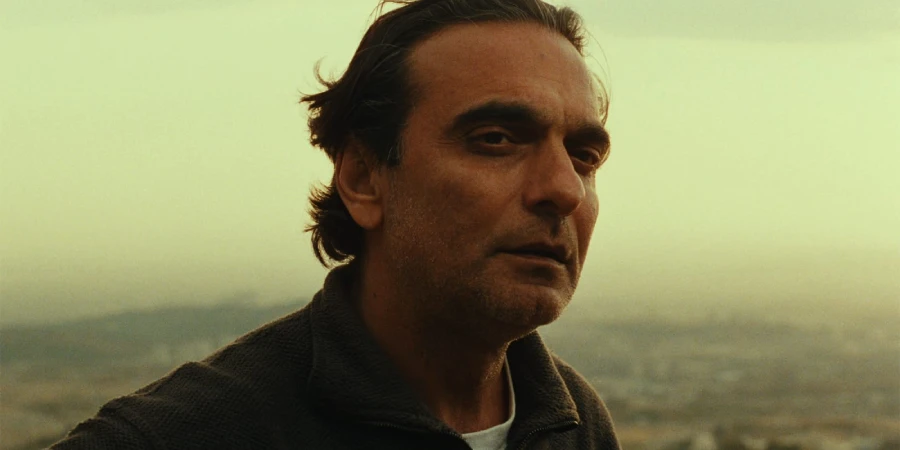

Abbas Kiarostami’s Taste of Cherry presents a man on a simple, yet profoundly disturbing, quest. He drives the arid hills outside Tehran, searching for someone to help him end his life. This minimalist journey, however, blossoms into a complex meditation on existence itself. The film is less about death and more about the quiet, unexpected reasons for living.
Detailed Summary
The Enigmatic Driver
A middle-aged man, Mr. Badii, drives his Range Rover through the dusty, undeveloped outskirts of Tehran. He approaches various day laborers, offering them a ride and a well-paying job. His proposition, however, remains vague and unsettling.
Mr. Badii eventually makes his offer clear. He has already dug a grave for himself in the hills and plans to take his own life that night. He needs someone to come to the spot in the morning and either help him if he has changed his mind or cover his body with twenty shovelfuls of dirt if he has not.
The First Refusal: The Young Soldier
His first serious candidate is a young, nervous Kurdish soldier. Mr. Badii explains the entire plan to him, emphasizing the large sum of money he will receive for the easy task. The soldier, however, becomes terrified by the request.
Ultimately, he flees the car and runs back to his barracks. His refusal is born of fear and a rigid adherence to rules, representing a youthful inability to confront such a heavy existential question.
The Second Refusal: The Seminarian
Next, Mr. Badii picks up an Afghan seminarian. He presents his case again, but this time he encounters a different kind of opposition. The religious student argues against suicide from a theological perspective.
He explains that taking one’s own life is a great sin, a violation of God’s gift. Interestingly, the seminarian shows more compassion than the soldier but is bound by his doctrine. He cannot condone the act and, therefore, also refuses the job.
The Final Offer: The Taxidermist
Finally, Mr. Badii finds a potential accomplice in Mr. Bagheri, an elderly Azeri taxidermist. Unlike the others, Mr. Bagheri is talkative and engages with Badii’s despair. He listens patiently to the morbid plan without immediate judgment.
Mr. Bagheri agrees to do the job, but only because he needs the money for his sick child. He then tries to dissuade Badii, not with scripture, but with a simple story about his own past moment of despair. He recounts how the simple taste of mulberries pulled him back from the brink, reminding him of life’s small, sensual pleasures. He encourages Badii to reconsider, to feel the sunset and see the moon.



Movie Ending
The ending of Taste of Cherry is one of the most debated in modern cinema. After his conversation with Mr. Bagheri, a thoughtful Mr. Badii drives to the chosen spot and lies down in the grave he dug for himself. As a storm rolls in, the screen cuts to black.
We are left in total darkness for an extended period, hearing only the sounds of rain and thunder. The audience is forced to sit with Badii in that grave, contemplating his final choice. Did he go through with it? The film never provides a direct answer to that question.
Instead, the narrative abruptly shatters. The film cuts to grainy, handheld video footage. We see director Abbas Kiarostami and his film crew on the same sun-drenched hills. Actor Homayoun Ershadi, who plays Badii, is seen alive and well, smoking a cigarette. Soldiers from an earlier scene march and sing. Consequently, Kiarostami breaks the fourth wall, reminding us that what we just watched was a construction, a film. This meta-ending nudges the viewer away from Badii’s specific fate and toward a broader appreciation for the act of creation, the beauty of the landscape, and life itself.
Are There Post-Credits Scenes?
No, there are no post-credits scenes in Taste of Cherry. The film’s self-referential final minutes serve as its own coda, and the story concludes before the credits roll.
Type of Movie
Taste of Cherry is a philosophical drama and a minimalist road movie. The film deliberately avoids conventional plot mechanics, action, and melodrama. Its tone is deeply contemplative, meditative, and existential.
Through long takes and conversations confined to a car, Kiarostami creates a powerful sense of intimacy and isolation. The pacing is slow and deliberate, demanding patience from the viewer as it explores profound questions about life, death, and human connection.
Cast
- Homayoun Ershadi – Mr. Badii
- Abdolrahman Bagheri – Mr. Bagheri (The Taxidermist)
- Afshin Khorshid Bakhtiari – Worker
- Safar Ali Moradi – The Soldier
- Mir Hossein Noori – The Seminarian
Film Music and Composer
A notable feature of Taste of Cherry is its almost complete lack of a non-diegetic score. Director Abbas Kiarostami chose not to use music to manipulate the audience’s emotions. This forces viewers to engage more directly with the characters’ dialogue and the stark, ambient sounds of their environment.
The only significant piece of music is Louis Armstrong’s “St. James Infirmary,” which plays over the final meta-cinematic footage. This inclusion, in contrast to the rest of the film’s silence, feels celebratory and life-affirming, reinforcing the ending’s thematic shift.


Filming Locations
The film was shot entirely on location in the barren, dusty hills on the outskirts of Tehran, Iran. These locations are not merely a backdrop; they are a character in the film. The endless construction sites, quarries, and unfinished roads symbolize a state of transition and impermanence.
This desolate, earth-toned landscape perfectly mirrors Mr. Badii’s internal state of alienation and despair. In a way, the entire terrain feels like a grave, reinforcing the film’s central preoccupation with mortality and the earth.
Awards and Nominations
Taste of Cherry achieved significant international acclaim. Its most prestigious award was the Palme d’Or at the 1997 Cannes Film Festival, an award it shared with Shohei Imamura’s The Eel. This win solidified Abbas Kiarostami’s status as a master of world cinema.
Behind the Scenes Insights
- Abbas Kiarostami employed a unique filming method for the car conversations. He mounted cameras inside the vehicle and often sat in the passenger seat (off-camera) to have a real conversation with the actor driving, fostering incredibly naturalistic performances.
- The actors on the passenger side were filmed separately. Kiarostami would read Mr. Badii’s lines to them, meaning the two actors in a conversation were often not in the car at the same time.
- Lead actor Homayoun Ershadi was a non-professional actor and architect whom Kiarostami discovered while stuck in Tehran traffic.
- Suicide is a major taboo in Iran, and the film faced censorship issues. Kiarostami was initially denied permission to travel with his film to the Cannes Film Festival but was eventually allowed to go after a personal appeal to the president.
Inspirations and References
While not a direct adaptation of any single work, Taste of Cherry is heavily influenced by the philosophical school of existentialism. The film’s core questions about finding meaning in a seemingly indifferent universe echo the works of writers like Albert Camus. Badii’s struggle can be seen as a cinematic exploration of the Sisyphus myth.
Stylistically, Kiarostami’s work, including this film, often draws comparisons to Italian Neorealism. This is evident in his use of real locations, non-professional actors, and a focus on the everyday struggles of ordinary people.
Alternate Endings and Deleted Scenes
There are no known alternate endings or significant deleted scenes for Taste of Cherry. The film’s controversial ending, which breaks the fourth wall, is Kiarostami’s definitive authorial statement.
Some viewers initially misinterpreted the final behind-the-scenes footage as a DVD extra or a mistake. However, it is an integral part of the intended cinematic experience, designed to pull the audience out of the narrative’s despair.
Book Adaptations and Differences
Taste of Cherry is not based on a book. It is an original screenplay written by director Abbas Kiarostami. The film’s themes and narrative structure are a product of his unique cinematic vision.


Memorable Scenes and Quotes
Key Scenes
- The Conversation with Mr. Bagheri: The long, heartfelt discussion where the taxidermist shares his story about the taste of mulberries is the film’s emotional and philosophical core. It is the first moment where Badii’s despair is met not with fear or dogma, but with a simple, humanistic celebration of life’s sensory details.
- Badii in the Grave: The sequence where Mr. Badii lies in the open grave as a storm begins is profoundly tense. The subsequent cut to a long stretch of pure black is a bold cinematic choice that forces the audience into a state of shared contemplation.
- The Final Meta-Footage: The jarring shift from the dark, somber narrative to bright, grainy video of the film crew at work is unforgettable. It completely recontextualizes the entire film, turning a story about death into a celebration of filmmaking and life.
Iconic Quotes
- Mr. Bagheri: “You want to give up the taste of cherries?”
- Mr. Bagheri: “I’m telling you my story, not to have you give me a sweet. I’m telling you so you can listen.”
- Mr. Badii: “It’s a difficult job, but you won’t have to work hard. It’s not physical labor.”
Easter Eggs and Hidden Details
- The Earth Movers: Throughout the film, Mr. Badii’s car is often dwarfed by giant earth-moving equipment. This visual motif reinforces the themes of digging, burial, and the constant reshaping of the land, mirroring Badii’s own project.
- A Winding Road: The repetitive shots of Badii’s car navigating winding, circuitous roads symbolize his non-linear, meandering search for meaning and an end to his suffering. He is, quite literally, going in circles.
- The Film Crew’s Presence: The ending reveals the artifice of the film. However, attentive viewers might notice Kiarostami’s signature minimalist style—like the static camera shots on the passenger—hinting at the constructed nature of the narrative all along.
Trivia
- The title, Taste of Cherry, is a direct translation of the original Farsi title, Ta’m-e Gooylas. Interestingly, Mr. Bagheri speaks of mulberries in the film, not cherries, but the director chose the latter for its poetic quality.
- Homayoun Ershadi went on to have a successful acting career after this debut, appearing in films like The Kite Runner (2007) and Zero Dark Thirty (2012).
- Despite winning the Palme d’Or, the film was not initially selected as Iran’s official entry for the Academy Award for Best Foreign Language Film.
Why Watch?
This film is a demanding but deeply rewarding cinematic pilgrimage. It challenges viewers to confront life’s biggest questions without offering easy answers. Watch it for its profound simplicity and for an ending that will spark conversation long after the credits roll.
Director’s Other Movies
- Close-Up (1990)
- Through the Olive Trees (1994)
- The Wind Will Carry Us (1999)
- Certified Copy (2010)
- Like Someone in Love (2012)
Recommended Films for Fans
- The Seventh Seal (1957)
- Stalker (1979)
- The Turin Horse (2011)
- Paterson (2016)
- Nomadland (2020)
- Perfect Days (2023)