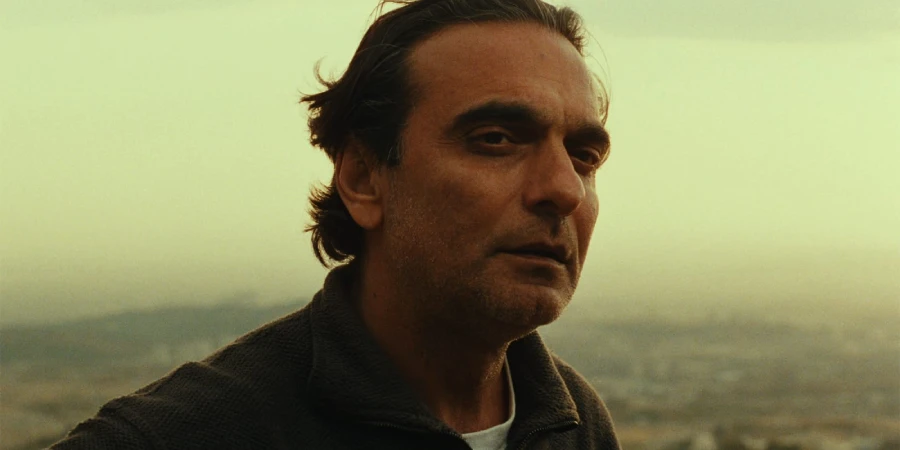

A man driving toward his own death sounds grim. However, Abbas Kiarostami’s Taste of Cherry transforms this journey into a profound meditation on life itself. The film, in fact, confronts its audience with a simple, unsettling proposition. Consequently, it leaves far more questions than answers.
Detailed Summary
The entire film follows a middle-aged man, Mr. Badii, as he drives his Range Rover through the dusty, construction-scarred outskirts of Tehran. His purpose is initially unclear. However, he gradually reveals his mission to the various strangers he picks up. Mr. Badii has decided to commit suicide and has already dug his own grave under a solitary tree. He needs someone to come to the spot in the morning and either help him if he has changed his mind or, if he is dead, throw twenty spades of earth over his body.
The Search Begins
Mr. Badii’s search for an assistant begins with a series of tentative encounters. He first approaches a young, shy Kurdish soldier. On the other hand, the soldier becomes terrified by the morbid request and flees the vehicle, running back to his barracks. Mr. Badii’s subsequent attempt involves an Afghan seminarian who is studying in Tehran. The two men engage in a philosophical and religious debate about the morality of suicide. Ultimately, the seminarian refuses the job, citing religious prohibitions against taking a life, including one’s own.
The Wise Taxidermist
Finally, Mr. Badii finds a potential candidate in Mr. Bagheri, an older Azeri man who works as a taxidermist at the Natural History Museum. Unlike the others, Mr. Bagheri is talkative and pragmatic. He listens patiently to the proposition. Moreover, he desperately needs the money for his sick child. He agrees to the job but also tries to dissuade Mr. Badii from his plan.
To do this, Mr. Bagheri shares a story from his own past. He, too, once contemplated suicide. However, on his way to end his life, he climbed a mulberry tree and tasted its fruit. The simple sensory pleasure of the cherries, the beauty of the sunrise, and the sight of children going to school reminded him of life’s value. This “taste of cherry,” as he calls it, saved him. He urges Mr. Badii to reconsider, suggesting that he, too, might find a reason to live. Nonetheless, he promises to fulfill the task if Mr. Badii goes through with it.
The Agreement
Mr. Badii appears moved by the story but remains resolute in his decision. He drives Mr. Bagheri to his workplace to show him the grave’s location. He gives the old man a large sum of money, an advance on his payment, and instructs him to arrive at the spot at 6:00 AM. After dropping Mr. Bagheri off, Mr. Badii proceeds with his plan as night falls. He takes sleeping pills and lies down in the open grave, watching the moon as a storm begins to gather. The screen fades to black.


Movie Ending
The ending of Taste of Cherry is famously ambiguous and a major source of discussion. After the screen fades to black on Mr. Badii in his grave, we are left in darkness and silence for a prolonged period. The audience is forced to contemplate his fate. Did he die? Did the storm make him change his mind? The film deliberately refuses to provide a clear answer to this question.
Then, unexpectedly, the film breaks its own reality. What follows is grainy, home-video-style footage. We see the film’s crew, including director Abbas Kiarostami, setting up shots in the same hilly landscape. The actor who plays Mr. Badii, Homayoun Ershadi, is seen casually smoking a cigarette. The young soldiers from the film march and sing while the crew records them. Louis Armstrong’s “St. Louis Blues” plays energetically over the scene. This vérité footage completely shatters the fourth wall. Instead of resolving the narrative, Kiarostami shows us the artifice of its creation. The ending suggests that the story is just that—a story. Therefore, the important thing is not whether Mr. Badii lives or dies, but the philosophical questions the journey raised for the audience.
Are There Post-Credits Scenes?
There are no post-credits scenes in Taste of Cherry. The film concludes with the self-referential footage of the crew at work, and the credits roll immediately after.
Type of Movie
Taste of Cherry is a minimalist existential drama. The film employs a slow, contemplative pace and a stark, naturalistic aesthetic. Furthermore, its narrative functions almost like a Socratic dialogue, exploring profound themes of life, death, and human connection through a series of conversations. The tone is somber and introspective yet contains moments of understated warmth and humanity, particularly in the interactions between Mr. Badii and the taxidermist.
Cast
- Homayoun Ershadi – Mr. Badii
- Abdolrahman Bagheri – Mr. Bagheri (The Taxidermist)
- Afshin Khorshid Bakhtiari – Worker
- Safar Ali Moradi – The Soldier
- Mir Hossein Noori – The Seminarian
Film Music and Composer
One of the most notable aspects of Taste of Cherry is its near-total lack of a non-diegetic musical score. Throughout the film, sound is dominated by natural, diegetic elements. For instance, we hear the constant rumble of Mr. Badii’s car engine, the wind in the hills, and the distant noises of construction. This absence of music enhances the film’s stark realism and forces the audience to focus on the dialogue and visuals.
The only significant piece of music appears in the film’s final moments. During the behind-the-scenes footage, a recording of Louis Armstrong performing “St. Louis Blues” plays. The sudden burst of lively jazz provides a stark, almost jarring contrast to the somber tone of the preceding narrative. Consequently, it contributes to the ending’s liberating, reality-breaking effect.



Filming Locations
Taste of Cherry was shot entirely on location in the barren, dusty hills on the outskirts of Tehran, Iran. These locations are not merely backdrops; in fact, they are central to the film’s themes. The dry, ochre-colored earth and sprawling construction sites create a landscape that is simultaneously ancient and in flux. This environment perfectly mirrors Mr. Badii’s internal state—a place of limbo between life and death, creation and destruction. The desolate beauty of the setting amplifies his profound sense of isolation.
Awards and Nominations
The film’s most prestigious honor was the Palme d’Or at the 1997 Cannes Film Festival, an award it shared with Shohei Imamura’s The Eel. This win solidified Abbas Kiarostami‘s status as a master of world cinema. In addition, the film received the Best Foreign Film award from the Boston Society of Film Critics and the National Society of Film Critics Awards, USA.
Behind the Scenes Insights
- Director Abbas Kiarostami often filmed his car scenes by mounting a camera inside and riding in the passenger seat. He would conduct conversations with the actor who was driving, creating a uniquely intimate and naturalistic performance.
- Homayoun Ershadi, who plays Mr. Badii, was not a professional actor. Kiarostami reportedly discovered him while stuck in Tehran traffic and was drawn to his pensive face.
- Kiarostami preferred working with non-professional actors, as he believed they brought a greater sense of authenticity to their roles. Many of the people Mr. Badii picks up were essentially playing versions of themselves.
- The film was temporarily banned in Iran. However, the ban was lifted just in time for Kiarostami to travel to the Cannes Film Festival, where it ultimately won the Palme d’Or.
Inspirations and References
While Taste of Cherry is an original work, its thematic concerns are deeply rooted in Persian poetry and existential philosophy. In particular, the film’s grappling with life’s fleeting pleasures and the inevitability of death echoes the work of poets like Omar Khayyam. Kiarostami himself was an avid reader of poetry, and its lyrical, questioning nature heavily influenced his filmmaking style. The central idea—finding a reason to live in a simple, sensory experience—is a classic existentialist motif about creating meaning in a seemingly meaningless world.
Alternate Endings and Deleted Scenes
There are no known officially released alternate endings or deleted scenes for Taste of Cherry. The controversial meta-ending was Abbas Kiarostami‘s intended conclusion from the start. He designed it specifically to break the audience out of the narrative spell and encourage reflection. According to Kiarostami, a conventional ending where Mr. Badii definitively lives or dies would have closed off the conversation. The filmmaker, on the other hand, wanted the film’s questions to linger with the viewer long after the credits rolled.
Book Adaptations and Differences
Taste of Cherry is not an adaptation of a book. It is based on an original screenplay written by its director, Abbas Kiarostami. The story and its philosophical explorations are a direct product of his unique cinematic vision.



Memorable Scenes and Quotes
Key Scenes
- The Conversation with the Seminarian: This scene is a tense theological debate about the ethics of suicide, showcasing Mr. Badii’s desperation and the compassionate yet firm refusal from the young student.
- Mr. Bagheri’s Monologue: The taxidermist’s story about tasting mulberries is the heart of the film. It offers a powerful, life-affirming counterpoint to Mr. Badii’s despair, all grounded in a simple, tangible memory.
- The Final Fade to Black: The long, tense sequence of Mr. Badii lying in his grave as a storm brews is utterly riveting. His face is illuminated by flashes of lightning before the screen goes completely dark, leaving his fate unknown.
- The Verité Ending: The abrupt shift to behind-the-scenes footage is one of modern cinema’s most audacious and unforgettable endings, forcing a complete re-evaluation of everything that came before it.
Iconic Quotes
- “I am telling you about the taste of cherries. You want to give up the taste of cherries?” – Mr. Bagheri
- “The world isn’t the way you see it. You have to change your outlook.” – Mr. Bagheri
- “If you look at the four seasons, each season brings fruit. In summer, there’s fruit, in autumn, too. Winter brings different fruit and spring, too. No mother can fill her fridge with such a variety of fruit for her children.” – Mr. Bagheri
Easter Eggs and Hidden Details
- Landscape as a Character: The constant digging and construction in the background are not accidental. They symbolize a world being torn down and rebuilt, mirroring Mr. Badii’s attempt to deconstruct and possibly reconstruct his own life.
- The Director’s Presence: Although we only see him at the very end, Kiarostami’s voice is allegedly heard off-screen during the film, giving directions to his actors, further blurring the line between fiction and reality.
- Self-Referential Framing: Many shots are framed by the car’s windows and windshield. This creates a sense that we are not just watching a story, but watching a film being projected, foreshadowing the final meta-cinematic reveal.
Trivia
- The film’s international title, Taste of Cherry, comes from Mr. Bagheri’s monologue, but the original Persian title is Ta’m-e Gīlās.
- Relations between Iran and the United States were so strained that the film’s American distributor, Zeitgeist Films, had to send the prize money for the US critics’ awards to Kiarostami via a third party in Paris.
- Despite its heavy themes, Kiarostami insisted the film was optimistic. He argued that the entire story is about a man searching for life—either in a reason to live or in a confirmation of his final resting place.
Why Watch?
This film is a slow, meditative journey that challenges you to think. Instead of providing easy answers, it poses profound questions about what makes life worth living. Its brilliant, controversial ending will stick with you long after the credits roll.
Director’s Other Movies
- Where Is the Friend’s Home? (1987)
- Close-Up (1990)
- Through the Olive Trees (1994)
- The Wind Will Carry Us (1999)
- Certified Copy (2010)
- Like Someone in Love (2012)
Recommended Films for Fans
- Stalker (1979)
- The Turin Horse (2011)
- Paterson (2016)
- Nomadland (2020)
- Perfect Days (2023)