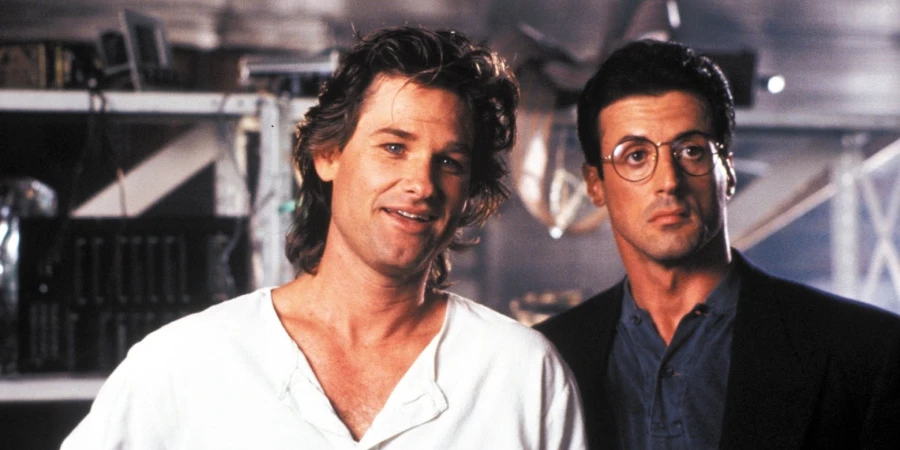

Nothing screams late-80s action cinema quite like Sylvester Stallone in designer suits and Kurt Russell in scuffed leather. Tango & Cash is the glorious, explosive result of throwing two of the decade’s biggest action stars into a blender with a ridiculous plot. Ultimately, the film is a self-aware parody of the very buddy-cop genre it inhabits, and it does so with a knowing wink and a massive explosion.
Detailed Summary
The Rival Cops
The film introduces us to two of Los Angeles’s top narcotics detectives, who are also bitter rivals. First, there’s Lieutenant Ray Tango (Sylvester Stallone). He is a meticulously dressed, sophisticated officer who plays the stock market and lives in Beverly Hills. In contrast, Lieutenant Gabe Cash (Kurt Russell) is a messy, wise-cracking cop who lives a more blue-collar life. Despite their different methods, they both have one thing in common: they are a major thorn in the side of crime lord Yves Perret (Jack Palance). Consequently, they continuously dismantle his vast drug and weapons operations, costing him millions.
The Frame-Up
Fed up with their interference, Perret concocts an elaborate plan to neutralize the two cops. He orchestrates a fake drug deal, luring Tango and Cash to a warehouse. However, when they arrive, they find a dead, wired-up FBI agent instead of drugs. The LAPD, led by Tango’s own boss, storms the location and arrests them. To seal their fate, Perret’s audio expert, Skinner (Michael J. Pollard), uses snippets of their voices to create a fake audio recording that implicates them in the agent’s murder. As a result, Tango and Cash are charged with murder and conspiracy.
Prison Blues
During their trial, the duo’s lawyer cuts a deal for them to serve 18 months in a minimum-security prison. Unfortunately for them, Perret has paid off officials to reroute them to a maximum-security penitentiary. This prison is filled with hundreds of criminals that Tango and Cash personally put behind bars. They are immediately targeted by a lynch mob led by one of Perret’s henchmen. They survive the initial onslaught, but Perret’s primary inside man, Requin (Brion James), arranges for them to be tortured. Meanwhile, Tango plans an escape.
The Escape
Realizing they will be killed if they remain, Tango and Cash execute a daring escape. With the help of the prison’s assistant warden, who is secretly working for Perret, they are set up to be torn apart by vicious dogs in the prison yard. However, they use this chaotic opportunity to their advantage. They manage to reach the prison’s roof. Using a leather belt and a cable clamp, they slide down a high-voltage power line to freedom, landing in a fiery shower of sparks just outside the prison walls. Subsequently, they become fugitives with no choice but to prove their innocence.
Clearing Their Names
Now on the run, Tango and Cash split up to find the people who framed them. Cash reconnects with Tango’s sister, Katherine “Kiki” Tango (Teri Hatcher), a nightclub dancer who he begins to fall for. Tango, meanwhile, visits his commanding officer and forces him to hand over information on Skinner. Following this, the two cops track down Skinner at his audio lab. They manage to get a confession out of him just before Requin arrives and kills him. They secure the incriminating tape, which proves their innocence in the FBI agent’s murder but also confirms Perret is behind the entire conspiracy.
The Final Showdown
Katherine is kidnapped by Perret’s men, forcing a final confrontation. Tango and Cash use one of Cash’s contacts at the LAPD motor pool to acquire a heavily armed and armored RV. They then assault Perret’s heavily fortified compound, which is a quarry outfitted like a military base. After a destructive chase involving a monster truck, they crash into Perret’s main building. The climax unfolds in a hall of mirrors where Tango and Cash face off against Perret and Requin. Cash shoots Requin, and Tango impales Perret on a steel spike before shooting him, finally ending his reign of terror.

Movie Ending
The ending of Tango & Cash provides a clean and satisfying resolution. After killing Yves Perret and Requin in the hall of mirrors, Tango and Cash successfully rescue Katherine. The evidence they gathered, including Skinner’s confession tape, fully exonerates them. The final scene shows the duo reading a newspaper with a headline declaring their innocence and heroism. In this final moment, Cash playfully reveals that he and Katherine are a couple, which prompts a mock-outraged reaction from her overprotective brother, Tango. The film ends with the two rivals-turned-partners bickering like an old married couple, cementing their newfound friendship.
Are There Post-Credits Scenes?
No, there are no post-credits or mid-credits scenes in Tango & Cash. Once the credits begin to roll, the movie is officially over.
Type of Movie
Tango & Cash is a quintessential buddy-cop action-comedy. The film leans heavily into the tropes of the genre, often satirizing them with over-the-top action sequences and witty, self-referential dialogue. Its tone is bombastic and knowingly absurd. Furthermore, it blends high-stakes action with broad comedy, never taking itself too seriously and fully embracing the excess of 1980s cinema.
Cast
- Sylvester Stallone – Lt. Raymond “Ray” Tango
- Kurt Russell – Lt. Gabriel “Gabe” Cash
- Teri Hatcher – Katherine “Kiki” Tango
- Jack Palance – Yves Perret
- Brion James – Requin
- James Hong – Quan
- Marc Alaimo – Lopez
- Michael J. Pollard – Owen
- Robert Z’Dar – Face
Film Music and Composer
The score for Tango & Cash was composed by Harold Faltermeyer. Faltermeyer was a dominant force in 80s film music, famous for his iconic synth-pop scores for Beverly Hills Cop and Top Gun. His work on this film is instantly recognizable, featuring a driving, energetic blend of synthesizers, electronic drums, and electric guitar riffs. The main theme, in particular, perfectly captures the film’s high-octane and slightly comedic tone, becoming synonymous with 80s action.
Filming Locations
Production for Tango & Cash took place primarily in two key locations. The majority of the film, including the city scenes and car chases, was shot in and around Los Angeles, California. This setting provides the sun-drenched, urban backdrop typical of many 80s cop films. In contrast, the bleak and imposing prison scenes were filmed at the Ohio State Reformatory in Mansfield, Ohio. This historic, gothic prison, which was still partially operational at the time, lent an authentic sense of dread and scale to the middle act of the film. Notably, this same location would later become famous as the primary setting for The Shawshank Redemption (1994).
Awards and Nominations
While a commercial success, Tango & Cash was not a critical darling or an awards contender. In fact, it was recognized by the Golden Raspberry Awards, which honor the worst in film. The movie received three Razzie nominations: Worst Actor for Sylvester Stallone, Worst Supporting Actress for Kurt Russell (for his performance in drag), and Worst Screenplay.
Behind the Scenes Insights
- The film had a notoriously troubled production. The original director, Andrei Konchalovsky, was fired deep into filming due to creative differences with producer Jon Peters and Sylvester Stallone. Specifically, Konchalovsky wanted a more serious, dramatic tone, while Stallone and the studio pushed for a lighter, more comedic action film. Albert Magnoli was hired to finish the film and reshoot many scenes.
- Patrick Swayze was originally cast as Gabe Cash but dropped out to star in Road House. Kurt Russell was then brought in to play the part.
- The film went significantly over budget, in part because of the director change and extensive reshoots. By the end of production, the final cut was delivered to Warner Bros. just days before its scheduled Christmas release.
- Sylvester Stallone reportedly had the head of the studio’s hair and makeup department fired after becoming unhappy with how his hairstyle was being presented in dailies.
Inspirations and References
Tango & Cash is less inspired by a single work and more a product of its time. It serves as both an example and a meta-commentary on the buddy-cop genre, which was at its peak in the late 1980s with films like Lethal Weapon and 48 Hrs. The movie takes the established formula—two mismatched cops forced to work together—and pushes every element to a comical extreme. The heroes are “supercops,” the villain is a cartoonish puppet master, and the action sequences defy all laws of physics. Consequently, its primary inspiration is the genre itself.
Alternate Endings and Deleted Scenes
Due to the chaotic production and change in directors, the final film is quite different from what was originally envisioned. Director Andrei Konchalovsky’s initial cut was reportedly much darker, more violent, and less comedic. After he was fired, many of his scenes were either cut or reshot by Albert Magnoli to inject more humor and spectacle, largely at the behest of Stallone and the producers. There is no official “director’s cut,” but it is widely known that a more serious version of the film existed at one point during production.
Book Adaptations and Differences
Tango & Cash is not based on a book or any other pre-existing source material. It is an original story with a screenplay written by Randy Feldman.
Memorable Scenes and Quotes
Key Scenes
- The Prison Escape: Tango and Cash sliding down a high-voltage power line from the prison roof is a spectacular and famously implausible action set piece.
- The RV of Destruction: The duo’s assault on Perret’s compound using a weaponized RV, dubbed the “RV from Hell,” is a masterclass in 80s action excess.
- Tango in Drag: To sneak up on a suspect, the ultra-macho Tango unconvincingly disguises himself as a woman, a scene that earned Kurt Russell a Razzie nomination.
Iconic Quotes
- Gabe Cash: “Rambo is a pussy.” (A famous meta-joke, as Stallone’s most iconic character is John Rambo).
- Ray Tango: “I’m the Cosby-est. I’m the most Huxtable-est.”
- Ray Tango: “FUBAR.” Gabe Cash: “FUBAR? What’s FUBAR?” Ray Tango: “Fouled up beyond all recognition.”
- Yves Perret: “You’re a disease, and I’m the cure.” (A line Stallone would later reuse for his own character in the film Cobra).
Easter Eggs and Hidden Details
- During the arms deal shootout near the beginning, two magazines can be seen on a table: one titled Guns and the other Roses, a nod to the rock band Guns N’ Roses.
- The most famous meta reference is when Cash says “I hate Rambo,” to which Tango, played by Rambo himself (Stallone), gives a confused look. Cash then amends his statement, saying he has no problem with Stallone, just the character.
- Veteran character actor Robert Z’Dar, known for his extremely large jaw, plays the inmate nicknamed “Face.” His appearance is so distinct that it serves as its own kind of Easter egg for fans of B-movies.
Trivia
- Jack Palance won the Oscar for Best Supporting Actor two years later for City Slickers, where he famously parodied his tough-guy persona.
- The film was the third-highest-grossing R-rated movie of 1989 in the United States, behind Lethal Weapon 2 and Born on the Fourth of July.
- Teri Hatcher was a relative newcomer when she was cast as Katherine. This was one of her first major film roles before she became a household name with TV shows like Lois & Clark and Desperate Housewives.
Why Watch?
For a pure, unfiltered dose of 1980s action glory, look no further. This film is an explosive, hilarious, and utterly ridiculous ride. Ultimately, the charismatic chemistry between Stallone and Russell makes it an endlessly rewatchable classic of the buddy-cop genre.
Director’s Other Movies
Directed by Andrei Konchalovsky (original) and Albert Magnoli (replacement). Notable films include:
- Runaway Train (1985)
- Shy People (1987)
- Purple Rain (1984)
- American Anthem (1986)
Recommended Films for Fans
- Lethal Weapon (1987)
- 48 Hrs. (1982)
- The Last Boy Scout (1991)
- Beverly Hills Cop (1984)
- Commando (1985)
- Cobra (1986)