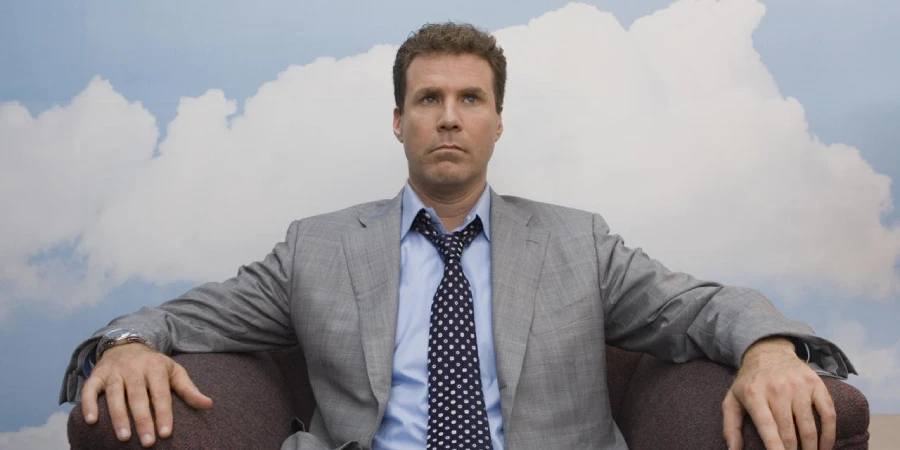

Stranger Than Fiction is one of those rare films that quietly sneaks up on you, pretends to be a quirky comedy, and then unexpectedly asks some deep, existential questions about free will, authorship, and what makes a life meaningful. Directed by Marc Forster and starring Will Ferrell in one of his most restrained performances, the film blends fantasy, romance, and philosophical drama with surprising elegance.
Detailed Summary
An Ordinary Man with an Unordinary Problem
Harold Crick is an IRS auditor who lives his life by strict routines: brushing his teeth a precise number of times, counting steps, and measuring everything—including his emotions. One day, while brushing his teeth, Harold hears a calm female voice narrating his life in exact detail. The voice describes not only what he is doing but what he is thinking and feeling.
At first, Harold assumes he is losing his mind. But when the narrator casually mentions that “little did he know, this seemingly innocuous event would result in his imminent death,” panic sets in.
Discovering the Narrator
Harold seeks help from a literature professor, Jules Hilbert, who theorizes that Harold might be the subject of a tragedy or a comedy. The distinction matters greatly: tragedies usually end with death, comedies do not. Harold begins analyzing the “genre” of his own life, trying to determine whether he is doomed.
Meanwhile, the narrator is revealed to be Karen Eiffel, a reclusive novelist struggling with writer’s block while trying to finish her latest book—unaware that her fictional character, Harold Crick, is very real.
Love, Change, and Narrative Rebellion
Harold’s rigid life begins to change when he meets Ana Pascal, a baker he is auditing. Through Ana, Harold learns to embrace spontaneity, emotion, and risk. As he starts living more fully—buying a guitar, learning to play, acting impulsively—the narrator grows increasingly frustrated because Harold is no longer behaving the way her story requires.
This clash between author and character becomes the heart of the film: Can a person rewrite their destiny once they become aware of it?
Racing Toward an Ending
Karen Eiffel finally completes her novel, which ends with Harold’s death in a tragic accident. Harold obtains a manuscript copy and reads his own ending. Rather than trying to escape it, he decides to meet Karen in person to understand why his death matters to the story.
What follows is a confrontation not of anger, but of philosophy: Is a meaningful death better than a meaningless life?
Movie Ending
Harold reads the manuscript and realizes that his death is written as an act of quiet heroism. In the final chapter, he sacrifices himself to save a child from being hit by a bus. Instead of fighting fate, Harold accepts it, believing that his death will give his life narrative purpose.
When Harold meets Karen Eiffel, he tells her she must finish the book exactly as written—even if it means he dies. This moment profoundly affects Karen, who for the first time truly understands that her fictional characters feel real because they are real in some emotional sense.
At the critical moment, Harold pushes the child out of the way and is struck by the bus. However, he survives—badly injured but alive. Karen, unable to fully kill him after meeting him, altered the ending slightly without sacrificing the thematic weight of the story.
Harold lives, changed forever. He returns to his now imperfect but joyful life, still hearing the narrator occasionally—but now the voice describes a man who is finally alive. The film closes on the idea that a life doesn’t need a tragic ending to be meaningful.
Are There Post-Credits Scenes?
No. Stranger Than Fiction does not include any post-credits or mid-credits scenes. The story ends definitively with the final shot and end credits.
Type of Movie
Stranger Than Fiction is a genre-blending film that combines fantasy, romantic comedy, and philosophical drama. It uses a high-concept premise to explore very human questions about purpose, control, and self-awareness.
Cast
- Will Ferrell as Harold Crick
- Emma Thompson as Karen Eiffel
- Maggie Gyllenhaal as Ana Pascal
- Dustin Hoffman as Professor Jules Hilbert
- Queen Latifah as Penny Escher
Film Music and Composer
The score was composed by Britt Daniel, frontman of the band Spoon. The music is subtle, indie-influenced, and emotionally restrained, perfectly matching the film’s introspective tone rather than overpowering it.
Filming Locations
The film was shot primarily in Chicago, Illinois. The city’s structured streets and architecture mirror Harold’s mechanical lifestyle, while its quieter neighborhoods help visually support his gradual emotional awakening. Chicago functions almost like a character itself—orderly, human, and quietly poetic.
Awards and Nominations
- Golden Globe nomination for Best Actor (Will Ferrell)
- AFI Movies of the Year (2006)
- Several critics’ circle awards for screenplay and supporting performances
Though not a major awards-season juggernaut, the film gained strong critical appreciation over time.
Behind the Scenes Insights
- Will Ferrell was cast specifically to subvert audience expectations of his usual comedic persona.
- Emma Thompson struggled with writer’s block while preparing for her role, ironically mirroring her character.
- The filmmakers consulted philosophers and literature professors to refine the story’s narrative logic.
- Many of Harold’s numerical routines were choreographed with real mathematic input.
Inspirations and References
The film draws inspiration from postmodern literature, especially works that blur the line between author and character. Influences include writers like Kurt Vonnegut and concepts similar to Luigi Pirandello’s Six Characters in Search of an Author.
Alternate Endings and Deleted Scenes
An early draft featured Harold actually dying at the end. Test audiences found it emotionally powerful but overly bleak. The final version keeps the thematic impact while offering a more hopeful resolution. Several deleted scenes further explored Karen Eiffel’s isolation but were removed for pacing.
Book Adaptations and Differences
The film is an original screenplay and not based on a book. Ironically, it has since inspired novels and academic essays discussing narrative theory, authorship, and metafiction.
Memorable Scenes and Quotes
Key Scenes
- Harold hearing the narrator for the first time
- The literature professor explaining comedy vs tragedy
- Harold reading his own death scene
- The confrontation between Harold and Karen Eiffel
Iconic Quotes
- “I brought you flours.”
- “You have to die so the book can be written.”
- “I think I’m in a tragedy.”
Easter Eggs and Hidden Details
- The watch Harold wears visually mirrors the film’s recurring clock imagery.
- Numbers appear subtly in the background early on, then disappear as Harold loosens control.
- Karen Eiffel’s apartment is filled with unfinished drafts, symbolizing endless rewrites of fate.
Trivia
- The film was originally titled Everything Must Go.
- Dustin Hoffman improvised several academic monologues.
- Will Ferrell learned to play the guitar specifically for the film.
- The IRS procedures shown are surprisingly accurate.
Why Watch?
If you enjoy films that respect your intelligence, make you laugh quietly, and leave you thinking long after the credits roll, this is a must-watch. It’s a reminder that living fully matters more than understanding everything.