
Alfred Hitchcock’s Spellbound plunges audiences not into a haunted house, but into the far more terrifying landscape of the human mind. It dares to make psychoanalysis the detective and a repressed memory the villain. This isn’t just a mystery; it’s a desperate scramble through the corridors of a broken psyche to find a truth buried by trauma.
Detailed Summary
Dr. Edwardes’ Arrival
Dr. Constance Petersen is a brilliant but emotionally detached psychoanalyst at Green Manors, a psychiatric hospital in Vermont. Her colleagues see her as cold and clinical. However, her world turns upside down with the arrival of the new hospital head, the renowned Dr. Anthony Edwardes.
Constance finds herself immediately and inexplicably drawn to this charming man. Their connection is palpable, sparking a romance that surprises everyone, especially Constance herself. They share a moment over a book she wrote.
Unmasking the Imposter
Cracks in Dr. Edwardes’ persona quickly begin to show. He exhibits a strange phobia of parallel lines against a white background, triggered by Constance drawing lines on a tablecloth. He also has a severe reaction to a patient’s story, revealing he lacks any memory of his past.
Constance soon realizes this man is not Dr. Edwardes at all. He is an amnesiac imposter who has assumed the doctor’s identity. Fearing he murdered the real Dr. Edwardes and took his place, he flees the hospital in a panic.
On the Run
Convinced of his innocence and deeply in love, Constance abandons her career to chase after him. She finds him at the Empire State Hotel in New York City under the name “John Ballantyne.” She dedicates herself to curing his amnesia and solving the mystery.
Their journey takes them to the home of Dr. Alex Brulov, Constance’s former mentor. Together, they try to peel back the layers of John’s trauma. Meanwhile, the police are hot on their trail, believing John to be a fugitive murderer.
The Dream Sequence
Dr. Brulov suggests that John’s dreams hold the key to his lost memories. John recounts a bizarre dream filled with surreal imagery, famously designed by artist Salvador Dalí. The dream involves a man with no face, a distorted casino, and a shadowy figure dropping a wheel from a rooftop.
Constance and Brulov meticulously analyze the dream’s symbolism. They interpret the distorted wheel as a revolver and the precipice as a ski slope. For instance, the clues point toward an incident involving the real Dr. Edwardes at a place called Gabriel Valley.
The Skiing Breakthrough
Acting on the dream’s clues, Constance takes John to Gabriel Valley for a ski trip. She hopes confronting the location of the trauma will unlock his memory. John is terrified, associating the color white and the tracks in the snow with his deep-seated phobia.
As they ski down the mountain, John’s memory comes rushing back in a dramatic climax. He remembers witnessing the real Dr. Edwardes fall off a cliff. He believes he accidentally caused the death, confirming his guilt complex but not his role as a killer.
The Real Killer
With John’s name cleared of murder but the death still ruled an accident, Constance returns to Green Manors. She discusses the case with Dr. Murchison, the former head of the hospital who was replaced by Dr. Edwardes. Something Murchison says about Edwardes’ personality strikes Constance as odd.
She realizes that Murchison’s slip of the tongue indicates he must have known Edwardes personally, a fact he had previously concealed. Consequently, a devastating realization dawns on her: Murchison was the one at Gabriel Valley. He murdered Edwardes and allowed the amnesiac John to take the blame.
Movie Ending
Dr. Constance Petersen confronts Dr. Murchison in his office, calmly presenting her deductions. She deconstructs his psychological profile, exposing his jealousy and resentment toward the man who replaced him. She explains that John’s guilt complex was a symptom of having witnessed the murder, not of committing it.
Murchison initially dismisses her but grows increasingly agitated as her logic traps him. Realizing he is cornered, he pulls out a revolver and threatens her. In a chilling moment, he turns the gun on himself. The camera assumes his point of view, showing his hand turning the gun toward the audience before firing.
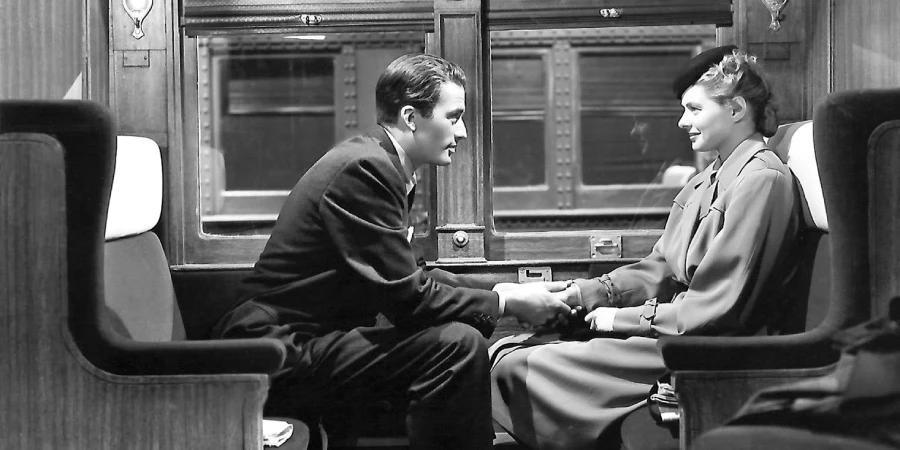
The final scene shows Constance and a fully recovered John Ballantyne happily together, about to depart on a train for their honeymoon. He is exonerated, his memory is restored, and their love has triumphed over trauma and deception.
Are There Post-Credits Scenes?
No, there are no post-credits scenes in Spellbound. As was standard for films made during the Golden Age of Hollywood, the movie concludes when the credits begin to roll.
Type of Movie
Spellbound is a psychological thriller blended with elements of film noir and romance. Its defining feature is the central role of Freudian psychoanalysis, which serves as the primary tool for solving the film’s mystery. The tone is tense and suspenseful, but ultimately optimistic about the power of love and therapy to heal the mind.
Cast
- Ingrid Bergman – Dr. Constance Petersen
- Gregory Peck – John “J.B.” Ballantyne / Dr. Anthony Edwardes
- Michael Chekhov – Dr. Alexander “Alex” Brulov
- Leo G. Carroll – Dr. Murchison
- Rhonda Fleming – Mary Carmichael
- John Emery – Dr. Fleurot
Film Music and Composer
The film’s iconic score was composed by Miklós Rózsa, who won an Academy Award for his work. The music is famous for being one of the first film scores to feature the theremin. This electronic instrument creates an eerie, otherworldly sound.
Rózsa used the theremin specifically to represent John Ballantyne’s amnesiac state and psychological distress. As a result, its wavering pitch became synonymous with mental turmoil in cinema for years to come.
Filming Locations
While most of Spellbound was shot on soundstages at the Selznick International Studios, certain key sequences used real locations to enhance their realism. The pivotal skiing scenes, for instance, were filmed at the Alta Ski Area near Salt Lake City, Utah.
In contrast, the dream sequence and the psychiatric hospital interiors were constructed entirely in-studio. This approach allowed Hitchcock to maintain tight stylistic control over the film’s psychological environments.
Awards and Nominations
Spellbound was a critical and commercial success, earning several Academy Award nominations. Its most significant win was the Oscar for Best Music, Scoring of a Dramatic or Comedy Picture for Miklós Rózsa.
In addition, the film received nominations for Best Picture, Best Director (Alfred Hitchcock), Best Supporting Actor (Michael Chekhov), and Best Special Effects for the dream sequence.
Behind the Scenes Insights
- Producer David O. Selznick hired famed surrealist artist Salvador Dalí to design the film’s dream sequence. Hitchcock wanted Dalí’s authentic surrealism, but Selznick found it too bizarre and ultimately cut much of the planned 20-minute sequence.
- Hitchcock clashed frequently with Selznick, who exercised heavy creative control over the production. Selznick was passionate about psychoanalysis and insisted it be portrayed as a near-miraculous cure.
- For the final POV shot of Dr. Murchison’s suicide, the crew constructed an oversized wooden hand to hold a giant prop revolver. This was necessary to achieve the correct depth and focus for the camera.
- Ingrid Bergman prepared for her role by spending time with psychoanalyst and producer’s associate, May Romm, to better understand the mindset and methods of a therapist.
Inspirations and References
The film’s plot is based on the 1927 novel The House of Dr. Edwardes, written by Hilary Saint George Saunders and John Palmer under the pseudonym Francis Beeding. Producer David O. Selznick purchased the rights, intending to create a film that would popularize his keen interest in psychoanalysis.
Alternate Endings and Deleted Scenes
The most famous deleted content from Spellbound involves Salvador Dalí’s dream sequence. The original concept was far longer and more disturbing. One cut moment reportedly involved Ingrid Bergman’s character covered in ants.
Selznick found Dalí’s vision “too shocking” and hired production designer William Cameron Menzies to direct a simplified, more narratively straightforward version of the sequence, cutting much of Dalí’s work.
Book Adaptations and Differences
Spellbound is a loose adaptation of the novel The House of Dr. Edwardes. While the core premise of an amnesiac imposter at a mental institution remains, the film makes significant changes. The novel is a darker spy thriller with supernatural overtones, including devil worship.
Screenwriter Ben Hecht and producer David O. Selznick jettisoned these elements. They shifted the focus entirely to Freudian psychology and added a much stronger romantic storyline between Constance and John. Ultimately, the film presents a more hopeful view of mental healing than the book.
Memorable Scenes and Quotes
Key Scenes
- The Dream Sequence: A surreal journey into the subconscious, featuring melting wheels, faceless men, and giant eyeballs. It remains one of the most famous artistic collaborations in film history.
- The Milk Glass: When John drinks a glass of milk offered by Dr. Brulov, Hitchcock uses forced perspective to make the glass appear enormous, visually representing its importance to a sleep-drugged John.
- The Skiing Climax: Constance and John race down a mountain, their shadows looming large as his repressed memories finally surface in a dizzying sequence of flashbacks and terror.
- The Gun POV: The film’s final confrontation ends with the killer turning the gun on himself, with the camera showing the action from his perspective in a shocking, audience-implicating shot.
Iconic Quotes
- Dr. Alex Brulov: “Good night and sweet dreams… which we’ll analyze in the morning.”
- Dr. Constance Petersen: “People often feel guilt over something they never did. It’s a neurosis, a symptom of illness.”
- John Ballantyne: “The blank spaces… my mind is like a house that’s been completely looted.”
- Dr. Alex Brulov: “Any husband of Constance is a husband of mine, so to speak.”
Easter Eggs and Hidden Details
- Hitchcock’s Cameo: Alfred Hitchcock makes his signature cameo appearance about 43 minutes into the film. He is seen exiting an elevator at the Empire State Hotel, carrying a violin case and smoking a cigarette.
- Lines on the Tablecloth: The crisscrossing lines Constance draws on the white tablecloth, which trigger John’s phobia, visually foreshadow the ski tracks in the snow at Gabriel Valley.
- Color Symbolism: The color white is used throughout the film to trigger John’s anxiety. It appears in the white tablecloth, the white bedspread, the bathroom, and finally, the vast white expanse of the ski slope.
Trivia
- Gregory Peck was not the first choice for the lead role. Joseph Cotten, who had worked with Hitchcock on Shadow of a Doubt, was originally considered.
- The film’s success popularized the theremin, leading to its use in many 1950s science-fiction films like The Day the Earth Stood Still to create an “alien” sound.
- Michael Chekhov, who played Dr. Brulov, was the nephew of playwright Anton Chekhov and a renowned acting teacher who taught stars like Marilyn Monroe and Clint Eastwood.
- The film originally had a three-frame flash of the color red when the gun fires at the very end, but this was often cut by projectionists or has been lost in many prints.
Why Watch?
Hitchcock’s masterclass in psychological suspense remains a must-see. Its innovative use of psychoanalysis as a plot device, combined with the groundbreaking Dalí dream sequence and a powerful score, makes it a landmark film that is both thrilling and intellectually engaging.
Director’s Other Movies
- Rebecca (1940)
- Notorious (1946)
- Rear Window (1954)
- Vertigo (1958)
- North by Northwest (1959)
- Psycho (1960)
- The Birds (1963)
Recommended Films for Fans
- Gaslight (1944)
- The Snake Pit (1948)
- The Three Faces of Eve (1957)
- Marnie (1964)
- A Beautiful Mind (2001)
- Shutter Island (2010)