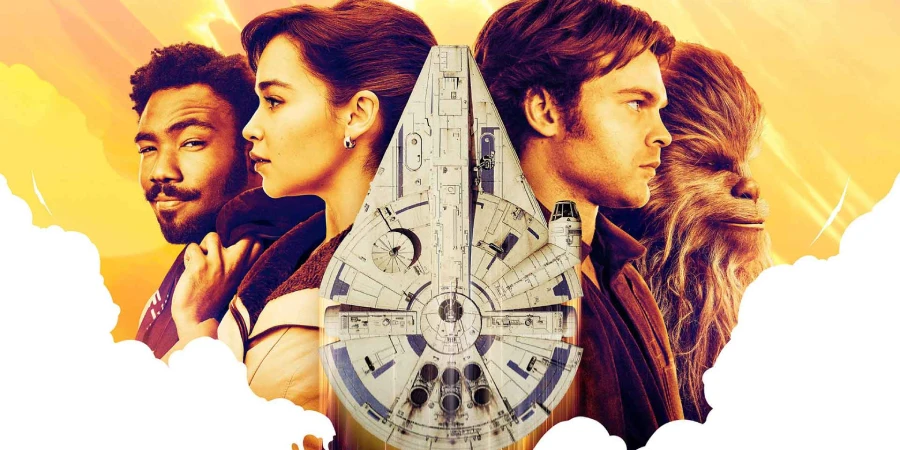

Solo: A Star Wars Story is a standalone entry in the Star Wars universe that explores the origin story of one of the saga’s most iconic characters. Set years before A New Hope, the film focuses on how Han Solo became the cynical, sharp-tongued smuggler we all know—while also adding new layers, allies, betrayals, and galactic crime lore.
Detailed Summary
Life on Corellia: The Birth of a Smuggler
The film opens on Corellia, a grimy industrial planet controlled by crime syndicates. Young Han survives by stealing and dreaming of escaping the planet with his love, Qi’ra. Their attempt to flee together fails when Qi’ra is captured, and Han escapes alone. In desperation, he enlists in the Imperial Navy, giving his name as Han Solo—a surname assigned mockingly because he has no family.
This moment establishes Han’s core motivation: freedom and loyalty to the people he loves, even when the galaxy keeps tearing them away.
Imperial Service and Meeting Tobias Beckett
Han’s military career goes badly, and he’s thrown into infantry combat. There, he meets Tobias Beckett, a seasoned criminal posing as a soldier. After Han tries to blackmail his way into Beckett’s crew, he’s punished by being thrown into a pit with a “monster,” which turns out to be Chewbacca.
Instead of fighting, Han communicates with Chewie and forms a bond that becomes one of the most important friendships in Star Wars history. They escape together, officially becoming partners.
The Heist on Vandor and the Cost of Crime
Han joins Beckett’s crew for a major train heist on the snowy planet Vandor. The mission goes wrong due to interference from a rebel group called Enfys Nest, resulting in the deaths of Beckett’s partner Val and another crew member.
This section emphasizes a key theme: the criminal underworld is brutal, unstable, and rarely glamorous. Han begins to realize that survival often comes at a moral cost.
Meeting Lando Calrissian and the Millennium Falcon
To repay their debts, the crew seeks help from Lando Calrissian, a charming gambler and smuggler who owns the Millennium Falcon. Han immediately admires the ship and challenges Lando to a card game, losing—but planting the seed for future rivalry.
They recruit L3-37, Lando’s droid co-pilot, whose outspoken beliefs about droid freedom play a surprising role later in the story.
Kessel Run and the Rise of a Legend
The group attempts a dangerous mission to steal unrefined coaxium from Kessel, resulting in the famous Kessel Run. During the escape, L3 is destroyed, and her consciousness is integrated into the Falcon’s navigation system.
Han pilots the Falcon through uncharted space, completing the Kessel Run in less than twelve parsecs, cementing his reputation as an exceptional pilot. This scene reframes a classic Star Wars boast as skill rather than arrogance.
Betrayals, Qi’ra’s Choice, and Crimson Dawn
As the crew prepares to deliver the coaxium, tensions explode. Beckett betrays Han. Qi’ra reveals her allegiance to Crimson Dawn, a powerful crime syndicate. Enfys Nest is revealed not as a villain but as a rebel fighting against galactic exploitation.
Han outsmarts Beckett, killing him before he can betray anyone else again. This moment is critical—it shows Han choosing pragmatism over idealism, a trait that defines him later in life.
Movie Ending
At the climax, Qi’ra kills the Crimson Dawn lieutenant Dryden Vos to save Han, but her loyalty ultimately lies with survival and power rather than romance. She contacts the true leader of Crimson Dawn: Darth Maul, revealed to be alive and operating behind the scenes.
Instead of staying with Han, Qi’ra chooses to rise within the criminal hierarchy, leaving him behind without explanation. This moment is emotionally pivotal—Han loses the person he escaped Corellia for, reinforcing his emotional walls.
The film ends with Han traveling to Tatooine, hearing rumors of a gangster building an empire—clearly Jabba the Hutt. In the final scene, Han challenges Lando to another card game and wins the Millennium Falcon, completing his transformation into the legendary smuggler.
The ending ties together Han’s cynicism, independence, and love of freedom, while opening doors to stories that were never fully continued.
Are There Post-Credits Scenes?
No. Solo: A Star Wars Story does not include any post-credits or mid-credits scenes. All major revelations, including Darth Maul’s appearance, occur before the credits roll.
Type of Movie
Solo is a space adventure film with strong elements of heist cinema, blending action, sci-fi, and character-driven drama. It focuses more on criminal underworld storytelling than galactic warfare.
Cast
- Alden Ehrenreich – Han Solo
- Emilia Clarke – Qi’ra
- Donald Glover – Lando Calrissian
- Woody Harrelson – Tobias Beckett
- Joonas Suotamo – Chewbacca
- Thandiwe Newton – Val
- Phoebe Waller-Bridge – L3-37
- Paul Bettany – Dryden Vos
- Ray Park (physical performance) – Darth Maul
Film Music and Composer
The score was composed by John Powell, with the iconic Han Solo theme written by John Williams. Powell’s music blends classic Star Wars motifs with a more playful, adventurous tone, reflecting Han’s reckless charm and growth.

Filming Locations
- Pinewood Studios (UK) – Primary interior sets and Falcon scenes
- Fjaðrárgljúfur Canyon, Iceland – Mimban battle sequences
- Italy and Spain – Used for exotic planet environments
These locations grounded the film visually, giving the galaxy a more gritty, lived-in feel compared to the polished worlds of the sequel trilogy.
Awards and Nominations
- Nominated for Best Visual Effects at multiple critics’ associations
- Won technical awards for sound editing and production design
While not a major awards contender, the film was widely praised for its visuals and practical effects.
Behind the Scenes Insights
- The film originally had directors Phil Lord and Christopher Miller, who were replaced mid-production by Ron Howard
- Over 70% of the movie was reshot
- Donald Glover studied Billy Dee Williams’ speech patterns extensively
- Ron Howard aimed to make the film feel more like a classic western and heist movie than a traditional Star Wars epic
Inspirations and References
- Inspired by classic western outlaw films
- Heavy influence from crime and heist cinema
- Direct references to the original Star Wars trilogy
- Expanded lore from Star Wars novels and comics
Alternate Endings and Deleted Scenes
- A longer subplot involving Enfys Nest was cut
- Additional Qi’ra and Crimson Dawn scenes were planned
- Early drafts hinted at a direct sequel that never materialized
No alternate ending was filmed, but the story was clearly structured as the beginning of a larger arc.
Book Adaptations and Differences
The novelization expands on Qi’ra’s internal conflict and Crimson Dawn’s structure. The film simplifies much of this to maintain pacing and accessibility for casual audiences.

Memorable Scenes and Quotes
Key Scenes
- Han and Chewbacca’s first meeting in the pit
- The Vandor train heist
- The Kessel Run
- Han winning the Millennium Falcon
Iconic Quotes
- “I’ve got a really good feeling about this.”
- “I’m putting together a crew.”
- “Let’s make something real.”
Easter Eggs and Hidden Details
- Han’s blaster stance mirrors his pose in A New Hope
- L3’s navigation integration explains Falcon quirks later
- Sabacc cards match designs from expanded universe lore
- Dryden Vos’ scars change color with his emotions
Trivia
- Chewbacca is given a canonical age of over 190 years
- The film explains Han’s surname for the first time
- Ron Howard’s brother Clint Howard appears in a cameo
- The Falcon’s “personality” is canonically L3’s consciousness
Why Watch?
If you want a character-driven Star Wars story focused on adventure, betrayal, and the criminal underworld, Solo offers a fresh perspective. It deepens Han Solo without ruining the mystery and adds rich lore to the galaxy.
Director’s Other Works (Ron Howard)
- Apollo 13 (1995)
- A Beautiful Mind (2001)
- Cinderella Man (2005)
- Rush (2013)
- Inferno (2016)