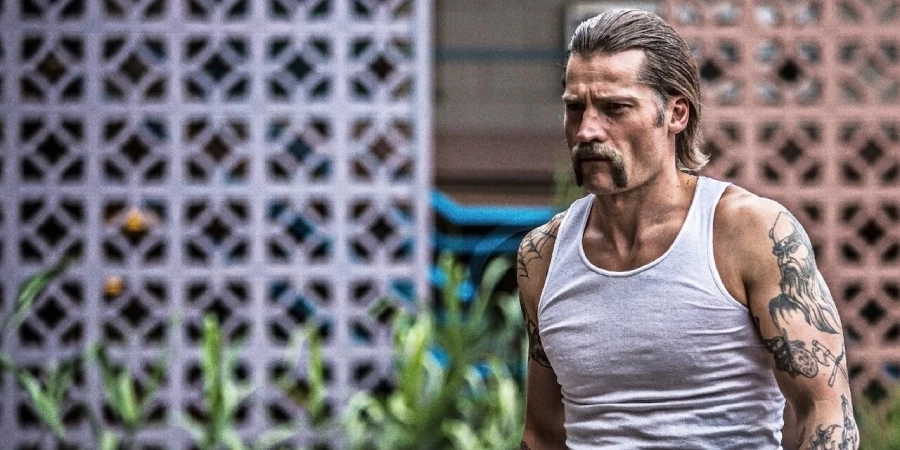

Shot Caller is a gritty, uncompromising prison crime drama that dives deep into how the justice system and prison culture can fundamentally reshape a person’s identity. Directed by Ric Roman Waugh, the film is tense, brutal, and emotionally heavy, focusing less on glamour and more on consequence.
Detailed Summary
A Normal Life Shattered
Jacob Harlon (Nikolaj Coster-Waldau) starts as a successful family man with a good job, a loving wife, and a young son. One night of drinking leads to a tragic car accident that kills his friend. Jacob is convicted of vehicular manslaughter and sentenced to prison. This moment is the emotional and moral breaking point of the film, establishing its core theme: one mistake can destroy an entire life.
Entering the Prison System
Jacob’s early days in prison are defined by fear and vulnerability. He is assaulted, threatened, and quickly learns that neutrality is not an option. Prison politics force him to align with the Aryan Brotherhood for protection, a decision that begins his transformation. His first act of violence is reluctant, but it marks the moment he crosses a line he cannot uncross.
Becoming “Money”
As years pass, Jacob hardens both physically and psychologically. He earns the nickname “Money” and rises within the white supremacist prison gang. Violence becomes routine, loyalty becomes survival, and morality fades. The film carefully shows how prison does not rehabilitate, but instead rewards brutality and obedience to criminal hierarchies.
Transfer to Maximum Security
Jacob is transferred to a maximum-security prison, where the stakes escalate dramatically. The rules are harsher, the inmates more dangerous, and the gang leadership more ruthless. At this stage, Jacob is no longer reacting to violence; he is actively orchestrating it.
Life After Prison Isn’t Freedom
Upon release, Jacob learns that prison loyalties don’t end at the gate. He is now part of a criminal network operating on the outside, expected to coordinate drug deals, hits, and intimidation. Attempting to protect his family only pulls him deeper into crime. His wife and son want nothing to do with him, highlighting the emotional cost of his transformation.


Movie Ending
In the final act, Jacob is ordered by the Aryan Brotherhood to carry out a gang assassination on the outside. Refusal would mean death, not just for him but potentially for his family. Jacob realizes that the only way to truly protect his loved ones is to cut himself off from them permanently.
He deliberately engineers a situation where he commits murder in a highly visible way, ensuring a life sentence. By returning to prison as a known and feared figure, he removes the gang’s leverage over his family. In a devastating final scene, Jacob watches his son from a distance, choosing permanent incarceration over continued violence spilling into his family’s life.
The ending makes it painfully clear that Jacob’s “choice” is not redemption, but containment. He saves his family not by escaping violence, but by absorbing it entirely himself. The film closes with the idea that some systems are so corrupting that survival itself becomes a tragedy.
Are There Post-Credits Scenes?
No. Shot Caller does not include any post-credits or mid-credits scenes. The story ends definitively with its final shot, reinforcing the bleak finality of Jacob’s fate.
Type of Movie
Shot Caller is a hard-hitting crime drama and prison film with strong elements of psychological thriller. It focuses on realism, moral decay, and systemic failure rather than action-driven spectacle.
Cast
- Nikolaj Coster-Waldau as Jacob Harlon / Money
- Jon Bernthal as Frank “The Beast”
- Lake Bell as Katherine Harlon
- Omari Hardwick as Kutcher
- Jeffrey Donovan as Bottles
- Benjamin Bratt as Sanchez
Film Music and Composer
The score was composed by Antonio Pinto, whose restrained and ominous music enhances the film’s tension. Rather than dominating scenes, the music subtly reinforces dread, inevitability, and emotional isolation.

Filming Locations
The movie was filmed primarily in New Mexico, using real prisons and stark desert environments. These locations contribute heavily to the film’s authenticity, emphasizing isolation, harshness, and emotional emptiness. The realism of the prison settings is crucial to making the transformation of the main character believable.
Awards and Nominations
While Shot Caller did not receive major awards, it earned strong critical praise for performances, particularly Nikolaj Coster-Waldau’s. Over time, it has gained a reputation as an underrated modern prison film.
Behind the Scenes Insights
- The director worked closely with former inmates and prison consultants to ensure realism.
- Nikolaj Coster-Waldau underwent intense physical training to reflect Jacob’s transformation.
- Much of the prison dialogue is inspired by real inmate communication patterns.
- Violence was intentionally filmed without stylization to avoid glamorization.
Inspirations and References
The film draws inspiration from real-life prison gang structures, especially the Aryan Brotherhood. While not based on a single true story, it reflects documented realities of the U.S. prison system and the difficulties of leaving gang life behind.
Alternate Endings and Deleted Scenes
No officially released alternate ending exists. However, interviews suggest that early drafts explored Jacob attempting escape or witness protection, both of which were rejected for being unrealistic. The final ending was chosen specifically for its grim honesty.
Book Adaptations and Differences
Shot Caller is not based on a book. It is an original screenplay developed from research and real-world accounts of prison life and criminal organizations.

Memorable Scenes and Quotes
Key Scenes
- Jacob’s first violent act in prison, marking his moral collapse
- The transfer to maximum-security prison
- The outdoor gang meeting after Jacob’s release
- The final murder that ensures his return to prison
Iconic Quotes
- “You’re not a criminal yet. But you will be.”
- “There are no choices in here. Only consequences.”
Easter Eggs and Hidden Details
- Jacob’s nickname “Money” subtly references his initial motivation: providing for his family.
- Gang tattoos shown in the film are accurate to real prison symbolism.
- Repeated shots of barred windows visually mirror Jacob’s shrinking freedom over time.
Trivia
- The film was shot in under 30 days.
- Jon Bernthal improvised several intimidating moments.
- The director previously worked on prison-themed projects, influencing the film’s tone.
Why Watch?
If you want a raw, uncompromising look at how institutions can destroy identity, Shot Caller delivers. It avoids clichés, refuses easy redemption, and leaves a lasting emotional impact. This is not an easy watch, but it is a powerful one.
Director’s Other Works
- Felon (2008)
- Snitch (2013)
- Angel Has Fallen (2019)
- Greenland (2020)
Recommended Films for Fans
- Brawl in Cell Block 99 (2017)
- A Prophet (2009)
- American History X (1998)
- Bronson (2008)
- Felon (2008)