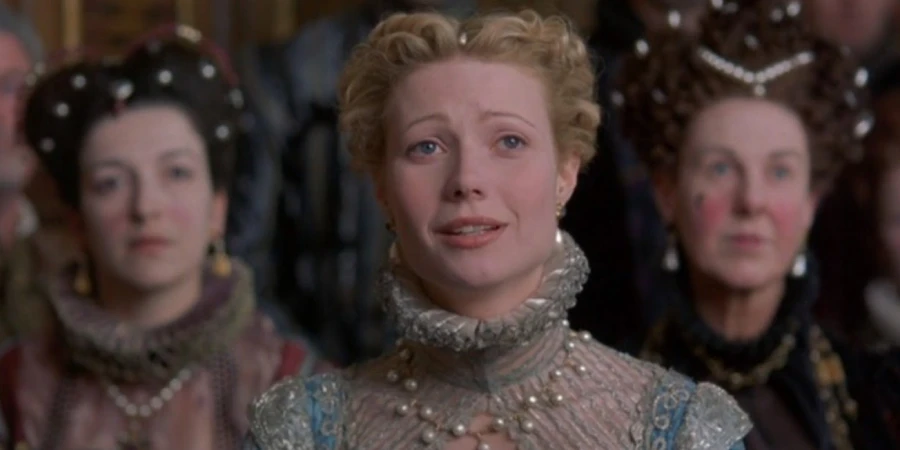

Shakespeare in Love imagines a fictional love story in the life of the young playwright William Shakespeare while he is writing what would become Romeo and Juliet. Blending romance, theatrical comedy, and literary references, the movie turns Elizabethan theatre into a lively backstage adventure.
Detailed Summary
Shakespeare’s Creative Crisis
The story begins in London around 1593. William Shakespeare (played by Joseph Fiennes) is suffering from severe writer’s block. He owes a new play to theatre owner Philip Henslowe but cannot find inspiration.
The unfinished play is called Romeo and Ethel, the Pirate’s Daughter, and Shakespeare struggles to make it work. He tries consulting various sources for inspiration—including a rather comedic “therapy session” with a doctor who claims to cure writer’s block.
Viola de Lesseps: A Secret Passion for Theatre
Enter Viola de Lesseps (played by Gwyneth Paltrow), a noblewoman obsessed with theatre. Because women are forbidden from performing on stage in Elizabethan England, Viola disguises herself as a man named “Thomas Kent” to audition for Shakespeare’s play.
Her audition is so passionate that Shakespeare becomes fascinated by this mysterious young actor.
The Secret Identity Revealed
Shakespeare soon discovers that Thomas Kent is actually Viola. Despite the social barriers between them—she is aristocratic and promised in marriage to Lord Wessex—the two fall deeply in love.
Their affair becomes the emotional spark Shakespeare desperately needed. As their relationship intensifies, the play itself evolves. The silly pirate comedy gradually transforms into something far more tragic and beautiful: Romeo and Juliet.
The Theatre World in Chaos
Meanwhile, the production faces constant obstacles:
- Rival theatre owners try to sabotage the show.
- Child actor Sam suddenly loses his voice.
- Viola must continue disguising herself to perform.
- Authorities threaten to shut down theatres.
The theatrical troupe improvises constantly, creating an atmosphere of frantic creativity.
Queen Elizabeth’s Interest
The story also involves Elizabeth I (played by Judi Dench). The Queen hears rumors that a play is being written about true love and makes a wager with Wessex that such love cannot exist.
This royal curiosity raises the stakes for Shakespeare and the theatre company.

Movie Ending Explained
The final act centers on the premiere performance of Romeo and Juliet.
When the show finally opens, Viola secretly performs the role of Juliet while still disguised as a male actor. Shakespeare himself must unexpectedly step into the role of Romeo after another actor becomes unavailable.
As the play unfolds on stage, the fictional love story mirrors Shakespeare and Viola’s real relationship. The emotions in the performance feel authentic because they truly are.
Eventually Viola’s disguise is discovered. Women are forbidden to act, and the theatre is shut down by authorities. However, Queen Elizabeth attends the performance and recognizes the emotional truth of the story.
She declares that the play proves real love does exist—settling the wager. As punishment but also mercy, she allows the play to continue and ensures Shakespeare avoids serious consequences.
Viola, however, cannot remain with Shakespeare. She must honor her arranged marriage and leave England with Lord Wessex for the Virginia colony.
Their farewell is bittersweet. Viola tells Shakespeare that their love story should not end in tragedy like Romeo and Juliet, but instead inspire something new.
Inspired by Viola’s departure and spirit, Shakespeare begins writing a new play about a shipwrecked heroine in a distant land—clearly foreshadowing Twelfth Night.
The film closes with Shakespeare imagining Viola as the heroine of this new story, standing on a beach in the New World.
It is a romantic but melancholic ending, suggesting that even though the lovers cannot stay together, their relationship becomes immortal through art.
Are There Post-Credits Scenes?
No. Shakespeare in Love does not include any post-credits scenes. The story concludes fully within the final moments of the film.
Cast
- Joseph Fiennes — William Shakespeare
- Gwyneth Paltrow — Viola de Lesseps
- Geoffrey Rush — Philip Henslowe
- Colin Firth — Lord Wessex
- Judi Dench — Queen Elizabeth I
- Tom Wilkinson — Hugh Fennyman
- Ben Affleck — Ned Alleyn
Film Music and Composer
The musical score was composed by Stephen Warbeck.
His music blends Renaissance-inspired instrumentation with emotional orchestral themes, reinforcing the romantic and theatrical atmosphere. The score won the Academy Award for Best Original Dramatic Score.
Filming Locations and Their Importance 🎬
Several historic English locations were used to recreate Elizabethan London.
- London, England: Many exterior shots capture the narrow streets and theatre culture associated with Shakespeare’s era.
- Kent, England: Historic buildings and countryside locations helped create the aristocratic environment of Viola’s world.
- Hatfield House: This famous estate was used for scenes involving the royal court and aristocratic settings, adding authenticity to the film’s depiction of Elizabethan nobility.
These locations helped the filmmakers recreate late 16th-century England with impressive historical atmosphere.


Awards and Nominations
The film was extremely successful during award season.
At the 71st Academy Awards it won 7 Oscars, including:
- Best Picture
- Best Actress — Gwyneth Paltrow
- Best Supporting Actress — Judi Dench
- Best Original Screenplay
- Best Original Score
- Best Costume Design
- Best Art Direction
It received 13 Academy Award nominations in total.
Behind the Scenes Insights
- Judi Dench appears on screen for only about eight minutes, yet still won an Oscar for Best Supporting Actress.
- Gwyneth Paltrow reportedly beat several major actresses for the role of Viola.
- The screenplay went through many revisions before playwright Tom Stoppard helped refine the dialogue.
- The production team carefully studied Elizabethan theatre staging and costumes to recreate authentic performances.
- Many scenes were shot to resemble how audiences in Shakespeare’s time would have experienced theatre.
Inspirations and References
The film draws inspiration from several sources:
- The life of William Shakespeare
- The play Romeo and Juliet
- Elizabethan theatre traditions
- Shakespeare’s later play Twelfth Night
Although Shakespeare’s love affair in the film is fictional, the movie cleverly integrates real historical figures and theatrical practices.
Alternate Endings and Deleted Scenes
No major alternate ending was ever filmed, but some deleted scenes exist:
- Extended rehearsal scenes showing the development of the play.
- Additional comedic moments with theatre owner Henslowe.
- A longer sequence explaining Viola’s life before meeting Shakespeare.
These scenes were removed mainly to maintain pacing.
Book Adaptations and Differences
The movie was not originally based on a novel. Instead, a novelization was later published after the film’s release.
Because the film came first, the book mostly follows the movie’s storyline rather than expanding it significantly.
Memorable Scenes and Quotes
Key Scenes
- Viola’s audition disguised as “Thomas Kent”
- Shakespeare realizing Viola’s true identity
- The chaotic backstage preparations for the play
- Queen Elizabeth attending the theatre performance
- The final emotional performance of Romeo and Juliet
Iconic Quotes
- “It will all turn out well.”
- “How will it end? — As all stories must: with a marriage.”
- “I know something of a woman in a man’s profession.” — Queen Elizabeth
Easter Eggs and Hidden Details
- Many lines spoken by characters are adapted from real Shakespeare plays.
- Several minor characters are named after real actors from Shakespeare’s theatre company.
- The film subtly references multiple Shakespeare works beyond Romeo and Juliet.
- The idea for Twelfth Night appearing at the end cleverly links Shakespeare’s future writing to Viola’s influence.
Trivia
- Judi Dench’s Oscar-winning performance is one of the shortest acting wins in Academy Award history.
- The film was produced by Miramax.
- The screenplay became famous for its rapid-fire Shakespearean humor and wordplay.
- Ben Affleck intentionally performed with a theatrical acting style to mimic Elizabethan stage acting.
Why Watch?
You should watch this film if you enjoy:
- Clever literary references
- Romantic historical stories
- Films about theatre and creativity
- Witty dialogue inspired by Shakespeare
The movie is especially enjoyable for viewers who like stories about art being born from real emotion.
Director’s Other Works
Films directed by John Madden include:
- Mrs Brown (1997)
- Captain Corelli’s Mandolin (2001)
- Proof (2005)
- The Debt (2010)
- The Best Exotic Marigold Hotel (2011)
Recommended Films for Fans
- Elizabeth (1998)
- Elizabeth: The Golden Age (2007)
- The Favourite (2018)
- Much Ado About Nothing (1993)
- Anonymous (2011)