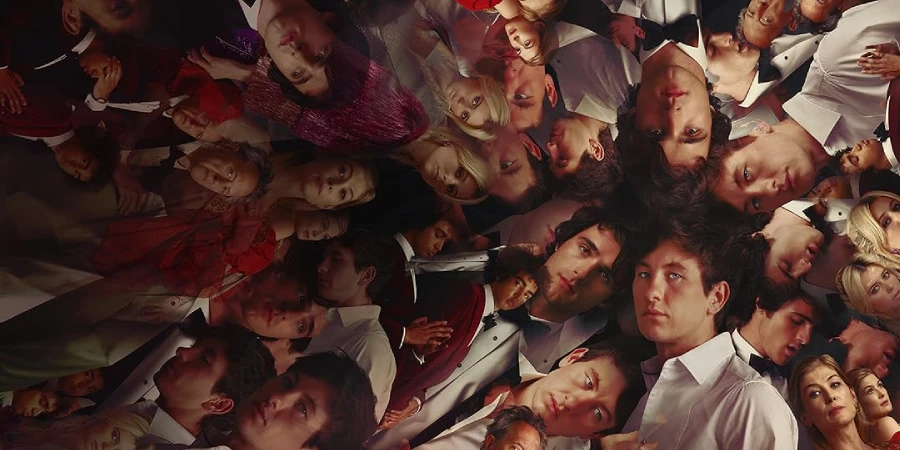

Saltburn (2023), written and directed by Emerald Fennell, is a dark, seductive psychological thriller that blends class satire, obsession, and gothic melodrama into a single unsettling tale.
Detailed Summary
Arrival at Oxford and Meeting Felix
Oliver Quick (Barry Keoghan), a socially awkward and seemingly underprivileged student at Oxford, becomes obsessed with charismatic and aristocratic Felix Catton (Jacob Elordi). After Oliver claims to have family troubles and nowhere to go, Felix—out of sympathy—invites him to spend the summer at his family’s enormous estate, Saltburn. This is the beginning of Oliver’s deepening psychological entanglement with the Catton family.
Life at Saltburn and Oliver’s Growing Obsession
At the luxurious, eccentric estate, Oliver meets Felix’s oddball relatives, including his aloof mother Elspeth (Rosamund Pike), eccentric father Sir James (Richard E. Grant), and sarcastic sister Venetia (Alison Oliver).
Oliver increasingly idolizes Felix. His obsession crosses into disturbing territory—private rituals, invasive boundary-crossing, and a desire to absorb every part of Felix’s life.
The Catton Family’s Cracks
As the summer progresses, Oliver subtly manipulates everyone around him. Felix begins to pull away, sensing something “off” about Oliver. Meanwhile, Venetia falls into depression, suspicious that Oliver’s humble-orphan persona may not be so truthful.
Death, Lies, and Manipulation
Felix dies suddenly (officially due to infection complications), devastating the family. Venetia later takes her own life. Both events are presented ambiguously, but it becomes increasingly clear Oliver has engineered chaos through carefully planted lies and manipulations, positioning himself as the Cattons’ “poor, loyal friend.”
Inheriting Saltburn
By the time Oliver leaves the estate, Sir James and Elspeth are barely holding themselves together emotionally—leaving Oliver as the only surviving, reliable “child figure.” Oliver’s plan is becoming frighteningly obvious.


Movie Ending
The film concludes with a startling and unambiguous revelation: Oliver orchestrated everything.
We learn that:
- Oliver lied about his family’s poverty; his parents are alive and perfectly ordinary.
- He manipulated Felix into trusting and pitying him.
- He sowed discord within the Catton family, fueling their emotional instability.
- He nudged Venetia further into despair.
- He positioned himself as the tragic, loyal friend, knowing the Cattons would emotionally depend on him.
The final moments show Oliver triumphantly dancing naked through the now-empty Saltburn mansion to the tune of “Murder on the Dancefloor.” The Cattons are all gone—dead or destroyed—and Oliver has inherited the estate. The emptiness of the house stands in sharp contrast to Oliver’s manic, naked celebration.
The ending is a bold statement on class envy, psychological predation, and the lengths to which someone might go to infiltrate the world of the wealthy. It confirms what the film has hinted but never stated outright: Oliver is not a victim—he’s the architect of the downfall of an entire family.
Are There Post-Credits Scenes?
There are no post-credits scenes in Saltburn. Once the final sequence ends, the film’s story is complete.
Type of Movie
Saltburn is a dark psychological thriller with strong elements of social satire and gothic drama. It blends erotic tension, class commentary, and psychological manipulation into a single sharp-edged narrative.
Cast
- Barry Keoghan as Oliver Quick
- Jacob Elordi as Felix Catton
- Rosamund Pike as Elspeth Catton
- Richard E. Grant as Sir James Catton
- Alison Oliver as Venetia Catton
- Archie Madekwe as Farleigh
- Carey Mulligan as Pamela
- Paul Rhys as Duncan
Film Music and Composer
The film’s score was composed by Anthony Willis, blending moody orchestral tones with unsettling soundscapes.
The soundtrack plays a crucial narrative role, especially the use of “Murder on the Dancefloor” in the final scene, which has since become iconic and deeply associated with the film.


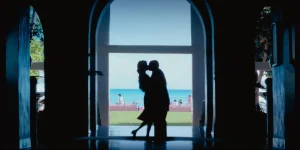
Filming Locations
Saltburn was primarily shot in:
- Drayton House (Northamptonshire, England) – A privately owned historic estate rarely used for filming, providing the perfect backdrop for the Catton family’s aristocratic and decadent lifestyle.
- Additional scenes were shot around Oxford, reinforcing the film’s themes of class hierarchy and elitism.
The choice of these real, untouched estates gives the movie a sense of authenticity and grandeur that CGI could not replicate.
Awards and Nominations
Saltburn received significant awards attention, including:
- Academy Award nominations for Best Actor (Barry Keoghan) and Best Supporting Actor (Jacob Elordi)
- BAFTA nominations, particularly for acting and production design
- Golden Globe nominations for performances and screenplay
It didn’t sweep major categories, but it sparked massive cultural conversation and critical analysis.
Behind the Scenes Insights
- Emerald Fennell intentionally avoided modern technology in the film’s look to make Saltburn feel timeless and eerie.
- Barry Keoghan was the first actor cast; Fennell wrote the role with him in mind.
- The estate’s real owners allowed filming on the condition that the crew did not alter historical rooms.
- The infamous bathtub scene required careful choreography and multiple takes due to its sensitive nature.
- Jacob Elordi improvised several small moments to make Felix feel naturally charming and effortlessly likable.
Inspirations and References
- The film is heavily influenced by Brideshead Revisited, both the Evelyn Waugh novel and its adaptations.
- Patricia Highsmith’s The Talented Mr. Ripley is echoed in Oliver’s calculated social climbing.
- Gothic literature like Rebecca and Jane Eyre also plays a part, especially in the decaying-aristocracy atmosphere.
- Fennell has cited real-life cases of social impostors as partial inspirations.
Alternate Endings and Deleted Scenes
While no fully alternate ending was produced, Fennell has confirmed that:
- Several darker or more explicit scenes were trimmed for pacing.
- There was an extended version of the final dance sequence that was ultimately shortened.
- Additional dialogue from Oliver’s family existed but was removed to preserve the mystery around his backstory.
Book Adaptations and Differences
Saltburn is not based on a book, but its structure and character archetypes closely resemble British class literature and psychological thrillers. Some viewers mistake it for an adaptation because of its very literary storytelling style.


Memorable Scenes and Quotes
Key Scenes
- Oliver watching Felix intensely during their first interactions at Oxford.
- The “birthday dinner” at Saltburn where tensions between the Cattons crack open.
- The bathtub scene, one of the film’s most talked-about moments.
- Oliver digging a grave while covered in mud—symbolic rebirth imagery.
- The final nude dance through the mansion.
Iconic Quotes
- “I thought you might be lonely.”
- “People like us… we’re not built for people like him.”
- “He’s obsessed with you.”
- “I didn’t lie. I just didn’t tell the truth.”
Easter Eggs and Hidden Details
- The symmetrical framing throughout the film subtly hints at Oliver’s calculating, methodical nature.
- Saltburn’s layout resembles a maze—a visual metaphor for Oliver’s manipulations.
- Felix’s casual kindness is contrasted with Oliver’s obsessive stillness in scenes where they share the frame.
- Elspeth’s frequent misremembering of people’s names shows her disconnect from reality and privilege.
- The cat statue that appears in several scenes foreshadows Oliver becoming the new “Catton.”
Trivia
- The final dance was filmed with live playback of the song to get natural timing.
- Emerald Fennell appears in a cameo as a party guest.
- Barry Keoghan lived in near-isolation during filming to stay in Oliver’s psychological state.
- Jacob Elordi’s height difference was intentionally emphasized through camera angles.
Why Watch?
Because Saltburn is both unsettling and irresistibly stylish. Its blend of sharp class commentary, bold eroticism, and psychological tension makes it the kind of film people debate for months. The ending alone is worth the watch—shocking, audacious, and visually unforgettable. It’s a movie that rewards close attention with layers of subtext and slow-burning dread.
Director’s Other Movies
- Promising Young Woman (2020)
- Careful How You Go (2017) – short
- The Ratcatcher (2019) – short
Recommended Films for Fans
- The Talented Mr. Ripley (1999)
- Brideshead Revisited (2008)
- Thoroughbreds (2017)
- Call Me by Your Name (2017)
- We Need to Talk About Kevin (2011)
- Stoker (2013)