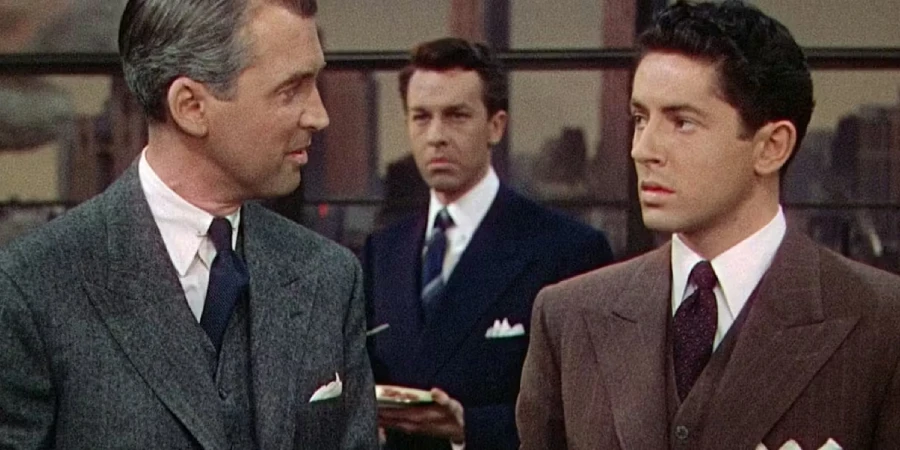

Rope (1948) is one of Alfred Hitchcock’s boldest and most intellectually provocative films. Shot to appear as a single, continuous take, it is a tense psychological thriller that explores arrogance, moral superiority, guilt, and the illusion of control. Though deceptively simple in setting, the film is a masterclass in suspense.
Detailed Summary
The Opening Murder: Crime as an Intellectual Game
The film opens abruptly with Brandon Shaw and Phillip Morgan strangling their former classmate David Kentley with a rope. There is no buildup, no mystery about who committed the crime. Hitchcock immediately shifts the suspense from who did it to will they get away with it.
David’s body is hidden inside a large wooden chest in the living room. In an act of chilling arrogance, Brandon decides to host a dinner party immediately afterward — with the corpse still in the room.
The Dinner Party: Tension Beneath Polite Conversation
Guests arrive, including David’s father, his fiancée Janet, and his former best friend Kenneth. The chest containing David’s body is used as a buffet table, heightening the audience’s anxiety with every casual interaction.
Brandon dominates the conversation, openly discussing theories of intellectual superiority and “justified murder”, ideas he learned from his former professor Rupert Cadell. Phillip, on the other hand, is visibly unraveling, drinking heavily and struggling to maintain composure.
Rupert Cadell Enters: The Moral Catalyst
Rupert, played by James Stewart, arrives late to the party. He once discussed Nietzschean ideas with Brandon and Phillip, never believing they would act on them. Brandon subtly taunts Rupert with philosophical hints, enjoying the danger of exposure.
Rupert begins to notice inconsistencies: David’s unexplained absence, Phillip’s nervous behavior, and Brandon’s unsettling confidence. Suspicion slowly replaces polite curiosity.
Cracks in the Perfect Crime
As the evening progresses, emotional pressure mounts. Janet becomes increasingly distressed by David’s disappearance. Phillip’s anxiety reaches a breaking point when he nearly confesses during a piano performance.
Rupert, now deeply uneasy, stays behind after the guests leave, determined to uncover the truth.
Movie Ending
Rupert confronts Brandon and Phillip directly. He opens the chest and discovers David’s body, confirming his worst fears. Phillip breaks down completely, sobbing and admitting the murder. Brandon, however, remains disturbingly calm and defiant.
Rupert is horrified not only by the murder but by his own role in inspiring it. He condemns Brandon’s belief that intelligence grants moral authority. In a powerful reversal, Rupert fires gunshots out the window to attract attention, symbolically rejecting secrecy and superiority.
The film ends with sirens approaching, signaling inevitable justice. The murderers do not flee or resist; the tension dissolves into grim inevitability. The final moments emphasize responsibility, guilt, and the danger of ideas taken too far.
Are There Post-Credits Scenes?
No. Rope ends definitively with no post-credits scenes or epilogues, consistent with classical Hollywood filmmaking of the era.
Type of Movie
Rope is a psychological thriller with strong elements of crime drama and philosophical suspense, driven more by dialogue and tension than action.
Cast
- James Stewart – Rupert Cadell
- John Dall – Brandon Shaw
- Farley Granger – Phillip Morgan
- Joan Chandler – Janet Walker
- Sir Cedric Hardwicke – Mr. Kentley
- Constance Collier – Mrs. Atwater
Film Music and Composer
The film features minimal musical scoring, relying heavily on natural sound and dialogue. Composer David Buttolph contributed sparse music, allowing silence and ambient noise to heighten tension rather than relieve it.
Filming Locations
The entire film takes place in a single apartment set, built on a soundstage at Warner Bros. Studios in Hollywood. The set was designed with movable walls and hidden camera tracks, allowing Hitchcock to simulate long, uninterrupted takes. The New York skyline backdrop subtly changes lighting to reflect real-time progression from evening to night, reinforcing realism.
Awards and Nominations
Rope did not receive major awards at the time of release. Its experimental nature divided critics, but it has since been reevaluated as one of Hitchcock’s most influential works.
Behind the Scenes Insights
- Hitchcock attempted to make the film look like one continuous shot, limited only by 10-minute film reel lengths.
- Hidden cuts were disguised by moving the camera into dark objects like jackets or furniture.
- Hitchcock later admitted the experiment was intellectually interesting but emotionally restrictive.
- James Stewart reportedly found the long takes extremely demanding, as mistakes meant restarting entire sequences.
Inspirations and References
- Based on the 1929 stage play Rope’s End by Patrick Hamilton
- Loosely inspired by the real-life Leopold and Loeb murder case
- Influenced by Nietzschean philosophy and debates on moral elitism
Alternate Endings and Deleted Scenes
No known alternate endings were filmed. However, the original play was more explicit in its moral condemnation, while Hitchcock chose a more restrained but psychologically devastating conclusion.
Book Adaptations and Differences
The film adaptation simplifies the stage play’s dialogue-heavy structure, relying more on visual tension and performance. Hitchcock also altered character dynamics to better suit cinematic pacing and suspense.

Memorable Scenes and Quotes
Key Scenes
- The opening murder with no musical cue
- The dinner guests unknowingly eating from the chest
- Phillip’s breakdown at the piano
- Rupert opening the chest and discovering the body
Iconic Quotes
- “The power to kill can be just as satisfying as the power to create.”
- “Until you know what this world is about, you can’t judge what it should be.”
Easter Eggs and Hidden Details
- The rope itself is visible multiple times in plain sight after the murder
- The chest is always placed at the visual center of the frame
- Lighting subtly darkens as guilt increases
- Brandon frequently positions himself above others, reinforcing superiority themes
Trivia
- The film contains only about 10 hidden cuts
- Hitchcock appears briefly as a neon sign silhouette in the background
- The entire story unfolds in roughly real time
- Hitchcock reportedly disliked the final result more than audiences did
Why Watch?
Rope is essential viewing if you enjoy psychological tension, moral dilemmas, and bold filmmaking techniques. It’s not about action — it’s about watching confidence crumble and arrogance collapse under its own weight.
Director’s Other Works
- Rebecca (1940)
- Shadow of a Doubt (1943)
- Rear Window (1954)
- Vertigo (1958)
- Psycho (1960)