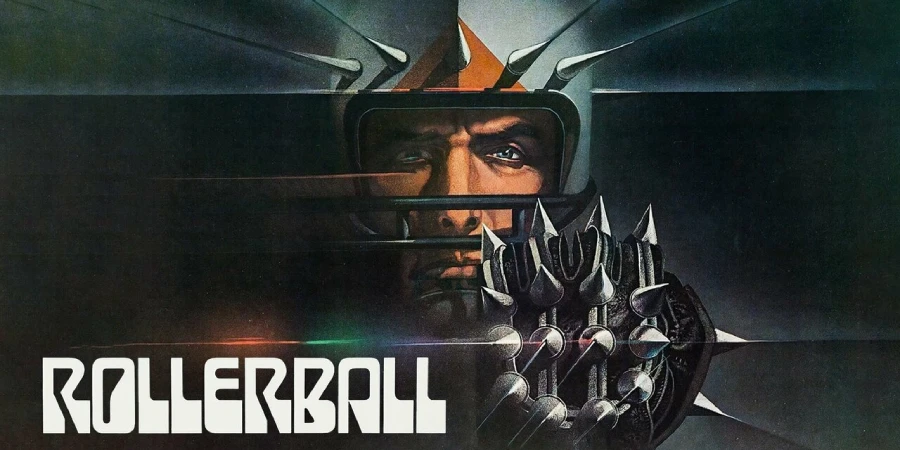

Rollerball (1975), directed by Norman Jewison, is one of sci-fi cinema’s most politically charged films, exploring corporate control, individual freedom, and the dangers of entertainment as a weapon. Set in a dystopian future where the world is ruled not by governments but by corporations, the film centers on a violent sport designed to suppress individualism.
Detailed Summary
A Corporate World Without Nations
The year is 2018. Traditional governments no longer exist. Instead, massive corporations control every aspect of life: housing, food, energy, education, transportation. These corporations promote a violent sport called Rollerball to demonstrate that individual achievement is pointless and that the “team” (a metaphor for conformity) is everything.
The Legendary Player: Jonathan E.
Jonathan E. (James Caan) is a star player on the Houston Rollerball team. His talent and popularity threaten the corporate agenda. Instead of celebrating him, the Energy Corporation—led by the cold Executive, Mr. Bartholomew—attempts to pressure him into retirement. They claim it’s “for the good of the sport,” but the real reason is fear. A champion inspires independent thought.
Escalation and Rule Changes
When Jonathan refuses to quit, the corporations begin modifying the rules to make Rollerball progressively more dangerous. The sport’s already violent nature is amplified. Penalties are removed. Death becomes part of the game. Jonathan realizes he is being targeted—not for punishment, but for symbolic execution in front of the world.
Jonathan’s Personal Loss
Jonathan’s former wife, Ella, was taken from him by corporate decree. In this world, relationships are assigned. She visits him after years apart, but her emotional distance reveals how completely corporations control private lives. This personal tragedy fuels Jonathan’s resistance.


Movie Ending
In the final and most brutal match, Houston plays New York with almost no rules. There are no time limits, no penalties, and no substitutions allowed. The game devolves into a massacre as players die one by one. The crowd expects Jonathan to be killed, completing the corporations’ message: no one is bigger than the system.
However, Jonathan refuses to die.
He survives the relentless attacks and ultimately becomes the only player left standing. Instead of delivering a finishing blow, he circles the rink slowly as the crowd begins chanting his name in a spontaneous rebellion. The cameras linger on Jonathan’s blood-stained face as the realization sets in: the corporations have failed. Individual human strength—and free will—has survived. The film ends with silence, emphasizing the uncertainty of what will happen now that the system has been publicly humiliated.
Are There Post-Credits Scenes?
There is no post-credits scene in Rollerball (1975). The story concludes with the final shot of Jonathan, making that moment the film’s definitive ending.
Type of Movie
The film blends dystopian science fiction with sports action and social critique. It’s both a futuristic thriller and a satire about corporate power and the erasure of individuality.
Cast
- James Caan as Jonathan E.
- John Houseman as Mr. Bartholomew
- Maud Adams as Ella
- John Beck as Moonpie
- Ralph Richardson as Librarian
Film Music and Composer
The soundtrack uses classical music instead of original scoring, giving the film a surreal, ritualistic feel. Pieces include:
- Toccata in D Minor (Bach)
- Symphony No. 5 (Shostakovich)
This choice amplifies the idea that Rollerball is not just a game but a tool of power and public control.

Filming Locations and Their Importance
- Munich, Germany: The Olympic Velodrome served as the Rollerball arena. Its stark architecture enhances the sense of a cold, systematic society.
- BMW Headquarters (Munich): Used for corporate interior shots, symbolizing futuristic and intimidating control.
- Various industrial sites in Germany: Helped emphasize the corporate-dominated landscape.
The European Brutalist architecture communicates a world stripped of warmth, individuality, and emotion.
Awards and Nominations
- Nominated for Best Editing at the BAFTA Awards.
- Praised by critics for its production design and social commentary.
- Though it did not win major awards, it has grown into a cult classic and is considered a pioneer in dystopian sci-fi.
Behind the Scenes Insights
- James Caan described the filming as physically punishing; the Rollerball sequences were almost real contact.
- Some stunt performers were hospitalized due to the violent nature of the game scenes.
- The director insisted on realistic sports choreography, which created the belief that Rollerball could actually become a real sport.
- Norman Jewison intended the film as a warning about corporations replacing governments.
Inspirations and References
- Influenced by George Orwell’s ideas about power and control.
- Reflects concerns of increasing corporate influence in the 1970s.
- Intended as a satire warning against the fusion of mass entertainment and authoritarian systems.
Alternate Endings and Deleted Scenes
- An early draft had Jonathan die, reinforcing the system’s dominance. It was rejected for being too nihilistic.
- Several scenes showing corporate board debates were filmed but cut to maintain a focus on Jonathan’s emotional journey rather than politics alone.
Book Adaptations and Differences
The film led to a novelization by William Harrison, who also wrote the original short story. The book provides deeper internal dialogue, showing Jonathan’s thoughts and fear. The film chooses a more visual approach, using silence and staring crowds to provide emotional weight.

Memorable Scenes and Quotes
Key Scenes
- Jonathan’s retirement meeting where Mr. Bartholomew subtly threatens him.
- Moonpie bragging about how he doesn’t need to think, symbolizing the perfect corporate athlete.
- The library scene, revealing knowledge is restricted, hinting at systemic censorship.
- The final game where rules are stripped away, exposing the true face of corporate power.
Iconic Quotes
- “You must understand: we don’t want a hero.”
- “No player is greater than the game.”
- “The game was created to demonstrate the futility of individual effort.”
These lines are chilling because they reflect real fears about conformity and control.
Easter Eggs and Hidden Details
- The Rollerball helmets resemble corporate logos, symbolizing ownership over athletes’ bodies.
- Energy Corporation’s motto is never spoken, only shown visually on walls, reinforcing subliminal control.
- Jonathan’s home is spacious and luxurious—designed to trap him through comfort, not oppression.
Trivia
- Rollerball sparked controversy because some viewers wanted the violent sport to become real.
- James Caan stated the movie was one of the most physically demanding of his career.
- The film’s producers feared it might inspire copycat leagues, which ironically proved the film’s message.
Why Watch?
Watch Rollerball (1975) if you’re interested in sci-fi that doesn’t just entertain but challenges how societies manipulate people through media and sports. Its grim warning feels even more relevant today. The film asks a difficult but important question: What happens when entertainment becomes a tool of control instead of joy?
Director’s Other Works
- In the Heat of the Night (1967)
- Fiddler on the Roof (1971)
- And Justice for All (1979)
- Moonstruck (1987)
Recommended Films for Fans
- THX 1138 (1971)
- Soylent Green (1973)
- Network (1976)
- Escape from New York (1981)
- The Running Man (1987)