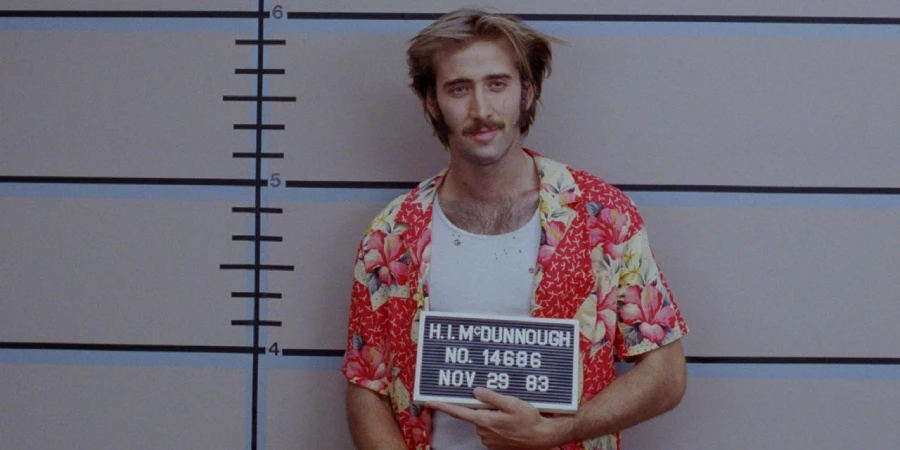

Raising Arizona is a fast-talking, surreal crime comedy from the Coen Brothers that turns a simple premise into a wildly original cinematic experience. Equal parts cartoon logic, emotional sincerity, and anarchic humor, the film has become a cult classic over the decades.
Detailed Summary
The Unlikely Romance of H.I. and Ed
H.I. McDunnough, a repeat petty criminal, meets police officer Edwina “Ed” McDunnough during his many mugshots. Their relationship develops in an unconventional but strangely sincere way. H.I. reforms, Ed quits the police force, and the two get married, determined to build a normal life together.
The Baby Shortage Problem
Their dream hits a wall when they discover Ed cannot have children. Rejected by adoption agencies due to H.I.’s criminal record, the couple spirals into desperation. Meanwhile, a local furniture tycoon, Nathan Arizona, announces the birth of quintuplets, which H.I. and Ed irrationally interpret as “having more than he can handle.”
The Kidnapping Plan
In a moment of morally confused logic, H.I. kidnaps one of the Arizona babies, convincing himself they are giving the child a better home rather than committing a crime. What follows is a cascade of chaos involving escaped convicts, bungled robberies, and increasingly absurd complications.
Enter Leonard Smalls
A mysterious bounty hunter named Leonard Smalls appears, seemingly tracking the stolen baby. He is presented almost like a mythic figure, riding through the desert, armed to the teeth, and delivering ominous monologues. His presence adds a surreal, almost apocalyptic tension to the story.
Everything Spirals Out of Control
H.I.’s criminal past catches up with him as his former prison friends arrive, Ed grows increasingly disillusioned, and the pressure of their lie becomes unbearable. The couple’s attempt at normalcy collapses under the weight of their choices.



Movie Ending
H.I. realizes that their decision to steal the baby was fundamentally wrong, not just legally but morally. After a final confrontation with Leonard Smalls, who is revealed to be more symbolic than literal (a manifestation of H.I.’s guilt, fear, and violent instincts), H.I. escapes with the baby.
He returns the child safely to Nathan Arizona’s home, anonymously correcting the wrong he and Ed committed. Nathan never learns who took the baby, and the family remains intact.
Ed and H.I. reconcile, accepting that they cannot force happiness through desperate acts. The film ends with H.I. describing a dream-like vision of the future, where he imagines himself and Ed surrounded by a large extended family, including children and grandchildren. Importantly, the film does not confirm whether this future will happen. Instead, it leaves the audience with a hopeful but uncertain ending, emphasizing growth, maturity, and the idea that wanting to be good is the first step toward becoming good.
Are There Post-Credits Scenes?
No. Raising Arizona does not include any post-credits or mid-credits scenes. Once the film ends, the story is complete.
Type of Movie
Raising Arizona is a crime comedy with strong elements of absurdist humor and cartoon-like slapstick, balanced by a surprisingly heartfelt emotional core typical of early Coen Brothers films.
Cast
- Nicolas Cage as H.I. McDunnough
- Holly Hunter as Edwina “Ed” McDunnough
- John Goodman as Gale Snoats
- William Forsythe as Evelle Snoats
- Trey Wilson as Nathan Arizona Sr.
- Randall “Tex” Cobb as Leonard Smalls
Film Music and Composer
The score was composed by Carter Burwell, beginning a long-term collaboration with the Coen Brothers. The music blends banjo-driven Americana with frenetic orchestral cues, perfectly matching the film’s manic energy and Southern Gothic tone.


Filming Locations
The movie was filmed primarily in Arizona, including Phoenix and surrounding desert areas.
These locations are crucial to the film’s identity, reinforcing its dusty, sunburned, almost mythic version of the American Southwest. The wide desert landscapes amplify the film’s themes of isolation, lawlessness, and exaggerated Americana.
Awards and Nominations
While Raising Arizona did not receive major awards upon release, it gained significant critical appreciation over time. Holly Hunter’s performance was widely praised, and the film is now frequently cited in retrospectives of the Coen Brothers’ most influential works.
Behind the Scenes Insights
- The Coen Brothers wrote the script specifically with Nicolas Cage in mind.
- Many action scenes were staged like silent-era slapstick comedies.
- Carter Burwell had never scored a feature film before this project.
- The exaggerated dialogue rhythm was carefully rehearsed to sound musical rather than naturalistic.
- The bounty hunter character was designed as a symbolic figure, not a traditional antagonist.
Inspirations and References
The film draws inspiration from:
- Classic Looney Tunes-style slapstick
- Southern Gothic storytelling traditions
- Depression-era crime films
- Folklore archetypes, particularly the “wandering devil” figure
Alternate Endings and Deleted Scenes
No alternate ending has been officially released. However, several minor character scenes were trimmed to maintain the film’s pacing. Early drafts reportedly explored a darker ending, but the Coens opted for a more hopeful conclusion.
Book Adaptations and Differences
Raising Arizona is an original screenplay and is not based on a book. However, its structure and tone feel literary, borrowing heavily from myth, parable, and oral storytelling traditions.


Memorable Scenes and Quotes
Key Scenes
- H.I.’s extended convenience store robbery chase
- The baby kidnapping sequence with escalating absurdity
- Leonard Smalls emerging from a dust storm like a demon
- The final dream monologue about family and legacy
Iconic Quotes
- “We’re fixing to start a family.”
- “Son, you got a panty on your head.”
- “Sometimes I get the menstrual cramps real hard.”
Easter Eggs and Hidden Details
- Leonard Smalls’ name references biblical and apocalyptic imagery.
- Repeated circular imagery symbolizes cycles of crime and redemption.
- Many background characters mirror H.I.’s possible futures.
- The baby’s name is never revealed, emphasizing universality.
Trivia
- Nicolas Cage did many of his own stunts.
- The film was a box office disappointment initially but grew into a cult classic.
- The Coens wrote the script while experiencing writer’s block on another project.
- Holly Hunter learned her accent by listening to real police radio recordings.
Why Watch?
Because Raising Arizona is funny, fast, weird, and unexpectedly touching. It’s a perfect example of how comedy can be both ridiculous and deeply human, and it showcases the Coen Brothers at their most playful.
Director’s Other Works
- Blood Simple (1984)
- Miller’s Crossing (1990)
- Fargo (1996)
- The Big Lebowski (1998)
- No Country for Old Men (2007)
Recommended Films for Fans
- O Brother, Where Art Thou? (2000)
- Burn After Reading (2008)
- A Serious Man (2009)
- After Hours (1985)
- Badlands (1973)