Carl Theodor Dreyer’s Ordet is not a film you simply watch; it’s an experience you endure. Consequently, its final, astonishing scene feels less like a plot twist and more like a seismic event. This film patiently explores the chasm between institutional religion and personal, childlike faith, ultimately rewarding those who can wait through its deliberate pace.
Detailed Summary
The Divided Families
The story begins on a farm in rural West Jutland, Denmark, owned by the Borgen family. The devout patriarch, Morten Borgen, holds a deep, life-affirming faith tied to the teachings of N.F.S. Grundtvig. In contrast, his local rival, Peter the Tailor, leads a much stricter, more somber congregation. A deep sectarian rift, therefore, divides their two families. This division becomes a major problem when Morten’s youngest son, Anders, announces he is in love with Peter’s daughter, Anne, and wishes to marry her. Peter immediately rejects the proposal, citing the Borgens’ “worldly” faith as spiritually corrupt.
Johannes’s Madness
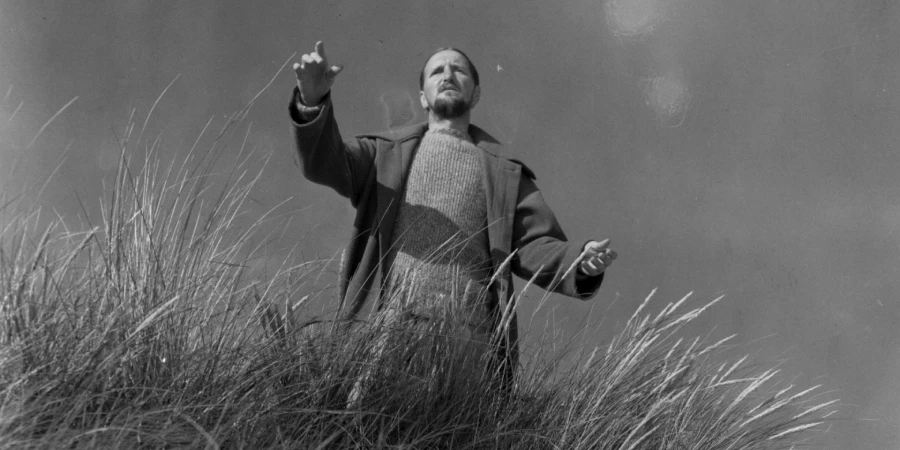
Meanwhile, the Borgen household deals with a crisis of a different sort. The middle son, Johannes, once a promising theology student, has gone mad from studying Søren Kierkegaard. He now believes he is Jesus Christ, wandering the windswept moors and speaking in parables. Morten’s eldest son, Mikkel, an agnostic, is married to the gentle and deeply faithful Inger. Inger, however, is the only one who treats Johannes with consistent compassion, truly embodying the Christian love that others only preach.
Inger’s Difficult Labor
Inger, pregnant with her third child, goes into a difficult labor. The doctor is summoned and warns that the birth is dangerous. As the family prays, Morten, in a moment of desperation, agrees to let Anders marry Anne if God spares Inger’s life. He even travels to Peter’s house to reconcile and seal the deal. Peter, moved by Morten’s humility, finally consents to the marriage. However, their joy is short-lived. The doctor returns with tragic news: the baby was stillborn, and Inger’s own life hangs precariously in the balance.
The Aftermath of Grief
Despite the doctor’s best efforts, Inger dies. Her death plunges the Borgen farm into a state of profound, silent grief. Morten’s faith is shattered; he feels God has betrayed their bargain. Mikkel, who had always relied on Inger’s faith, is now completely lost. Interestingly, during the height of the tragedy, Johannes disappears. He later returns, seemingly cured of his madness but stripped of his divine delusions. He is now just a man, quiet and shell-shocked by the recent events.


Movie Ending
The ending of Ordet is one of the most debated and powerful in cinema history. During Inger’s wake, as friends and family gather around her open casket, the proceedings are somber and procedural. Suddenly, Inger’s young daughter, Maren, approaches Johannes. She reminds him of a promise he made—that if she had enough faith, God could bring her mother back. Her innocent belief rekindles something within Johannes.
Filled with a newfound, pure faith, Johannes approaches the coffin. He is no longer the man who thought he was Jesus; instead, he is a man asking Jesus for a miracle. Then he delivers a simple, powerful prayer asking God to give Inger back her life. He then speaks the titular “word” (Ordet in Danish), commanding Inger to arise. For a long, tense moment, nothing happens. Then, Inger’s finger twitches. Her eyes slowly open. She sits up, alive and well.
Mikkel rushes to her side, embracing her as his lost faith is restored. Morten and Peter watch in stunned silence, their sectarian squabbles rendered meaningless by the impossible event. The film concludes as Inger and Mikkel share a kiss, a testament to the power of life, love, and a faith so profound it can bend reality itself.
Are There Post-Credits Scenes?
No, there are no post-credits scenes in Ordet. The film concludes definitively with the resurrection of Inger. True to the filmmaking style of its era, once the credits roll, the story is complete.
Type of Movie
Ordet is a spiritual drama. Its tone is overwhelmingly austere, meditative, and minimalist. Director Carl Theodor Dreyer uses a deliberately slow pace and long, unbroken takes to immerse the audience in the stark emotional and physical landscape of his characters. The film is not about action; rather, it is about the internal struggles of faith, doubt, and grief. Consequently, its atmosphere is heavy with silence and contemplation, making the final miraculous event all the more impactful.
Cast
- Henrik Malberg – Morten Borgen
- Emil Hass Christensen – Mikkel Borgen
- Preben Lerdorff Rye – Johannes Borgen
- Cay Kristiansen – Anders Borgen
- Birgitte Federspiel – Inger Borgen
- Ejner Federspiel – Peter the Tailor
- Gerda Nielsen – Anne
- Ann Elisabeth Groth – Maren Borgen
Film Music and Composer
The film’s score, credited to composer Poul Schierbeck, is used with extreme restraint. In fact, Ordet is notable for its near absence of non-diegetic music. The soundscape consists almost entirely of diegetic sounds: the ticking of a grandfather clock, the howling wind, conversation, and hymns sung by the characters. This sonic minimalism forces the viewer to focus on the dialogue and the heavy silences between words. The only significant musical piece is the hymn sung at Inger’s wake, which grounds the scene in grim reality before the miracle occurs.

Filming Locations
Dreyer shot Ordet on location in and around the village of Vedersø in West Jutland, Denmark. This choice was highly significant. The original playwright, Kaj Munk, served as a priest in that exact village, and the film’s stark, flat landscapes were his home. As a result, shooting there lent the film an unparalleled sense of authenticity. The desolate beauty of the moors and the spartan design of the farmhouses become characters in their own right, reflecting the internal spiritual state of the families.
Awards and Nominations
Ordet achieved significant international acclaim upon its release. Its most prestigious award was the Golden Lion at the 1955 Venice Film Festival. In addition, it won the 1956 Golden Globe Award for Best Foreign Language Film. It is now widely considered one of the greatest films ever made and a cornerstone of Danish cinema.
Behind the Scenes Insights
- Director Carl Theodor Dreyer was a notorious perfectionist. He reportedly forced actor Preben Lerdorff Rye (Johannes) to repeat lines hundreds of times to achieve the exact tone he desired.
- The film is famous for its long, fluid camera movements. Dreyer meticulously planned each shot, creating a style that feels both theatrical and intensely cinematic.
- The interior of the Borgen farmhouse was a set built specifically for the film, but Dreyer insisted it be designed with absolute fidelity to a real Jutland farmhouse of the period.
- Actress Birgitte Federspiel (Inger) had to lie perfectly still in the coffin for the long takes of the final scene, a feat of physical discipline.
Inspirations and References
The film is a direct adaptation of the 1925 play Ordet by Kaj Munk. Munk was a Danish playwright and Lutheran pastor who was executed by the Gestapo in 1944 for his fierce opposition to the Nazi occupation of Denmark. His play explored the tensions between different factions within the Church of Denmark and argued for a simple, powerful faith. Dreyer was deeply reverent of Munk’s work and sought to translate its spiritual power to the screen faithfully.
Alternate Endings and Deleted Scenes
There are no known alternate endings or significant deleted scenes for Ordet. Carl Theodor Dreyer was a director known for his precise and uncompromised vision. He filmed exactly what he intended to use, and the final cut of the film is considered his definitive version. Therefore, the narrative viewers see today is the only one that was ever completed.
Book Adaptations and Differences
Ordet is based on a play, not a book. Dreyer’s film is remarkably faithful to Kaj Munk’s 1925 stage play. The characters, dialogue, and plot structure remain largely intact. The primary difference, however, lies in the medium itself. Dreyer’s masterful use of cinematography—his slow-panning camera, stark lighting, and minimalist compositions—transforms the theatrical source material into something uniquely cinematic. He uses the camera to create a mood of spiritual suspense that a stage production could not replicate as effectively.

Memorable Scenes and Quotes
Key Scenes
- Inger’s Death: The scene is handled with harrowing quietness. After the doctor fails to save her, the camera lingers on the faces of the grieving family members, capturing their silent devastation. The moment the grandfather clock stops is particularly chilling, symbolizing the end of life and time in the house.
- The Resurrection: The film’s climax is an unforgettable sequence of sustained tension. Johannes’s calm prayer, the agonizing wait, and Inger’s slow awakening are captured in a long, mesmerizing take that challenges both the characters’ and the audience’s disbelief.
Iconic Quotes
- Johannes: “I am the light of the world. He who follows me shall not walk in darkness but shall have the light of life.”
- The Doctor: “Death is a fact. A fact is a fact.”
- Morten: “I’ve become a doubter. It may sound strange, but there’s a certain freedom in that.”
- Johannes: “Give me the word! The word that can bring the dead back to life.”
Easter Eggs and Hidden Details
- The Stopping Clock: When Inger dies, the large grandfather clock in the main room audibly stops ticking. This is a classic cinematic metaphor, symbolizing that the heart of the home has ceased to beat.
- Light and Shadow: Dreyer uses lighting to symbolize a character’s spiritual state. For instance, Inger is often bathed in a soft, warm light, while the arguments between Morten and Peter take place in more harshly lit or shadowed rooms.
- Johannes’s Return to Sanity: When Johannes returns after Inger’s death, his hair is neatly combed and he is dressed differently. This visual shift subtly signals his return from perceived madness to a state of lucid grief before his final act of faith.
Trivia
- This was Carl Theodor Dreyer’s penultimate film and his first since Day of Wrath (1943), a gap of over a decade.
- Actor Henrik Malberg, who played the patriarch Morten Borgen, was nearly 80 years old during filming.
- The film’s visual style, known as “transcendental style” by critic Paul Schrader, has been highly influential on directors like Ingmar Bergman and Andrei Tarkovsky.
- Despite its heavy religious themes, the film was a major financial and critical success in secular Denmark.
Why Watch?
Watch this film for its sheer, uncompromising power. Ordet is a demanding and patient work that rewards you with one of cinema’s most astonishing and emotionally resonant endings. It will test your skepticism and stay with you for days.
Director’s Other Movies
- The Passion of Joan of Arc (1928)
- Vampyr (1932)
- Day of Wrath (1943)
- Gertrud (1964)
Recommended Films for Fans
- The Seventh Seal (1957)
- Winter Light (1963)
- Andrei Rublev (1966)
- Stalker (1979)
- First Reformed (2017)