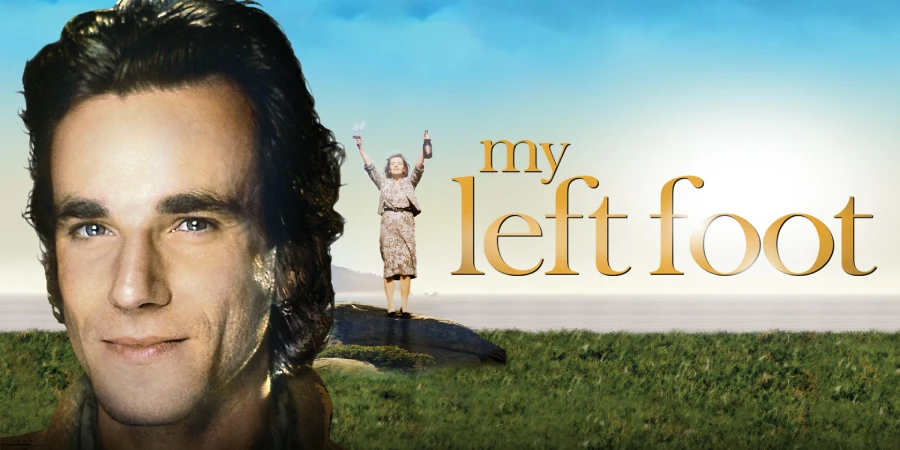

A foot is not the ideal instrument for human expression. However, for Irish artist and writer Christy Brown, it was his only tool. My Left Foot chronicles his exceptional life with a raw honesty that avoids sentimentality. Consequently, the film delivers one of cinema’s most powerful stories of resilience.
Detailed Summary
A Challenging Beginning
The film begins by introducing Christy Brown, born into a sprawling, poor Dublin family in 1932. He is diagnosed with severe cerebral palsy. Doctors, in fact, tell his parents he is a “mental defective” and suggest institutionalizing him. His father, a hard-drinking bricklayer named Mr. Brown, struggles to connect with a son he cannot understand. In contrast, his mother, the indefatigable Mrs. Brown, refuses to give up on Christy, sensing a sharp mind trapped within his uncontrollable body.
The First Word
Years pass with Christy unable to communicate, largely confined to a corner of the bustling family home. Then, one fateful day, he sees his sister struggling with her lessons. Driven by an intense desire, he seizes a piece of chalk with his left foot, the only part of his body he can somewhat control. Consequently, he scrawls the word “MOTHER” on the floor. This single act shatters the family’s perception of him. Furthermore, his father, overwhelmed with pride, carries him to the local pub to celebrate his “genius” son.
Adolescence and Isolation
As a teenager, Christy’s world remains limited despite his newfound ability to write and draw with his foot. He experiences profound loneliness and the raw frustrations of adolescence. For instance, he develops a crush on a local girl, only to be heartbroken when she moves on. He desperately wants to contribute to the family. Therefore, he painstakingly directs his brothers in building a study for his mother, only to have them take all the credit. His father, however, recognizes Christy’s effort and again carries him to the pub, a gesture of respect and inclusion.
Meeting Dr. Eileen Cole
Christy’s life transforms with the arrival of Dr. Eileen Cole, a dedicated therapist. She recognizes his sharp intellect and artistic talent. Importantly, she begins a rigorous regimen of physical and speech therapy. Dr. Cole pushes him to speak, using his first guttural word—”fuck”—as a victory. Moreover, she organizes an art exhibition for his paintings, introducing him to a world beyond his Dublin neighborhood.
Artistic Expression and First Love
Under Dr. Cole’s guidance, Christy blossoms as a painter. His work gains recognition, yet his emotional life remains turbulent. He develops deep romantic feelings for Eileen, misinterpreting her professional care for personal affection. At a celebratory dinner following his successful exhibition, he prepares to confess his love. He is utterly devastated, however, when Eileen announces she is engaged to the gallery owner. Christy reacts with rage and despair, creating an intensely uncomfortable scene before his father carries him home.
Descent and Redemption
Following this rejection, Christy falls into a deep depression, becoming a belligerent alcoholic. His bitterness alienates his family. In a particularly low moment, his family hosts a party to celebrate his father’s retirement, but Christy’s foul mood casts a pall over the event. Tragically, his father suffers a fatal stroke during the party. Later, Christy, consumed by grief and drink, nearly chokes to death. This near-death experience serves as a wake-up call. Because of this, he resolves to channel his pain into writing his autobiography, My Left Foot.

Movie Ending
The film’s ending frames the entire narrative. We return to the present, where a clean-shaven and well-dressed Christy is attending a charity benefit in his honor. He is being cared for by a nurse named Mary Carr. Initially, he is sullen and difficult, but Mary is unphased by his attitude. She matches his sharp wit with her own. During their banter, she accidentally spills a drink on him. As a result, they retreat to a quiet study to clean up. In this intimate moment, Christy, emboldened by her spirit, asks her on a date. She playfully agrees, sealing the deal with a kiss on his cheek.
The film concludes with on-screen text revealing that Christy and Mary married and were together until his death. Ultimately, the ending is a powerful testament to new beginnings and the idea that love and companionship can be found at any stage of life.
Are There Post-Credits Scenes?
No, My Left Foot does not have any post-credits scenes. The film concludes entirely before the credits roll, which was standard practice for movies from this era.
Type of Movie
My Left Foot is a biographical drama. Its tone is remarkably unsentimental and gritty. The film steadfastly refuses to romanticize disability or poverty. Instead, it presents a raw, honest portrait of a complex man and his working-class family. Despite the harsh realities it depicts, the film is ultimately inspirational and laced with a sharp, dark Irish wit that provides moments of levity.
Cast
- Daniel Day-Lewis – Christy Brown
- Brenda Fricker – Mrs. Bridget Brown
- Ray McAnally – Mr. Paddy Brown
- Fiona Shaw – Dr. Eileen Cole
- Hugh O’Conor – Young Christy Brown
- Ruth McCabe – Mary Carr
Film Music and Composer
The poignant and understated musical score for My Left Foot was composed by the legendary Elmer Bernstein. Bernstein, known for iconic scores like The Magnificent Seven and To Kill a Mockingbird, created a theme that is both melancholic and hopeful. The simple, flute-led main theme perfectly captures Christy’s inner world. Consequently, the music enhances the emotional depth of the story without ever becoming overly sentimental or manipulative.


Filming Locations
The movie was filmed almost entirely on location in Dublin, Ireland. Director Jim Sheridan chose to shoot in actual working-class neighborhoods, such as Ballyfermot. In addition, scenes were filmed in the nearby coastal towns of Bray and Killiney. This commitment to authenticity was crucial. As a result, the grim, cramped, and rain-swept Dublin streets ground the film in a tangible reality, making the Brown family’s struggles and triumphs feel all the more visceral and real.
Awards and Nominations
My Left Foot was a critical triumph, earning numerous accolades. Most notably, at the 62nd Academy Awards, Daniel Day-Lewis won his first Oscar for Best Actor for his transformative performance. In addition, Brenda Fricker won the Oscar for Best Supporting Actress for her powerful portrayal of Mrs. Brown. The film also received nominations for Best Picture, Best Director (Jim Sheridan), and Best Adapted Screenplay.
Behind the Scenes Insights
- Daniel Day-Lewis remained in character for the entire duration of the shoot. He stayed in his wheelchair between takes, and crew members had to lift him over equipment and spoon-feed him. This intense method acting caused him to break two ribs from maintaining the hunched-over posture.
- Director Jim Sheridan felt a deep personal connection to the story, having grown up in a similar Dublin environment. Consequently, he insisted on casting many local Dubliners in smaller roles to enhance the film’s authenticity.
- The paintings featured in the film were not created by Day-Lewis’s foot. They were, in fact, painted by artist Gene Lambert, who worked closely with the production to replicate Christy Brown’s style and subject matter.
- Ray McAnally, who delivered a powerful performance as Christy’s father, sadly passed away from a heart attack before the film was released. His role was praised posthumously.
Inspirations and References
The film is based entirely on the true story of its protagonist, Christy Brown (1932–1981). The screenplay, written by Shane Connaughton and Jim Sheridan, is a direct adaptation of Brown’s own 1954 autobiography of the same name, My Left Foot. The book chronicles his early life and struggles to communicate and create.
Alternate Endings and Deleted Scenes
There are no known official alternate endings or significant deleted scenes available to the public for My Left Foot. The theatrical cut is considered the definitive version of the film, and director Jim Sheridan has not indicated that any major narrative elements were left on the cutting room floor.
Book Adaptations and Differences
The film is adapted from Christy Brown’s autobiography, My Left Foot. While largely faithful to the spirit of the book, the filmmakers made several key changes for cinematic effect. For instance, the book focuses almost exclusively on Christy’s childhood and ends when he is a young adult. The film, in contrast, condenses the timeline and adds events from Brown’s later life, particularly his romance with his wife, Mary Carr, who he wrote about in his later novel, Down All the Days. Furthermore, the character of Dr. Eileen Cole is a composite based on several people who helped Christy, including Dr. Robert Collis.
Memorable Scenes and Quotes
Key Scenes
- Writing “MOTHER”: The pivotal moment where young Christy grabs the chalk with his foot, proving to his family for the first time that a vibrant mind exists within his body. It is a scene of pure, unadulterated triumph.
- The Pub: After the “MOTHER” scene, Christy’s father hoists him onto his shoulders and carries him to the boisterous local pub, proudly declaring him a “genius.” This scene beautifully encapsulates their complicated but loving relationship.
- Restaurant Meltdown: Christy’s heartbreaking and furious reaction to Dr. Cole’s engagement announcement is a raw, difficult-to-watch display of unrequited love and deep-seated frustration.
- The Final Date: The charming and witty exchange between Christy and Mary Carr at the end provides a hopeful, forward-looking conclusion to his story, showing that his life is far from over.
Iconic Quotes
- Mr. Brown: “This is Christy Brown, my son. Genius.”
- Christy Brown (voiceover): “I was born in the Rotunda Hospital on June 5th, 1932. The 10th of my mother’s 22 children. Of whom 13 survived. It was the feet that mattered. A family chronicle was stored in my mother’s feet.”
- Mrs. Brown: “I’ve had 22 children, and I’ve never regretted one of them.”
- Christy Brown (to Dr. Cole): “Congratulations to the happy couple. May they have a happy and fruitful union. And may they be afflicted with a terrible disease.”
Easter Eggs and Hidden Details
- Art Imitating Life: Many of the paintings shown in the film are faithful recreations of Christy Brown’s actual artwork, capturing his distinctive style and subject matter.
- Symbolic Confinement: Director Jim Sheridan frequently uses tight framing, cramped doorways, and small rooms to visually represent Christy’s physical confinement, making his eventual emotional and artistic liberation all the more powerful.
- Authentic Dublin Slang: The script is filled with authentic Dublin slang and idioms from the period, adding another layer of realism to the setting and characters. On the other hand, this required subtitling in some markets.
Trivia
- The film’s budget was so small that director Jim Sheridan and producer Noel Pearson had to defer their own fees to get it made.
- Hugh O’Conor, who brilliantly played the young Christy, learned to write with his left foot for the role.
- Brenda Fricker was so convinced she would not win the Oscar that she did not prepare an acceptance speech and was genuinely shocked when her name was called.
- The real Christy Brown could actually speak with more clarity than depicted in the film, but the filmmakers chose to emphasize his difficulty to highlight his profound daily struggle.
Why Watch?
This film is a masterclass in performance and storytelling. Watch for Daniel Day-Lewis’s legendary commitment and Brenda Fricker’s powerhouse support. It is a raw, funny, and profoundly moving story of human spirit, told without a drop of pity.
Director’s Other Movies
- The Field (1990)
- In the Name of the Father (1993)
- The Boxer (1997)
- In America (2002)
- Brothers (2009)
Recommended Films for Fans
- The Diving Bell and the Butterfly (2007)
- The Theory of Everything (2014)
- Awakenings (1990)
- A Beautiful Mind (2001)
- The Sessions (2012)