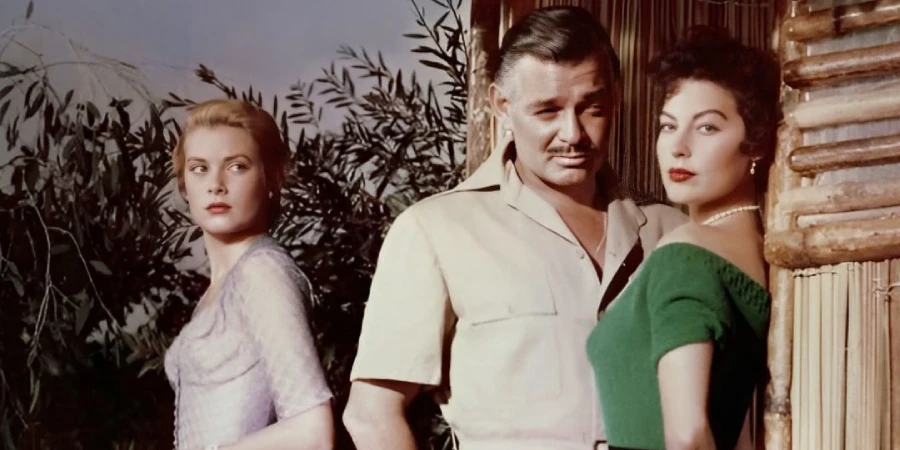

Technicolor jungles and sizzling romantic tension define Mogambo as a high-stakes adventure of the heart. Clark Gable returns to familiar territory as a rugged white hunter caught between two very different women. This remake of Red Dust swaps a rubber plantation for the African wilderness to create a visually stunning masterpiece.
Detailed Summary
An Unexpected Arrival
Victor Marswell runs a thriving safari business in Kenya. Eloise Kelly, a brash American socialite, arrives at his camp by mistake. She was supposed to meet a wealthy maharajah who has already departed. Consequently, she finds herself stranded in the middle of the bush with the cynical Victor.
Their interaction starts with sharp barbs and mutual annoyance. However, a romantic spark quickly develops between the two lonely travelers. Victor appreciates her toughness, while Eloise finds his rugged charm irresistible. Their brief fling hits a massive roadblock when the Nordleys arrive for a planned expedition.
The Research Expedition
Donald Nordley is a British anthropologist hoping to study gorillas in the wild. He brings his refined and icy wife, Linda, along for the dangerous journey. Victor is immediately struck by Linda’s elegance and quiet beauty. He soon loses interest in the boisterous Eloise as he focuses on his new client’s wife.
Eloise watches with growing jealousy as Victor and Linda grow closer. Moreover, the group begins a long trek into the interior regions of the continent. Tension simmers beneath the surface as the expedition encounters wild animals and harsh weather. Linda finds herself falling for Victor, despite her marriage to the oblivious Donald.
A Dangerous Triangle
The group eventually reaches the gorilla territory high in the mountains. Here, the emotional stakes reach a boiling point. Linda and Victor share secret glances and quiet moments away from the group. Consequently, Eloise uses her sharp wit to mock the budding affair and highlight the betrayal.
Victor realize that Linda belongs in a refined world he cannot provide. On the other hand, Linda is prepared to leave her husband for the life of a hunter’s wife. She confronts Victor about their future during a high-stress moment in the camp. This confrontation sets the stage for a violent and emotional climax.

Movie Ending
Linda shoots Victor in a fit of passionate rage after he purposefully insults her character. He staged a drunken scene with Eloise to convince Linda that he is a heartless scoundrel. This noble lie works, as it forces Linda back into the arms of her loyal husband. Donald remains entirely unaware that his wife tried to kill her lover.
Eloise witnesses the entire event and helps cover up the shooting. She tells the Nordleys that Victor was simply being his usual drunken self. Victor recovers from the flesh wound as the Nordleys depart for their home. He finally realizes that Eloise is the only woman who truly understands his rough lifestyle.
The closing moments see him chasing down Eloise before she can board her boat. Together, they stand on the riverbank, ready to face the African wilderness as a couple. Their shared experience in the jungle solidified a bond that transcends their initial bickering. Ultimately, Victor finds his match in a woman who matches his own fiery spirit.
Are There Post-Credits Scenes?
No post-credits scenes exist in this production. This film follows the standard industry practices of the 1950s. The story concludes definitively before the final title card appears.
Type of Movie
This film is a classic adventure-romance set against an exotic backdrop. It blends the excitement of a high-budget safari with the intimacy of a melodrama. The tone is often gritty but maintains the polished glamour typical of Metro-Goldwyn-Mayer features.
Cast
- Clark Gable – Victor Marswell
- Ava Gardner – Eloise “Honey Bear” Kelly
- Grace Kelly – Linda Nordley
- Donald Sinden – Donald Nordley
- Philip Stainton – John J. Brown-Pryce
- Eric Pohlmann – Leon Boltchak
- Laurence Naismith – Skipper
Film Music and Composer
Robert Katscher is credited with the main theme, though the film relies heavily on authentic African sounds. Unlike many dramas of the era, the production lacks a traditional sweeping orchestral score. Instead, the soundtrack features local tribal music and natural ambient noise to heighten the realism. This choice creates a more immersive and raw atmosphere for the viewing audience.

Filming Locations
The production moved to Kenya, Uganda, and Tanganyika to capture authentic landscapes. These actual locations provide a scale that no Hollywood backlot could ever replicate. Specifically, the crew filmed near the Okavango River to show the beauty of the diverse wildlife. Using real locations added significant physical challenges but ensured the film’s lasting visual legacy.
Awards and Nominations
The film earned two Academy Award nominations in 1954. Both Ava Gardner and Grace Kelly received nods for their acting performances. Additionally, Grace Kelly won a Golden Globe for her supporting role.
Behind the Scenes Insights
- Clark Gable contracted a serious throat infection during the lengthy African shoot.
- John Ford reportedly had a difficult relationship with the cast due to his legendary temper.
- The crew had to deal with intense heat and local political unrest during filming.
- Ava Gardner spent her free time learning about the local cultures and the surrounding environment.
- Production required a massive caravan of vehicles to transport equipment through the jungle.
Inspirations and References
The primary inspiration for this movie is the 1932 film Red Dust. Interestingly, Clark Gable starred in that original version over two decades earlier. The story is an adaptation of a play written by Wilson Collison. While the original took place in Vietnam, the studio moved this version to Africa to capitalize on contemporary interest in the continent.
Alternate Endings and Deleted Scenes
Censorship boards forced significant changes to the romantic dynamics. In the original script, the adultery was much more explicit. To satisfy the Hays Code, the filmmakers emphasized that the affair was more emotional than physical. No publicly available alternate endings survive, as the studio followed the approved screenplay strictly.
Book Adaptations and Differences
This film is not based on a novel. It stems directly from a 1928 stage play. The movie expands the scope of the play by introducing the vast safari elements and the gorilla hunt. Consequently, the cinematic version feels much larger than the claustrophobic stage production.

Memorable Scenes and Quotes
Key Scenes
- The tense encounter where a leopard threatens Eloise in the camp.
- The dramatic climax where Linda fires a pistol at an unarmed Victor.
- A scenic riverboat sequence that establishes the burgeoning chemistry between the leads.
- The intense hunt for the gorillas in the misty mountain forests.
Iconic Quotes
- “I’m the only thing in this jungle that doesn’t have a price tag.”
- “Don’t worry about me. I’ve been thrown out of better places than this.”
- “I think I’ve been waiting for you all my life.”
Easter Eggs and Hidden Details
- The name Mogambo is actually a Swahili word meaning “passion,” though some sources suggest it was a creative invention.
- Clark Gable wears outfits nearly identical to his wardrobe in the original 1932 film.
- Real members of the Samburu tribe appear as extras throughout the camp scenes.
- Look closely at the animal footage, as some shots were repurposed from nature documentaries.
Trivia
- Gene Tierney was the original choice for the role of Linda Nordley.
- Grace Kelly began a real-life romance with Clark Gable during the production.
- The film was one of the highest-grossing movies of 1953.
- Ava Gardner performed many of her own stunts involving the local wildlife.
Why Watch?
Gable and Gardner provide some of the best chemistry in Hollywood history. The breathtaking scenery of the African bush remains a visual marvel decades later. Witnessing two legendary actresses compete for the same man is pure cinematic gold. This movie represents the pinnacle of old-school studio filmmaking at its finest.
Director’s Other Movies
- The Searchers (1956)
- The Grapes of Wrath (1940)
- Stagecoach (1939)
- The Man Who Shot Liberty Valance (1962)
- The Quiet Man (1952)
Recommended Films for Fans
- Red Dust (1932)
- King Solomon’s Mines (1950)
- The African Queen (1951)
- Out of Africa (1985)
- The Snows of Kilimanjaro (1952)