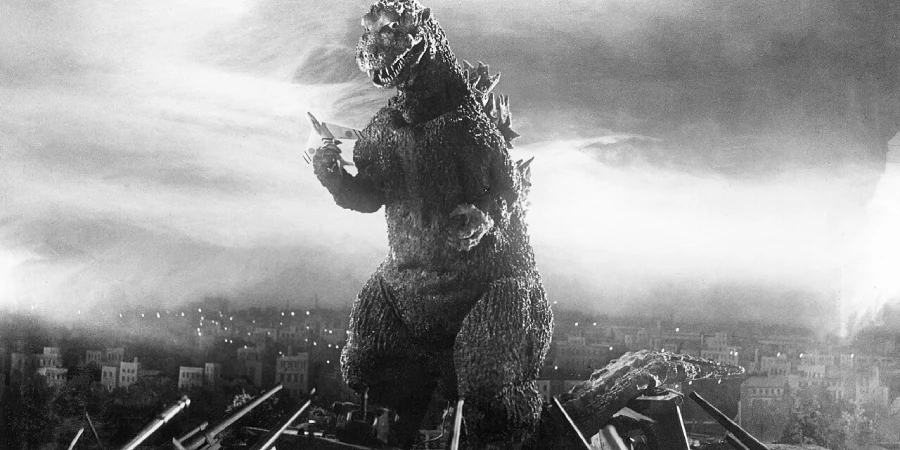

Godzilla (1954), originally titled Gojira, is not just a monster movie. It is a cinematic landmark that introduced the kaiju genre to the world and transformed a radioactive nightmare into one of cinema’s most enduring icons. Beneath the destruction and spectacle lies a powerful reflection on nuclear trauma, post-war fear, and human responsibility.
Detailed Summary
The Mystery at Sea
The film opens with a disturbing series of events in the Pacific Ocean. Fishing vessels are suddenly destroyed by blinding flashes of light. Survivors report intense heat and massive waves, echoing real-life nuclear test incidents of the early 1950s.
Soon after, another ship disappears completely.
These unexplained disasters alarm Japanese authorities and draw the attention of scientists.
First Appearance of Godzilla
When strange seismic activity strikes Odo Island, villagers speak of an ancient legend about a monster named Godzilla, believed to punish humanity when balance is disturbed.
During a stormy night, the creature appears for the first time. Its enormous head rises over the village as it demolishes homes and kills livestock. This moment is deliberately brief but unforgettable, emphasizing terror rather than spectacle.
Scientific Investigation
Paleontologist Dr. Kyohei Yamane investigates the island and discovers that Godzilla is a prehistoric creature awakened and mutated by hydrogen bomb testing.
His findings are crucial:
- Godzilla survived the dinosaur extinction.
- Nuclear radiation drastically increased its size and power.
- Its body emits lethal radiation.
Dr. Yamane warns that using weapons against Godzilla may only worsen the cycle of destruction.
The Ethical Divide
Japan faces a moral dilemma.
- The military wants to destroy Godzilla immediately.
- Scientists fear further nuclear escalation.
- The public panics as news spreads.
This conflict mirrors post-war Japan’s struggle between survival and pacifism.
Meanwhile, Dr. Yamane’s daughter Emiko is secretly engaged to scientist Dr. Daisuke Serizawa, a man hiding a terrifying invention known as the Oxygen Destroyer, capable of annihilating all life in water.
Godzilla Attacks Tokyo
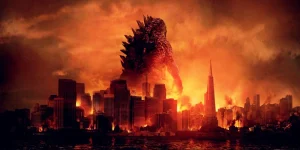
Godzilla emerges from Tokyo Bay and begins one of the most haunting destruction sequences in film history.
Key moments include:
- Trains crushed like toys
- Buildings collapsing in flames
- Godzilla’s atomic breath melting steel towers
- Hospitals overflowing with injured civilians
The imagery intentionally parallels Hiroshima and Nagasaki, with scenes resembling burned ruins and radiation victims.
This sequence defines the film’s emotional weight.
Humanity’s Last Hope
Conventional weapons fail completely. Godzilla shrugs off artillery and electrical barricades.
As Tokyo lies in ruins, Emiko reveals Serizawa’s secret weapon to the authorities, believing it is humanity’s only chance.
Serizawa is horrified.
He fears his invention will become another nuclear weapon if replicated. The moral burden weighs heavily on him.
Movie Ending
The final act is somber, tragic, and deeply symbolic.
Serizawa agrees to use the Oxygen Destroyer only once, on the condition that his research dies with him.
A naval mission is launched to Tokyo Bay. Godzilla rests beneath the water.
Serizawa and Emiko descend in diving suits.
When Godzilla awakens, Serizawa activates the device. The Oxygen Destroyer rapidly dissolves all oxygen in the surrounding water.
Godzilla rises in agony, thrashing violently before finally collapsing. His body disintegrates into a skeletal remains, then vanishes entirely.
Before the weapon activates fully, Serizawa cuts his own oxygen line, sacrificing himself so that no one can ever recreate his invention.
Above the surface, the sea boils and falls silent.
Godzilla is dead.
The film closes not in celebration, but mourning.
Dr. Yamane delivers the final warning:
“If nuclear testing continues, another Godzilla may appear somewhere in the world.”
The ending offers no triumph, only reflection and unease.
Are There Post-Credits Scenes?
No. Godzilla (1954) has no post-credits scenes. The film ends definitively after its final message, reinforcing its grave and cautionary tone.
Type of Movie
Godzilla is a science fiction disaster film that blends horror, kaiju spectacle, and political allegory, using monster cinema as a vehicle to explore the consequences of nuclear warfare.
Cast
- Takashi Shimura as Dr. Kyohei Yamane
- Akira Takarada as Hideto Ogata
- Momoko Kōchi as Emiko Yamane
- Akihiko Hirata as Dr. Daisuke Serizawa
Film Music and Composer
The music was composed by Akira Ifukube, whose thunderous orchestral themes became inseparable from Godzilla’s identity.
His score uses heavy brass and percussion to evoke:
- Military dread
- Ancient terror
- The weight of unstoppable force
The Godzilla theme remains one of the most recognizable motifs in film history.
Filming Locations
The movie was filmed primarily in Tokyo and Toho Studios, Japan.
Miniature sets recreated:
- Tokyo Tower
- Ginza district
- Urban rail systems
These detailed models allowed destruction to feel horrifyingly real, reinforcing post-war imagery familiar to Japanese audiences.
Awards and Nominations
At the time of release, Godzilla received:
- Japanese Movie Award for Best Special Effects
- Retrospective recognition as one of the most important films in Japanese cinema history
Its cultural importance far outweighs traditional award recognition.
Behind the Scenes Insights
- Godzilla actor Haruo Nakajima wore a 100 kg rubber suit in extreme heat.
- Filming inside the suit often caused fainting.
- The suit was made from molten rubber poured over concrete molds.
- Miniatures were built at extremely high detail to withstand close-up filming.
- Director Ishirō Honda insisted on treating the monster seriously, never comedically.
Inspirations and References
- The atomic bombings of Hiroshima and Nagasaki
- The 1954 Lucky Dragon No. 5 nuclear testing incident
- Japanese folklore of sea gods and dragons
- American monster films such as The Beast from 20,000 Fathoms (1953)
Alternate Endings and Deleted Scenes
No alternate ending was filmed.
However, early drafts considered:
- Godzilla surviving and returning to the sea
- Military victory instead of Serizawa’s sacrifice
Honda rejected these ideas to preserve the film’s anti-nuclear message.
Book Adaptations and Differences
The film inspired numerous novelizations, but it was not based on a book.
Later adaptations often removed or softened the nuclear allegory, especially in American versions, focusing more on spectacle than symbolism.

Memorable Scenes and Quotes
Key Scenes
- Godzilla’s first reveal during the storm
- Tokyo Tower melting under atomic breath
- Children singing in a hospital shelter
- Serizawa cutting his oxygen line underwater
Iconic Quotes
- “Monsters are tragic beings. They are born too tall, too strong, too heavy.”
- “If we keep testing bombs, another Godzilla may appear.”
Easter Eggs and Hidden Details
- Godzilla’s skin texture is modeled after keloid burn scars of atomic bomb survivors.
- The Geiger counter sound is used repeatedly to emphasize radiation.
- Godzilla’s roar was created by rubbing a leather glove across a double bass string.
- The monster’s slow movement was intentional to resemble unstoppable natural disasters.
Trivia
- Godzilla’s height was scaled to match Tokyo Tower’s planned construction height.
- The original film is significantly darker than later sequels.
- The American 1956 version removed key anti-nuclear dialogue.
- Godzilla appears on Japanese cultural heritage lists as a symbolic character.
Why Watch?
You should watch Godzilla (1954) because it is:
- A masterclass in meaningful science fiction
- A powerful anti-war statement disguised as a monster film
- The foundation of the entire kaiju genre
- Still emotionally effective despite its age
This is not a popcorn movie. It is a cinematic warning.
Director’s Other Works
- The Mysterians (1957)
- Rodan (1956)
- Mothra (1961)
- Destroy All Monsters (1968)
Recommended Films for Fans
- Rodan (1956)
- Mothra (1961)
- Gamera, the Giant Monster (1965)
- Shin Godzilla (2016)
- Godzilla Minus One (2023)