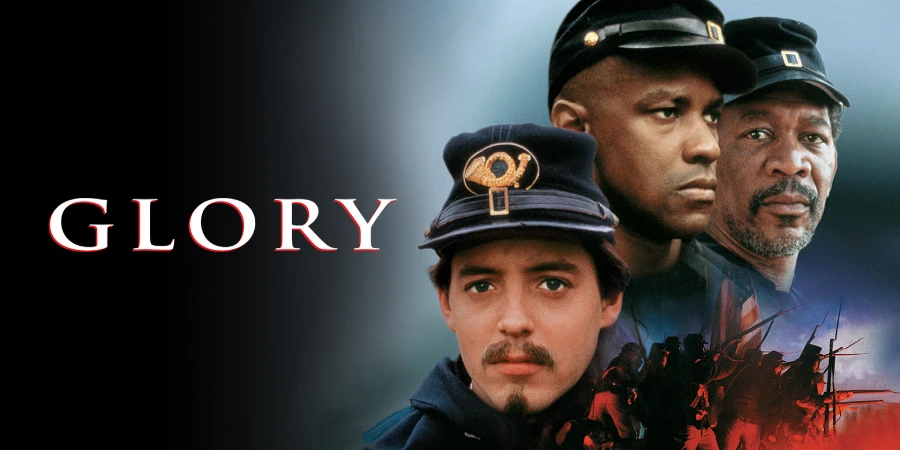

Glory (1989), directed by Edward Zwick, is one of the most acclaimed war dramas ever made, centered on the 54th Massachusetts Infantry Regiment, the first African American regiment in the U.S. Civil War. The film blends historical detail with emotional storytelling, highlighting courage, sacrifice, and the harsh realities of racism within and outside the army.
Detailed Summary
The Battle of Antietam: A Young Officer Reborn
The film opens with the Battle of Antietam, where young Union officer Robert Gould Shaw (Matthew Broderick) is wounded. The brutality he witnesses marks a turning point in his life. After surviving the battle, he is eventually offered command of the newly formed 54th Massachusetts Infantry, composed of African American soldiers.
Training the 54th: Discipline, Dignity, and Resistance
Shaw accepts command, joined by his friend Major Cabot Forbes (Cary Elwes). The regiment includes key characters such as Trip (Denzel Washington), Rawlins (Morgan Freeman), and Thomas (Andre Braugher). Training is severe, with Shaw enforcing strict discipline, believing the regiment must prove itself equal to white soldiers.
This section reveals deep tension: racism from military superiors, reduced pay, and the pressure to perform flawlessly.
Conflict and Brotherhood
As the men grow as soldiers, internal conflicts also surface. Trip’s anger, Thomas’s idealism, and Rawlins’s quiet leadership shape the atmosphere. Over time, Shaw begins to respect the men deeply and advocates fiercely for their rights, refusing unequal pay and demanding proper supplies.
First Missions: Proving Their Worth
The 54th earns its reputation through smaller missions, including a successful skirmish at Darien, Georgia. Shaw sees the dangerous hypocrisy of Union officers who use the regiment for looting or risky assignments, and he becomes increasingly determined to give his men the chance they deserve: a real battle.


Movie Ending
The final act centers on the assault on Fort Wagner, one of the most dramatic and heartbreaking sequences in war-film history.
Shaw volunteers the 54th to lead the attack, aware that this means almost certain death. The night before the battle, the soldiers gather around a campfire, sharing their fears, hopes, and prayers. This moment is among the film’s most emotionally powerful scenes.
During the assault, Shaw is shot and killed while trying to inspire the troops up the beach. The men of the 54th, including Trip, Rawlins, and Thomas, charge forward under intense enemy fire. Despite reaching the fort’s parapet, they are overwhelmed. Trip famously dies while attempting to raise the American flag after Shaw falls, a symbolic attempt to rally the regiment.
The next morning, Confederate soldiers bury the Black soldiers in a mass grave, Shaw included, placed beside the men he fought to honor. Though the attack fails militarily, the bravery of the 54th helps turn Northern public opinion toward greater Black enlistment, contributing significantly to the Union cause.
Are There Post-Credits Scenes?
No. Glory ends with its final historical notes on screen, and there are no post-credits scenes.
Type of Movie
This is a historical war drama that blends fact and cinematic storytelling to portray the emotional and political significance of the first Black Union regiment.
Cast
- Matthew Broderick as Colonel Robert Gould Shaw
- Denzel Washington as Private Trip
- Morgan Freeman as Sergeant Major John Rawlins
- Cary Elwes as Major Cabot Forbes
- Andre Braugher as Thomas Searles
- Jihmi Kennedy as Jupiter Sharts
Film Music and Composer
The score was composed by James Horner, known for his powerful orchestral sound. The music combines emotional choir arrangements and stirring military themes, contributing significantly to the film’s emotional weight. The Boys Choir of Harlem provided the unforgettable choral vocals.

Filming Locations
The movie was filmed in Georgia and Florida, with Fort Wagner sequences shot on Jekyll Island, Georgia.
These locations provided authentic sandy beaches, marshlands, and Civil War-era landscapes necessary for accurately portraying battlefields. The natural terrain helps immerse viewers in the soldiers’ harsh environment, emphasizing the realism of the film’s final assault.
Awards and Nominations
- Academy Awards:
- Won: Best Supporting Actor (Denzel Washington)
- Won: Best Cinematography
- Won: Best Sound
- Nominated: Best Art Direction
- Golden Globes:
- Nominated: Best Supporting Actor (Denzel Washington)
- Widely praised by critics, often listed among the greatest war films.
Behind the Scenes Insights
- Denzel Washington insisted on performing emotionally intense scenes in one take to maintain authenticity.
- The whipping scene was done only three times, and Washington’s tears were real—not caused by physical pain, but emotional immersion.
- To prepare, the actors trained in military drills daily, living in camp-like conditions.
- Matthew Broderick studied Shaw’s personal letters and diaries to portray him accurately.
- Director Edward Zwick insisted on historic accuracy in uniforms, weapons, and drills.
Inspirations and References
The film is based on true events and uses:
- Shaw’s real letters (published as Blue-Eyed Child of Fortune)
- Historical research on the 54th Massachusetts
- Harold Holzer’s writings on Civil War Black regiments
- The book “One Gallant Rush“ by Peter Burchard
Alternate Endings and Deleted Scenes
No alternate ending is known to exist, but several scenes were trimmed, including:
- More development of Shaw’s early internal conflicts
- Additional camp-life sequences
- Extended character moments for the supporting soldiers
These were removed primarily for pacing.
Book Adaptations and Differences
The film adapts One Gallant Rush, but also incorporates Shaw’s actual letters. Differences include:
- Some composite characters (Trip, Rawlins, Jupiter) are fictionalized but represent real social dynamics.
- Trip’s storyline is dramatized for emotional impact.
- Shaw’s portrayal is softened slightly; the real Shaw was stricter and more formal.
- The film compresses timelines for narrative clarity.


Memorable Scenes and Quotes
Key Scenes
- The whipping of Trip, and Rawlins comforting him afterward
- The regiment tearing up their unequal pay slips
- Thomas proving his bravery under fire despite being inexperienced
- The campfire prayer before the final assault
- The final charge at Fort Wagner
Iconic Quotes
- “Give ‘em hell, 54th!”
- “Ain’t much a matter what happens tomorrow. Cause we men.”
- “If this war is to be won, it will take more than bullets. It will take dignity.”
- “You are the only family I got.”
Easter Eggs and Hidden Details
- The letters Shaw writes in the film are based on real excerpts from his historic correspondence.
- The 54th’s uniforms are almost exact replicas of preserved originals.
- Trip’s name is symbolic; it reflects his emotional “journey” from anger to acceptance.
- The mass grave shown at the end mirrors the real burial layout documented after the battle.
Trivia
- Denzel Washington won his first Oscar for this role.
- The actors had to perform real bayonet drills under former marines.
- The film was one of the first major movies to spotlight Black soldiers in the Civil War.
- Morgan Freeman’s character is loosely inspired by several historical soldiers.
Why Watch?
Because Glory is not just a war film; it is a deeply human, historically grounded, emotionally devastating exploration of courage. If you’re drawn to films that are honest, stirring, and beautifully acted, this one leaves a mark that lasts long after the credits roll.
Director’s Other Movies
- About Last Night (1986)
- Legends of the Fall (1994)
- Courage Under Fire (1996)
- The Last Samurai (2003)
- Defiance (2008)
- Blood Diamond (2006)
Recommended Films for Fans
- Saving Private Ryan (1998)
- Gettysburg (1993)
- Lincoln (2012)
- Amistad (1997)
- 12 Years a Slave (2013)
- The Hurt Locker (2008)