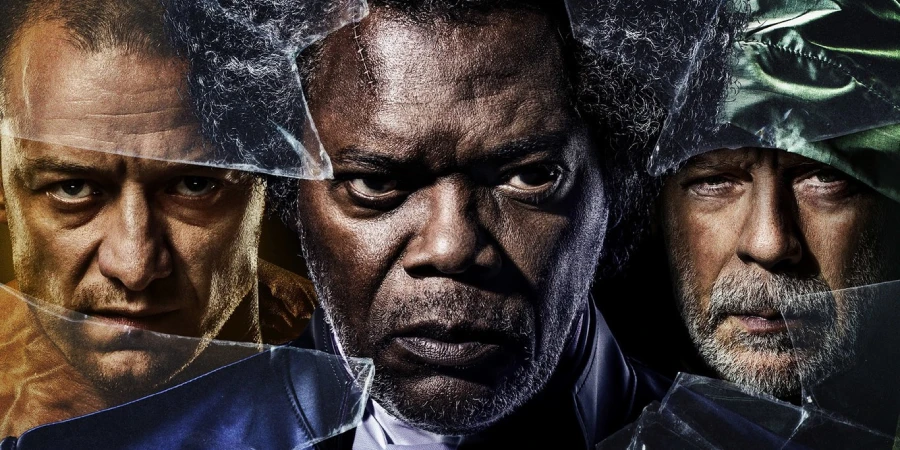

Glass (2019) is the final chapter of M. Night Shyamalan’s Eastrail 177 Trilogy, following Unbreakable (2000) and Split (2016). It’s a grounded, psychological superhero film that deliberately avoids flashy action in favor of themes like belief, identity, and control. Some fans found it bold, others frustrating—but it is undeniably a conversation starter.
Detailed Summary
The Return of David Dunn
The film opens with David Dunn (Bruce Willis) continuing his secret vigilante work, tracking criminals while running a security business with his son Joseph. His search leads him to Kevin Wendell Crumb, whose multiple personalities—including The Beast—are once again active.
The Capture of Three “Superhumans”
David confronts Kevin, resulting in a destructive fight that draws police attention. Both men are captured and taken to a psychiatric hospital, where Elijah Price (Mr. Glass) has already been confined for years. This brings all three central figures together for the first time.
Dr. Ellie Staple and the Question of Reality
At the hospital, Dr. Ellie Staple (Sarah Paulson) attempts to convince the trio that their perceived superhuman abilities are merely delusions caused by trauma and mental illness.
Her therapy sessions form the psychological core of the film, asking a disturbing question:
What if believing you’re special is the real disease?
Manipulation from the Shadows
Although heavily sedated and seemingly powerless, Mr. Glass begins orchestrating events, manipulating staff, patients, and even the narrative itself. Slowly, cracks appear in Dr. Staple’s logic, and the characters begin reclaiming belief in who they are.
The Promise of Revelation
Elijah convinces Kevin and David that their true purpose is not escape, but public revelation. He engineers a final confrontation outside the hospital—one meant to prove the existence of superhumans to the world.
Movie Ending
The final act takes place in a parking lot outside the psychiatric facility.
David Dunn fights The Beast, while Elijah watches from his wheelchair, satisfied that his plan is unfolding.
However, the ending is intentionally anti-climactic and brutal:
- David Dunn is drowned by a regular security officer, not defeated by a supervillain. His death emphasizes the film’s theme that heroes don’t always get glorious endings.
- Kevin Wendell Crumb is shot and killed, but not before his original personality briefly resurfaces, sharing an emotional goodbye with Casey Cooke.
- Elijah Price is beaten to death, smiling as he dies—because his plan succeeded.
The twist: Dr. Ellie Staple is not just a psychiatrist. She is part of a secret organization dedicated to suppressing superhumans to keep society stable.
However, Elijah anticipated this. Before dying, he secretly uploaded footage of the parking-lot fight to the internet.
In the closing scenes:
- Joseph Dunn, Casey Cooke, and Elijah’s mother watch the footage spread worldwide.
- Superhumans are exposed to the public.
- Elijah’s lifelong belief—that extraordinary people exist and deserve to be known—is finally validated.
The trilogy ends not with triumph, but with truth, loss, and a quiet sense of inevitability.
Are There Post-Credits Scenes?
No. There are no mid-credits or post-credits scenes in Glass. The story concludes definitively within the film itself.
Type of Movie
Glass is a psychological superhero thriller that blends drama and mystery. Instead of traditional comic-book spectacle, it focuses on belief systems, trauma, and deconstruction of hero mythology.
Cast
- Bruce Willis – David Dunn
- James McAvoy – Kevin Wendell Crumb / The Horde
- Samuel L. Jackson – Elijah Price / Mr. Glass
- Sarah Paulson – Dr. Ellie Staple
- Anya Taylor-Joy – Casey Cooke
- Spencer Treat Clark – Joseph Dunn
- Charlayne Woodard – Mrs. Price
Film Music and Composer
The score was composed by West Dylan Thordson, who also worked on Split. The music is minimalistic and tense, emphasizing unease rather than heroism. Silence is often used as effectively as sound.

Filming Locations
- Philadelphia, Pennsylvania – Continues the grounded, urban realism established in Unbreakable
- Allentown State Hospital (exteriors) – Used to portray the psychiatric facility
These locations reinforce the idea that superhuman stories can exist in ordinary, unglamorous places.
Awards and Nominations
- Saturn Awards – Nominated for Best Thriller Film
- BMI Film & TV Awards – Music recognition
While not heavily awarded, the film is often discussed critically for its subversive storytelling choices.
Behind-the-Scenes Insights
- M. Night Shyamalan self-financed the film to maintain creative control.
- James McAvoy played over 20 distinct personalities, each with unique posture and voice.
- Bruce Willis had limited dialogue due to health considerations, influencing the character’s quiet presence.
- The ending was planned from the start of the trilogy, not retrofitted.
Inspirations and References
- Comic book realism rather than fantasy
- Joseph Campbell’s hero mythology
- Real-world psychiatric skepticism of extraordinary claims
- Shyamalan’s desire to deconstruct superhero narratives
Alternate Endings and Deleted Scenes
- Early drafts featured a larger-scale public battle, later removed to preserve thematic intent.
- Several therapy scenes were shortened to improve pacing.
- No officially released alternate ending exists.
Book Adaptations and Differences
Glass is not based on a novel, but on Shyamalan’s original screenplay universe. However, it draws heavily from comic book structure, particularly the idea of secret histories and suppressed truths.

Memorable Scenes and Quotes
Key Scenes
- Kevin’s personalities arguing in the mirrored room
- Elijah orchestrating chaos while pretending to be sedated
- David’s quiet death, subverting superhero expectations
Iconic Quotes
- Elijah Price: “This was always going to end this way.”
- Dr. Staple: “You believe because you want to.”
- Kevin: “We are not a mistake.”
Easter Eggs and Hidden Details
- The security company name references Eastrail 177.
- Comic book color symbolism mirrors each character’s identity.
- The hospital ward numbers match comic panel layouts.
- Elijah’s final plan mirrors his speech from Unbreakable.
Trivia
- The trilogy spans nearly 19 years.
- Samuel L. Jackson insisted Elijah remain physically fragile.
- The film uses fewer CGI shots than most superhero movies.
- Shyamalan appears briefly, continuing his cameo tradition.
Why Watch?
Watch Glass if you appreciate:
- Bold narrative risks
- Superhero stories without fantasy escapism
- Films that challenge audience expectations
It may not be satisfying in a traditional sense, but it is intellectually provocative and emotionally resonant.
Director’s Other Works (Movies)
- Unbreakable (2000)
- Signs (2002)
- The Village (2004)
- Split (2016)
- Old (2021)
- Knock at the Cabin (2023)