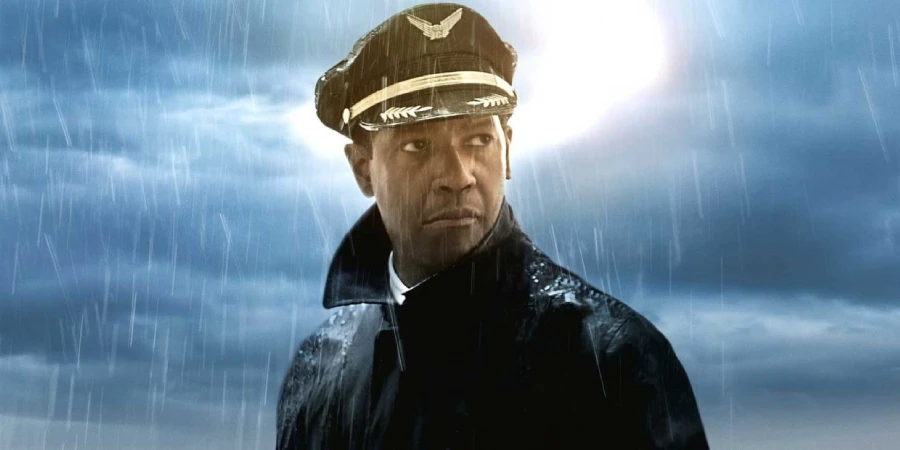

Captain Whip Whitaker pulls off an impossible feat. He miraculously lands a passenger jet that has gone into an uncontrollable dive. He saves nearly everyone on board. However, Whip is also a high-functioning alcoholic and drug addict, a truth that turns his heroic act into a complex moral crisis.
Detailed Summary
The In-flight Emergency
The film opens with Captain Whip Whitaker waking up in an Orlando hotel room. He is hungover after a night with flight attendant Katerina Marquez. Before heading to the airport for SouthJet Flight 227, he mixes a drink and snorts a line of cocaine to steady himself.
Once in the air, Whip discreetly adds vodka to his orange juice. A violent mechanical failure soon sends the plane into a terrifying nosedive. Acting on pure instinct and skill, Whip makes a stunning decision: he inverts the aircraft to arrest the dive. This maneuver allows him to glide the plane to a crash landing in an open field, saving 96 of the 102 souls on board.
The Hero Awakens
Whip awakens in an Atlanta hospital with minor injuries. His old friend Charlie Anderson, who represents the airline’s pilots’ union, informs him that he is being hailed as a national hero. Consequently, Whip learns a toxicology report revealed high levels of alcohol and cocaine in his system.
Charlie introduces him to a sharp lawyer, Hugh Lang. Hugh warns Whip that he could face criminal charges and life in prison if the NTSB proves he was intoxicated. The heroism of his flight maneuver, therefore, becomes secondary to his personal failings.
The Meeting with Nicole
Restless and craving a cigarette, Whip sneaks out of his hospital room. In a stark, empty stairwell, he meets Nicole Maggen. She is a photographer recovering from a heroin overdose that brought her to the same hospital.
They share a moment of quiet understanding. Both are at rock bottom, grappling with their respective addictions. This brief but powerful connection sets the stage for their intertwined journeys.
Hiding from the World
To escape the media frenzy, Whip retreats to his late father’s secluded farm. Solitude does not bring sobriety; instead, he empties his house of all alcohol but continues to deny his problem. He contacts his flamboyant drug dealer, Harling Mays, for supplies.
Whip also finds Nicole and invites her to stay at the farm. He hopes to help her stay clean, creating a fragile, codependent relationship. Nicole recognizes his alcoholism, but Whip aggressively deflects her attempts to help him.
The Investigation Heats Up
Meanwhile, NTSB investigator Ellen Block leads a meticulous inquiry. She is determined to uncover the truth behind the crash, regardless of Whip’s public image. Whip’s co-pilot, Ken Evans, awakens from a coma and tells his wife about his suspicions of Whip’s drinking.
A key piece of evidence surfaces: two empty miniature vodka bottles found in the plane’s trash. Though they belong to Whip, they are initially attributed to Katerina Marquez, who died in the crash. Hugh Lang plans to use this to discredit the toxicology report against Whip.
Rock Bottom
Whip’s refusal to confront his addiction destroys his relationship with Nicole. After a particularly nasty drunken argument, she leaves him and checks into a sober living community. Subsequently, Whip tries to reconnect with his estranged son and ex-wife, but his belligerent and intoxicated state only deepens their rift.
Hugh Lang successfully gets Katerina’s toxicology report voided on a technicality. The case now hinges solely on the two vodka bottles. Hugh is confident he can secure Whip’s freedom, provided Whip stays completely sober until the final hearing.
The Hearing
The night before the hearing, the airline sequesters Whip in a guarded hotel room. The room connects to an adjacent room with a fully stocked, unlocked minibar. After a long internal battle, Whip succumbs and goes on an epic bender, found unconscious the next morning.
In a panic, Charlie and Hugh call Harling Mays. Harling arrives with cocaine, which he uses to jolt Whip into a state of functional alertness just in time for the hearing. Whip, now high but appearing composed, walks into the hearing room, seemingly ready to lie his way to freedom.
Movie Ending
At the final National Transportation Safety Board hearing, everything goes according to plan. Hugh Lang expertly dismantles the prosecution’s case. He establishes that no one saw Whip drink on the day of the flight. The only remaining question is about the two empty vodka bottles found in the plane’s trash.
Investigator Ellen Block poses the final, crucial question. She asks Whip if he believes it’s possible the deceased flight attendant, Katerina Marquez, drank the vodka. This is his moment to lie and walk free, placing the blame on a dead woman. Whip hesitates, looks at a picture of Katerina, and his facade cracks. He confesses everything.
He admits to drinking the vodka. Furthermore, he admits to being drunk while flying the plane and on many other occasions. In a moment of absolute clarity, Whip declares, “I’m an alcoholic.” The film then jumps forward thirteen months. Whip, now in federal prison, is leading an Alcoholics Anonymous meeting for his fellow inmates. He seems sober, at peace, and is rebuilding his relationship with his son, who visits to interview him for a college essay about “the most fascinating person I’ve never met.” Ultimately, Whip finds true freedom not in evading the law, but in accepting the truth.
Are There Post-Credits Scenes?
No, Flight does not have any post-credits or mid-credits scenes. Once the credits begin to roll, the film is officially over.
Type of Movie
Flight is a gripping psychological drama. It centers on a complex character study rather than the spectacle of its opening disaster sequence. The tone is intense and somber, exploring heavy themes of addiction, denial, truth, and what it means to be a hero.
Cast
- Denzel Washington – William “Whip” Whitaker Sr.
- Don Cheadle – Hugh Lang
- Kelly Reilly – Nicole Maggen
- John Goodman – Harling Mays
- Bruce Greenwood – Charlie Anderson
- Melissa Leo – Ellen Block
- Brian Geraghty – Ken Evans
- Tamara Tunie – Margaret Thomason
- Nadine Velazquez – Katerina Marquez
Film Music and Composer
The film’s score was composed by the legendary Alan Silvestri, a frequent collaborator with director Robert Zemeckis. Interestingly, Silvestri’s original score is used sparingly. Most of the film’s soundtrack consists of licensed pop, rock, and soul tracks.
Songs like Joe Cocker’s “Feelin’ Alright” and The Rolling Stones’ “Sympathy for the Devil” are used to powerful effect. This choice roots the story in a tangible, messy reality that reflects Whip’s chaotic inner state.


Filming Locations
Flight was filmed almost entirely in and around Atlanta, Georgia. This real-world setting added a layer of authenticity to the story. Key locations included a stretch of land near Hampton, Georgia, which stood in for the crash site.
The production also utilized a real church for a funeral scene and built the hospital sets on a stage. This grounding in ordinary, suburban American locations provides a stark contrast to the extraordinary drama of Whip’s life.
Awards and Nominations
Flight received significant critical acclaim, particularly for its screenplay and central performance. The film earned two major Academy Award nominations.
Notably, Denzel Washington was nominated for Best Actor, and John Gatins was nominated for Best Original Screenplay. Washington also received nominations at the Golden Globes and Screen Actors Guild Awards for his powerful portrayal of Whip Whitaker.
Behind the Scenes Insights
- Flight marked director Robert Zemeckis’s return to live-action filmmaking after a 12-year period focused on performance-capture animated films like The Polar Express (2004) and A Christmas Carol (2009).
- The harrowing crash sequence was created using a combination of practical effects and CGI. A full-scale interior of the plane’s fuselage was built on a complex gimbal rig that could rotate 360 degrees to simulate the inversion.
- Denzel Washington thoroughly researched the role. He consulted with commercial airline pilots and also spent time with recovering alcoholics to understand the mindset of addiction and denial.
- The original screenplay by John Gatins spent over a decade in development hell before Zemeckis and Washington signed on.
Inspirations and References
While the screenplay for Flight is an original work by John Gatins, the specifics of the plane crash bear a striking resemblance to a real-life tragedy. The mechanical failure depicted in the film is similar to what caused the crash of Alaska Airlines Flight 261 in 2000.
In that incident, a failure of the horizontal stabilizer’s jackscrew assembly sent the plane into a dive. The pilots, like Whip, attempted to fly the plane inverted to regain control before it crashed into the Pacific Ocean, killing all 88 people on board. The film adapts this technical scenario for its fictional narrative.
Alternate Endings and Deleted Scenes
There are no known alternate endings for Flight. Director Robert Zemeckis and writer John Gatins were firm in their vision for Whip’s confession as the story’s necessary conclusion. The theatrical cut of the film is considered the definitive version, with no significant scenes reported to have been cut from the final product.
Book Adaptations and Differences
Flight is not based on a book. It is an original screenplay written by John Gatins, who drew on some of his own personal experiences and years of research to craft the story of Whip Whitaker.
Memorable Scenes and Quotes
Key Scenes
- The Inversion: The terrifying opening sequence where Whip, fueled by adrenaline and instinct, rolls the plane upside down to stop its dive. It’s a masterclass in tension and technical filmmaking.
- The Hospital Stairwell: Whip and Nicole’s first meeting. It is a quiet, powerful scene where two strangers, broken by addiction, find a brief moment of connection and understanding.
- Harling’s Revival: John Goodman’s electrifying scene as Harling Mays, who uses rock music and cocaine to jolt a drunken Whip into coherence for his hearing. It’s both comedic and deeply unsettling.
- The Confession: The final hearing where Whip, given an easy lie to save himself, chooses to tell the truth. It is the defining moment of his redemption.
Iconic Quotes
- “No one could have landed that plane like I did.” – Whip Whitaker
- “I drank the liquor. And I’m an alcoholic.” – Whip Whitaker
- “Don’t you ever touch me again… you motherless liquor-pimp!” – Harling Mays
- “That was God’s hand. For a man who doesn’t believe in God, you’ve sure been touched by him.” – Charlie Anderson
Easter Eggs and Hidden Details
- When Harling Mays first arrives to give Whip his drug supply, The Rolling Stones’ “Sympathy for the Devil” plays on his car stereo, perfectly summarizing his character’s role.
- In the hospital, while Whip is flipping through TV channels, a brief clip from Robert Zemeckis’s earlier film, Cast Away (2000), is visible on the screen.
- When Nicole leaves the hotel room after her overdose, she leaves behind a Bible with a note inside that Whip had given her. It contains a phone number for a support group, a lifeline Whip himself refused to take.
Trivia
- This was director Robert Zemeckis’s first R-rated film in over 30 years. His last was the comedy Used Cars in 1980.
- Screenwriter John Gatins drew upon his own past struggles with alcoholism when writing the script, which lent a layer of raw authenticity to Whip’s character.
- To ensure accuracy, the filmmakers consulted extensively with the National Transportation Safety Board (NTSB) and active airline pilots during production.
- The song “Feelin’ Alright” by Joe Cocker plays twice in the film: once near the beginning when Whip is high, and again over the end credits when he has found sobriety.
Why Watch?
Watch for a towering, Oscar-nominated performance from Denzel Washington. Flight is a riveting and morally complex character study that masterfully questions the nature of heroism. It is an unforgettable journey from a spectacular crash to a personal salvation.
Director’s Other Movies
- Back to the Future (1985)
- Who Framed Roger Rabbit (1988)
- Forrest Gump (1994)
- Contact (1997)
- Cast Away (2000)
- The Polar Express (2004)
Recommended Films for Fans
- The Verdict (1982)
- Leaving Las Vegas (1995)
- Thank You for Smoking (2005)
- Crazy Heart (2009)
- Sully (2016)