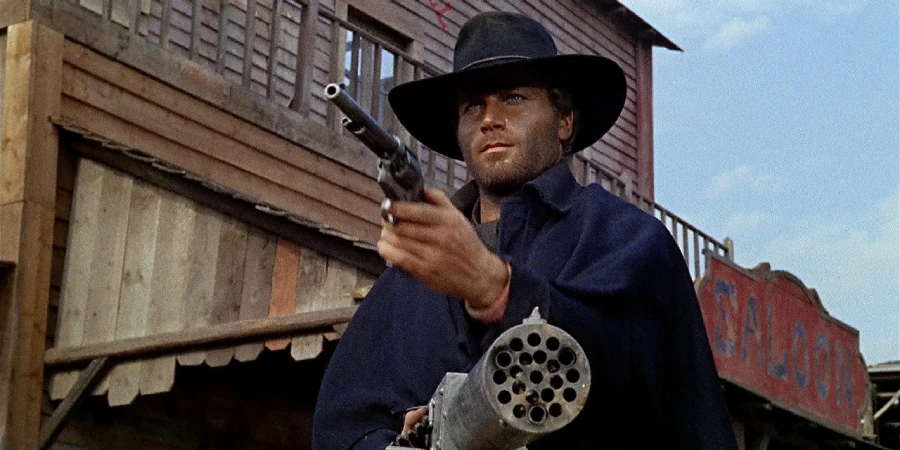
Sergio Corbucci’s Django (1966) is one of the most influential Spaghetti Westerns ever made, a gritty, violent, dust-covered revenge tale that helped shape the Western genre for decades to come.
Detailed Summary
The Drifter and the Coffin
The film opens with Django (Franco Nero), a lone gunslinger dragging a mysterious coffin through the mud as he approaches a border town ravaged by violence. This nameless, barren settlement is caught between two ruthless factions: Major Jackson’s racist Confederate gang and General Hugo Rodríguez’s Mexican rebels. Django’s arrival disrupts the balance, though his motives remain hidden early on.
Saving María and Drawing First Blood
Django saves María, a woman about to be executed by Jackson’s men. This instantly places him in conflict with the Major’s gang. Django settles at the local saloon/brothel, run by Nathaniel, and tension escalates as Jackson’s men attempt retaliation. Django, however, proves he’s not just another drifter—he’s a man bristling with secrets and an almost supernatural proficiency with a gun.
The Coffin’s Secret Revealed
In one of the most iconic reveals in Western cinema, Django finally opens the coffin, exposing a massive Gatling gun. This moment is a turning point: Django slaughters Jackson’s men with brutal efficiency. His motives become clearer—Jackson was responsible for the death of Django’s wife.
Teaming Up with the Mexicans
Django forms an uneasy alliance with General Rodríguez to steal the Mexican Army’s gold shipment. The heist succeeds, but Rodríguez betrays Django. Django escapes with the gold, but in a vicious twist, Rodríguez catches him and smashes Django’s hands as punishment for double-crossing them. The once unstoppable gunslinger is now physically broken.
Movie Ending
In the final act, Django—hands mutilated, spirit nearly crushed—drags himself back to the cemetery where he first revealed the Gatling gun. He knows Major Jackson is coming for him, and despite his condition, he refuses to flee.
Jackson and his remaining men corner Django at his wife’s grave. Django attempts to use his pistol, but his destroyed hands make it nearly impossible to grip or fire. Jackson laughs, mocking him.
What follows is one of the rawest, tensest climaxes in Western cinema:
- Django props the gun against the grave cross to compensate for his crushed hands.
- Jackson orders his men to execute him.
- At the last moment, Django manages to fire—killing the men with carefully placed shots, despite the agony.
Only Jackson remains. Django shoots him dead, finally avenging his wife.
The film ends with Django limping away from the cemetery, leaving behind the grave of his beloved and the burned-out ruins of the life he once sought to reclaim. There’s no triumphant music, no happy ending—just Django fading back into the lonely wilderness.
Are There Post-Credits Scenes?
No. Django (1966) ends exactly as the credits roll—no epilogue, no mid-credit tease, no hidden scene.
Type of Movie
Django is a gritty Spaghetti Western with strong elements of revenge drama and political commentary. It is darker and more violent than most American Westerns of its era, emphasizing brutality, corruption, and moral ambiguity.
Cast
- Franco Nero as Django
- José Bódalo as General Hugo Rodríguez
- Eduardo Fajardo as Major Jackson
- Loredana Nusciak as María
- Ángel Álvarez as Nathaniel
- Gino Pernice as Brother Jonathan
Film Music and Composer
The unforgettable score is composed by Luis Bacalov, blending traditional Western motifs with a haunting, almost melancholy vocal theme. The opening song “Django” became iconic and serves as one of the key identifiers of the film’s tone—tragic yet defiant.
Filming Locations
The film was primarily shot in:
- Lazio, Italy – particularly around Elios Studios and the surrounding landscapes
- Madrid, Spain – used for desert-like exteriors
These locations were chosen for their barren, harsh terrain, enhancing the film’s bleak and brutally atmospheric aesthetic. Their emptiness mirrors Django’s isolation and the desolation caused by endless conflict.
Awards and Nominations
At the time of release, Django did not receive major awards—partly due to its violent content and censorship controversies. However, over time, it has gained cult status and is now considered one of the most important Spaghetti Westerns ever made.
Behind the Scenes Insights
- Franco Nero was only 25 during filming but played Django with a stoic maturity that made him instantly iconic.
- The movie’s violence was so extreme for its era that it was banned in several countries for years.
- Corbucci reportedly encouraged Nero to adopt a slower, heavier walk to emphasize the weight of the coffin.
- The Gatling gun scenes required special stunt coordination due to hot shell casings flying everywhere.
- Corbucci and Sergio Leone were friendly rivals; each pushed the other to make bigger, bolder Westerns.
Inspirations and References
- Inspired by the gritty tone of Italian political cinema and postwar pessimism.
- Influenced by Japanese samurai films, particularly works of Kurosawa, where lone warriors wander into corrupt towns.
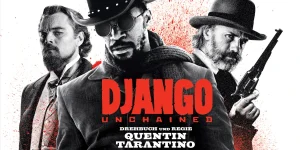
- The film later influenced Quentin Tarantino’s Django Unchained, which directly pays homage to Corbucci’s creation.
Alternate Endings and Deleted Scenes
While Django does not have confirmed multiple endings, several scenes were trimmed or censored internationally, including:
- Additional gore during the ear-cutting sequence
- More graphic gunfights
- A longer version of Django’s hand-smashing
However, no official “alternate ending” has ever surfaced.
Book Adaptations and Differences
The film is not based on a book, but it did inspire numerous unofficial sequels, adaptations, and novelizations—mostly from third-party creators attempting to capitalize on its popularity. These works often take Django into even more extreme, pulp-style adventures, diverging from Corbucci’s bleak realism.
Memorable Scenes and Quotes
Key Scenes
- Django dragging his coffin through the mud in the opening sequence
- The reveal of the Gatling gun
- The massacre of Jackson’s men
- Django’s hand-smashing punishment
- The final showdown in the cemetery
Iconic Quotes
- “I’m Django. Remember the name.”
- “You can’t kill me, Jackson. I’m already a dead man.”
- “A man needs a name. Otherwise he’s just a shadow.”
Easter Eggs and Hidden Details
- Django’s blue poncho subtly nods to Clint Eastwood’s attire in Leone’s films, but with a darker twist.
- The muddy border town symbolizes a “purgatory,” reinforcing Django’s ghost-like presence.
- The cross he uses in the finale is symbolic of both his wife’s memory and his own resurrection from despair.
Trivia
- The film inspired more than 30 unofficial sequels, most of which had nothing to do with the original.
- Franco Nero later cameoed in Django Unchained (2012).
- Django’s coffin became one of the most referenced props in Spaghetti Western history.
- Italian censors initially tried to block the movie entirely due to its violence.
Why Watch?
Because Django is one of the cornerstones of the Spaghetti Western genre, offering both brutal action and a surprisingly emotional core. Its style, music, atmosphere, and unrelenting grit make it essential viewing for anyone interested in the evolution of the modern antihero. It’s raw, bold, and decades ahead of its time.
Director’s Other Movies
- The Great Silence (1968)
- Companeros (1970)
- Navajo Joe (1966)
- What Am I Doing in the Middle of a Revolution? (1972)
Recommended Films for Fans
- A Fistful of Dollars (1964)
- For a Few Dollars More (1965)
- The Great Silence (1968)
- Once Upon a Time in the West (1968)
- Keoma (1976)