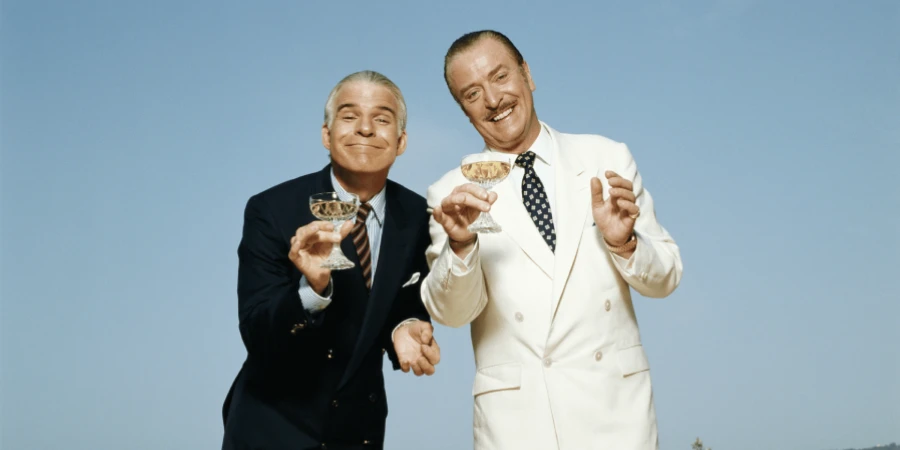

Dirty Rotten Scoundrels is a classic comedy that combines sharp dialogue, brilliant performances, and clever twists into one of the most beloved con-artist films of the 1980s. Directed by Frank Oz and starring Steve Martin and Michael Caine, the movie remains famous for its escalating mind games and unforgettable finale.
Detailed Summary
Arrival on the French Riviera
The story begins aboard a luxury train traveling to the French Riviera. We meet Freddy Benson, a small-time American con artist who survives by telling sob stories to wealthy women. His confidence quickly falters when he encounters Lawrence Jamieson, a polished British gentleman who operates a far more sophisticated scam empire.
Lawrence exposes Freddy’s amateur methods and reveals that the Riviera is his exclusive territory. Their first conflict is ideological as much as personal: Freddy believes in emotional manipulation, while Lawrence relies on elegance, status, and performance.
The Art of the Long Con
Freddy insists on staying and learning from Lawrence. Reluctantly, Lawrence agrees to mentor him, but tensions rise almost immediately. Freddy’s reckless style begins attracting unwanted attention, threatening Lawrence’s well-organized operations.
To settle their dispute, they agree to a high-stakes bet: whoever can swindle $50,000 from a wealthy woman first gets to stay on the Riviera, while the loser must leave forever.
Their target becomes Janet Colgate, a seemingly naive American tourist traveling alone with a fortune in her bank account.
Competing Scams and Deeper Deceptions
What follows is the heart of the film: layered cons stacked on top of cons.
Lawrence pretends to be a disgraced prince managing a charity, while Freddy creates an entirely different persona. Their schemes constantly sabotage one another, escalating into increasingly elaborate performances.
The most famous of these is Freddy’s transformation into “Ruprecht,” Lawrence’s supposed mentally disabled brother. This performance becomes one of the film’s comedic highlights and a crucial weapon in the psychological battle between the two men.
As each con artist believes he is outsmarting the other, Janet becomes emotionally involved, complicating matters further and blurring the line between manipulation and genuine affection.
The Illness Scheme
The competition intensifies when Freddy pretends to suffer from a rare medical condition that requires expensive treatment. Janet, sympathetic and trusting, offers financial help. Lawrence appears furious at Freddy’s cruelty, convincing the audience that Freddy may have gone too far.
At this point, the movie deliberately misleads viewers, planting doubts about who is actually winning and whether one of the men has crossed a moral line.


Movie Ending
The ending of Dirty Rotten Scoundrels is the film’s masterstroke and one of the most famous twist conclusions in comedy history.
Freddy appears to be dying from his fabricated illness. Janet agrees to give him the money needed for his cure. Shortly afterward, Freddy dramatically “dies,” seemingly proving that Lawrence has lost the bet due to Freddy’s manipulation.
Lawrence reacts with genuine shock and regret. Freddy, having successfully conned Janet out of the money, reveals himself alive and celebrates his victory. He prepares to leave the Riviera triumphantly, believing he has beaten Lawrence at his own game.
However, the final twist flips everything.
Lawrence reveals that Janet was never a real victim. She is actually his longtime partner in crime, and the entire competition was itself an elaborate con designed to trick Freddy. Every emotional moment, every apparent mistake, and even Lawrence’s anger were part of the setup.
Freddy realizes that he has not only lost the bet but has been conned more thoroughly than anyone else in the film.
The movie ends with Freddy being forced to leave the Riviera penniless, while Lawrence and Janet calmly prepare for their next wealthy target. The final moments underline the central theme of the film: the greatest con is the one you never realize you’re part of.
Are There Post-Credits Scenes?
No. Dirty Rotten Scoundrels does not include any post-credits or mid-credits scenes. The story ends definitively with the final reveal.
Type of Movie
Dirty Rotten Scoundrels is a comedy centered on deception and rivalry, blending farce, character-driven humor, and psychological games into a tightly written con-artist story.
Cast
- Steve Martin – Freddy Benson
- Michael Caine – Lawrence Jamieson
- Glenne Headly – Janet Colgate
- Anton Rodgers – Inspector Andre
- Ian McDiarmid – Arthur
Film Music and Composer
The musical score was composed by Miles Goodman. The soundtrack complements the Riviera setting with elegant, light orchestration that reinforces both the sophistication of Lawrence’s world and the playful tone of the comedy.



Filming Locations
The film was shot primarily in:
- Monte Carlo, Monaco
- Nice and Villefranche-sur-Mer, France
These locations are essential to the movie’s identity. The luxurious hotels, casinos, and coastlines visually reinforce the theme of wealth and illusion, making the Riviera feel like a playground built entirely for scams.
Awards and Nominations
While not a major awards contender, the film received:
- Saturn Award nomination for Best Comedy
- Widespread critical praise for performances and screenplay structure
Over time, it has achieved cult-classic status, often cited among the best comedies of the 1980s.
Behind the Scenes Insights
- The film is a remake of Bedtime Story (1964), starring Marlon Brando and David Niven.
- Steve Martin reportedly improvised parts of the “Ruprecht” scenes.
- Michael Caine studied real aristocratic behavior to perfect Lawrence’s mannerisms.
- Frank Oz emphasized timing over improvisation, rehearsing scenes extensively like stage comedy.
- The cast has stated that the final twist was intentionally hidden from some crew members to preserve secrecy.
Inspirations and References
- Based on the 1964 film Bedtime Story
- Inspired by classic European farces and theatrical comedies
- Draws heavily from stage traditions of mistaken identity and role-switching
Alternate Endings and Deleted Scenes
No officially released alternate ending exists. Several shorter dialogue scenes between Lawrence and Janet were removed to maintain pacing and preserve the surprise twist.
Book Adaptations and Differences
The movie is not based on a novel, but on a previous film. Compared to Bedtime Story (1964), the 1988 version:
- Adds sharper, faster-paced humor
- Expands Freddy’s character significantly
- Strengthens the final twist to be more emotionally satisfying

Memorable Scenes and Quotes
Key Scenes
- Freddy meeting Lawrence on the train
- The introduction of the “Ruprecht” character
- The fake medical emergency scene
- Freddy’s apparent death
- The final reveal involving Janet
Iconic Quotes
- “Why is the cork on the fork?”
- “May I go to the bathroom?”
- “You’re trying to steal my girl.”
- “You think you’re the only one who can con people?”
Easter Eggs and Hidden Details
- The hotel room numbers subtly change during scams, symbolizing shifting identities
- Lawrence’s accent slightly changes when he lies
- Janet’s behavior becomes increasingly confident near the end, hinting at the twist
- Props from Bedtime Story (1964) appear in background hotel scenes
Trivia
- Steve Martin considers Ruprecht one of his favorite roles.
- Michael Caine later said the film required more precision than most dramas.
- The movie influenced later con comedies like The Hustle (2019), itself a gender-swapped remake.
- Frank Oz described the film as “a magic trick disguised as a comedy.”
Why Watch?
If you enjoy smart comedies that reward attention, this film is essential viewing. Its humor doesn’t rely on slapstick alone but on timing, performance, and escalating deception. The final act is often cited as one of the most satisfying twist endings in comedy history.
Director’s Other Works
- The Dark Crystal (1982)
- Little Shop of Horrors (1986)
- What About Bob? (1991)
- The Indian in the Cupboard (1995)
- Bowfinger (1999)
- Death at a Funeral (2010)
Recommended Films for Fans
- The Sting (1973)
- A Fish Called Wanda (1988)
- Bowfinger (1999)
- Catch Me If You Can (2002)
- The Talented Mr. Ripley (1999)
- The Hustle (2019)
- Ocean’s Eleven (2001)