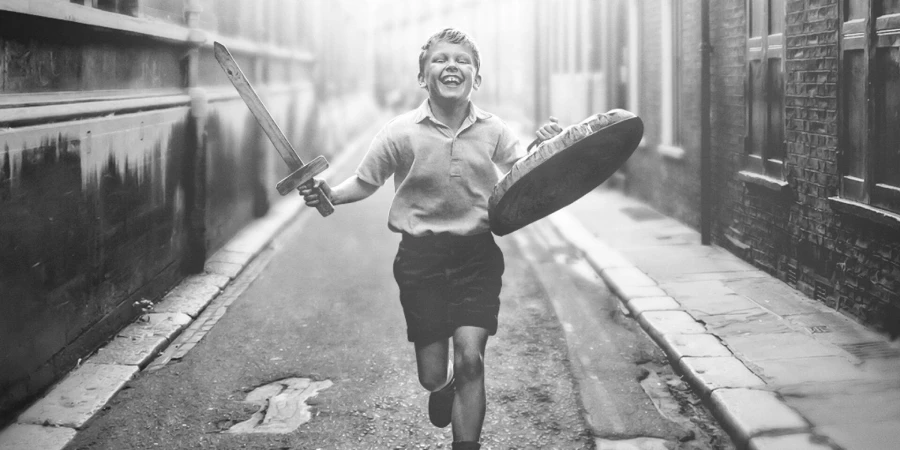

Kenneth Branagh’s Belfast (2021) is a deeply personal, semi-autobiographical film that looks at childhood, family, and identity during one of Northern Ireland’s most turbulent periods. Shot in striking black-and-white, the film blends political unrest with warmth, humor, and nostalgia, making it both intimate and universal.
Detailed Summary
A Child’s World Interrupted
The story is set in late 1960s Belfast, seen through the eyes of Buddy, a young boy growing up in a close-knit working-class Protestant neighborhood. His life revolves around school, movies, comic books, and a sweet crush on a classmate. This sense of innocence is abruptly shattered when sectarian violence erupts on his street, marking the beginning of The Troubles.
Family at the Center
Buddy’s family forms the emotional core of the film. His father works in England and comes home periodically, while his mother struggles to keep the family safe and morally grounded. Buddy’s grandparents provide wisdom, humor, and unconditional love. The film repeatedly contrasts the warmth of family life with the cold reality of political conflict outside their door.
Community, Pressure, and Identity
As tensions rise, Buddy’s neighborhood becomes divided. Local gangs and paramilitary figures pressure Buddy’s father to join their cause. The family is faced with difficult choices: stay in their beloved home or leave everything behind for safety and opportunity. Buddy watches adults wrestle with moral dilemmas he doesn’t fully understand but deeply feels.
Growing Up Amid Chaos
Buddy continues to attend school, go to the cinema, and listen to music, even as violence becomes normalized. The film uses pop culture, religion, and education to show how a child processes fear and uncertainty. Ordinary moments become acts of resistance against hatred and division.


Movie Ending
The film concludes with the family making the painful decision to leave Belfast. After escalating threats and one final confrontation involving Buddy, it becomes clear that staying would put their future at risk. Buddy’s father refuses to compromise his values by aligning with violent groups, even though doing so might make life easier in the short term.
Before leaving, Buddy says goodbye to his grandparents. One of the most emotionally powerful moments comes when his grandfather offers final words of guidance, reminding Buddy to always know where he came from. His grandmother’s farewell is quieter but equally devastating, underscoring the cost of leaving loved ones behind.
As the family departs, Buddy looks back at the only home he has ever known. The ending is not triumphant, but bittersweet and reflective. The violence is not magically resolved, but the family chooses hope, safety, and moral integrity over fear. The final scenes shift to color, linking Buddy’s past to Branagh’s present-day self, emphasizing memory, survival, and gratitude.
Are There Post-Credits Scenes?
No. Belfast does not include any post-credits or mid-credits scenes. The emotional resolution is fully contained within the film’s final moments.
Type of Movie
Belfast is a semi-autobiographical drama that blends coming-of-age storytelling with historical and political context. It is intimate rather than epic, focusing on personal experience over large-scale conflict.
Cast
- Jude Hill as Buddy
- Caitríona Balfe as Ma
- Jamie Dornan as Pa
- Judi Dench as Granny
- Ciarán Hinds as Pop
- Colin Morgan as Billy Clanton
Film Music and Composer
The original score was composed by Van Morrison, whose music plays a crucial role in setting the emotional and cultural tone. In addition to original compositions, the film features several of Morrison’s classic songs, making music a narrative voice rather than background decoration.

Filming Locations
Although set in Belfast, much of the film was shot in England, including recreated streets that mirror Branagh’s childhood neighborhood. This allowed precise control over the environment and visuals. The deliberate use of black-and-white cinematography emphasizes memory, nostalgia, and emotional truth over realism, while selective use of color highlights cinema and imagination as escapes from reality.
Awards and Nominations
Belfast received widespread critical acclaim and major awards recognition:
- Won Academy Award for Best Original Screenplay
- Nominated for Best Picture, Best Director, Best Supporting Actor (Ciarán Hinds), and Best Supporting Actress (Judi Dench)
- Won Golden Globe for Best Screenplay
- Multiple BAFTA nominations and wins
Behind the Scenes Insights
- Kenneth Branagh has described Belfast as his most personal film.
- Many scenes are directly inspired by Branagh’s real childhood memories.
- Judi Dench and Ciarán Hinds were cast specifically for their ability to convey warmth and lived-in intimacy.
- Branagh chose black-and-white to avoid romanticizing violence while preserving emotional clarity.
- The child actors were intentionally shielded from explicit political explanations to maintain authenticity.
Inspirations and References
- Kenneth Branagh’s own childhood experiences
- Italian neorealist cinema
- Classic family dramas
- Stage-like framing inspired by Branagh’s theater background
- Irish oral storytelling traditions
Alternate Endings and Deleted Scenes
No alternate endings have been officially released. Some longer family interactions and neighborhood moments were trimmed during editing to maintain pacing and focus on Buddy’s emotional journey rather than expanding the political narrative.
Book Adaptations and Differences
Belfast is not based on a book. It is an original screenplay rooted in Branagh’s personal history, making it closer to a cinematic memoir than an adaptation.

Memorable Scenes and Quotes
Key Scenes
- The opening riot on Buddy’s street, shattering normal life
- Buddy watching films in the cinema as violence escalates outside
- Conversations between Buddy and his grandparents about life and faith
- The family’s final walk through their neighborhood before leaving
Iconic Quotes
- “Be good, and if you can’t be good, be careful.”
- “This is where we belong… but maybe not anymore.”
Easter Eggs and Hidden Details
- Movie posters in the cinema scenes reference films Branagh loved as a child
- Subtle biblical imagery reflects the moral framework of Buddy’s family
- Street layouts match Branagh’s real childhood neighborhood
- The final color sequence links past and present Belfast visually
Trivia
- The film was shot in chronological order to help the child actors
- Judi Dench received an Oscar nomination with very limited screen time
- Branagh has said he waited decades before feeling ready to tell this story
- The film premiered at Telluride Film Festival to overwhelming praise
Why Watch?
You should watch Belfast if you value emotionally honest storytelling, strong performances, and films that explore history through a personal lens. It’s not about politics as ideology, but about how conflict shapes families and childhoods. Quiet, powerful, and deeply human.
Director’s Other Works (Movies)
- Henry V (1989)
- Much Ado About Nothing (1993)
- Hamlet (1996)
- Thor (2011)
- Cinderella (2015)
- Murder on the Orient Express (2017)
Recommended Films for Fans
- Roma (2018)
- The Fabelmans (2022)
- Hope and Glory (1987)
- Jojo Rabbit (2019)
- Cinema Paradiso (1988)