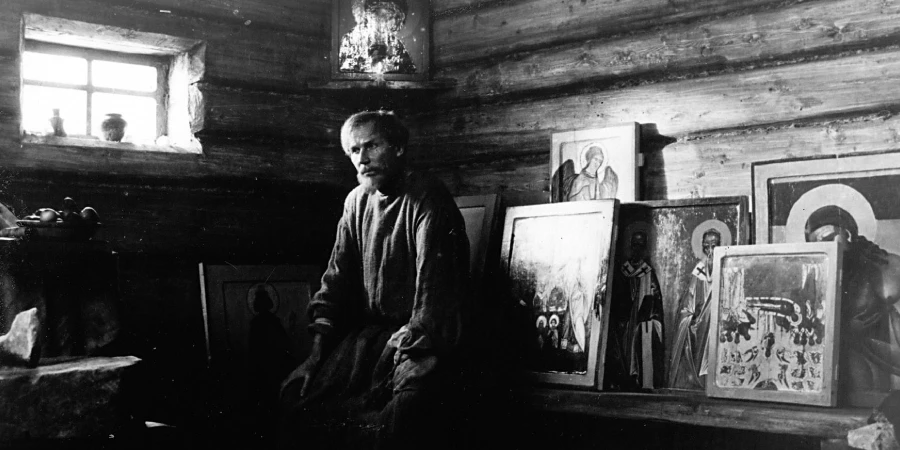

Andrei Tarkovsky’s Andrei Rublev is not simply a historical film. It is a brutal, sprawling poem about an artist’s soul tormented by a savage world. The film plunges viewers into the mud and blood of 15th-century Russia. Consequently, it asks whether art can possibly exist amid such overwhelming human cruelty.
Detailed Summary
Prologue: The Balloon
The film opens with a stunning and chaotic sequence. A man named Yefim attempts to fly in a crude hot-air balloon from a church tower. He soars over the landscape, experiencing a moment of pure, transcendent joy.
His flight is tragically short-lived. He crashes to the ground, surrounded by a dismissive crowd and a dying horse. This prologue, interestingly, establishes the film’s central theme: the human desire to transcend earthly suffering, often ending in failure.
Part I: The Jester (1400)
Three monks, Andrei Rublev, Daniil, and Kirill, seek shelter from a storm in a barn. A jester, or skomorokh, entertains the peasants with vulgar, anti-clerical jokes. Andrei is amused, but the stern Daniil is not.
Soldiers soon arrive and brutally arrest the jester. They smash his instrument and drag him away. Andrei is left disturbed, witnessing the harsh authority of the state crush simple folk art.
Part I: Theophanes the Greek (1405)
The ambitious monk Kirill visits the master painter Theophanes the Greek. Kirill hopes for an apprenticeship but his pride gets the better of him. Meanwhile, a messenger arrives with a different offer for Theophanes: a commission to paint the Cathedral of the Annunciation in Moscow.
Theophanes, however, has already heard of Andrei Rublev. He sends his own invitation to Andrei, bypassing Kirill entirely. A humiliated and bitter Kirill renounces the monastery in a rage.
Part I: The Passion (1406)
Andrei travels with his young apprentice, Foma. On their journey, Andrei and Theophanes debate the nature of humanity and art. Theophanes is cynical, believing humanity is inherently ignorant and wicked.
Andrei, in contrast, argues for compassion. He believes people should be reminded of goodness, not just judgment. Their philosophical clash is visualized in a stark, reenacted crucifixion scene in the snow.
Part I: The Holiday (1408)
While floating down a river, Andrei’s group stumbles upon a pagan midsummer ritual. The pagans are celebrating naked, running through the forest with torches. Andrei is both intrigued and unsettled by their freedom.
He is captured and tied up. A pagan woman named Marfa approaches him, kisses him, and then unties him. This encounter with unapologetic sensuality deeply affects the devout monk, further complicating his view of the world.
Part II: The Last Judgment (1408)
Andrei and Daniil are now working in the Cathedral of the Dormition in Vladimir. Andrei refuses to paint the Last Judgment, finding the theme too frightening for the common people. He cannot bring himself to terrorize them with images of damnation.
The Grand Prince’s men arrive to complain about the delay. Andrei’s crisis of faith deepens, and the cathedral walls remain blank.
Part II: The Raid (1408)
This section depicts the brutal sack of Vladimir by Tartars, aided by the Grand Prince’s jealous younger brother. The Tartars storm the city and the cathedral. They massacre the citizens who have taken refuge inside.
Amid the carnage, Andrei kills a Tartar soldier to save a young woman, Durochka, from being raped. Horrified by his own act of violence, Andrei takes a vow of silence and renounces painting. He leaves the desecrated church with the traumatized, now-mute Durochka.
Part II: The Silence (1412)
Years pass during a brutal famine. Andrei, still silent, travels with Durochka. He has completely abandoned his art. His old friend Kirill, humbled and broken, returns to their monastery and begs for readmittance.
Andrei’s former apprentice Foma has become a successful but mediocre painter. He gets killed by Tartars, dying a pointless death. Ultimately, Andrei’s silence represents the death of his artistic spirit in a world that seems to have no place for it.
Part II: The Bell (1423)
A Prince commissions a new bell for a cathedral. The bellmaker has died in a plague, so his young son, Boriska, claims to know the secret of bell-casting. He is given command of the massive project.
Boriska is a cruel and demanding taskmaster, driven by desperation. Andrei silently observes him. The entire community works tirelessly to dig the pit, build the mold, and hoist the massive bell. During the climactic casting, Boriska fears he has failed.
Movie Ending
The bell is finally raised and rung. It produces a perfect, beautiful sound that echoes across the land. The crowd erupts in celebration. Boriska, however, collapses in tears, confessing to Andrei that his father never actually told him the secret.
Andrei, witnessing this profound act of desperate, intuitive creation, is moved to break his vow of silence. He tells the boy, “You will cast bells. I will paint icons.” This moment reignites his faith in humanity and the creative spirit.
The film then dramatically shifts from stark black and white to vibrant color. An epilogue showcases the real, beautifully preserved icons painted by the historical Andrei Rublev. For instance, we see details from The Trinity, an affirmation that art, beauty, and faith did endure, despite the darkness that threatened to consume them.
Are There Post-Credits Scenes?
No, there are no post-credits scenes in Andrei Rublev.
Type of Movie
Andrei Rublev is a historical epic and a biographical drama. Its tone is meditative, somber, and often brutally realistic. Furthermore, it functions as a deep philosophical allegory about the role of the artist in society and the endurance of the human spirit.
Cast
- Anatoly Solonitsyn – Andrei Rublev
- Ivan Lapikov – Kirill
- Nikolai Grinko – Daniil
- Nikolai Sergeyev – Theophanes the Greek
- Irma Raush – Durochka (the holy fool)
- Nikolai Burlyayev – Boriska
- Yuriy Nazarov – Grand Prince / Younger Prince
- Roland Bykov – The Jester (Skomorokh)
Film Music and Composer
The score for Andrei Rublev was composed by Vyacheslav Ovchinnikov. His music is used sparingly throughout the film. It often blends seamlessly with diegetic sounds and liturgical chants.
A key aspect of the sound design is its contrast between the harsh sounds of the real world and the ethereal quality of the religious music. This effectively mirrors Andrei’s internal spiritual conflict.
Filming Locations
Tarkovsky shot the film on location in Russia, adding a powerful layer of authenticity. Key locations included the historic cities of Suzdal, Vladimir, and Pskov, as well as the Church of the Intercession on the Nerl.
Using these real medieval sites grounded the film’s spiritual themes in tangible history. The landscapes themselves become a character, representing the harsh, beautiful, and expansive Russian soul.
Awards and Nominations
Despite being suppressed by Soviet authorities for years, Andrei Rublev screened at the 1969 Cannes Film Festival. It won the prestigious FIPRESCI Prize there. The film’s delayed release, however, limited its participation in other major international award circuits at the time.
Behind the Scenes Insights
- Soviet censors demanded significant cuts, viewing the film as elitist, religiously ambiguous, and overly violent. Tarkovsky fought to preserve his vision, but was forced to shorten the film.
- Actor Anatoly Solonitsyn was not Tarkovsky’s first choice. The director initially wanted Stanislav Lyubshin, but Solonitsyn reportedly told Tarkovsky he was born to play Rublev and won him over.
- The film was embroiled in controversy over alleged animal cruelty, specifically for a scene involving a burning cow and a horse falling down stairs. Tarkovsky always maintained that no animals were truly harmed during the production.
- The budget was substantial for a Soviet film, but Tarkovsky famously went over budget and schedule, a common trait throughout his demanding career.
Inspirations and References
The film is inspired by the life of Andrei Rublev, Russia’s most revered icon painter, who lived from the 1360s to around 1430. Very little is actually known about his life. The filmmakers, therefore, used the sparse historical record as a canvas for a fictionalized spiritual biography.
Tarkovsky and his co-writer Andrei Konchalovsky were more interested in the inner world of the artist and the spirit of the age than in strict historical accuracy. The film is a meditation on the idea of Andrei Rublev.
Alternate Endings and Deleted Scenes
The original cut of the film, titled The Passion According to Andrei, ran for 205 minutes. Soviet authorities at Goskino demanded changes, leading to the creation of the 186-minute version most commonly seen today. Some of the excised material included more graphic violence during the raid on Vladimir and extended dialogue scenes.
A handful of other shorter versions exist, but there is no known “alternate ending.” The conclusion with the bell and the shift to color was always Tarkovsky’s intended climax.
Book Adaptations and Differences
Andrei Rublev is not an adaptation of a specific book. It is an original screenplay based on the life of a historical figure. The writers drew from historical chronicles and academic studies of 15th-century Russia to build their story.
Memorable Scenes and Quotes
Key Scenes
- The Pagan Ritual: A disorienting and hypnotic sequence where Andrei witnesses a naked, torch-lit celebration in the woods, confronting him with a powerful, pre-Christian sensuality that challenges his monastic worldview.
- The Raid on Vladimir: A masterful and horrifying depiction of medieval warfare. Tarkovsky’s camera moves through the chaos inside the cathedral, capturing the massacre with unflinching brutality, which leads to Andrei’s fateful decision.
- The Casting of the Bell: A monumental sequence of human effort, desperation, and creation. The tension of whether the bell will ring is a metaphor for Russia’s own uncertain future and the revival of Andrei’s artistic spirit.
Iconic Quotes
- Theophanes the Greek: “The Day of Judgment is the Day of Judgment. It should remind the world all the time of sin and that the hour of reckoning will come.”
- Andrei Rublev: “I don’t want to frighten people. That’s not what art is for.”
- Andrei Rublev: “You’ll go on casting bells. I’ll go on painting icons.”
Easter Eggs and Hidden Details
- Recurring Horses: Horses appear frequently throughout the film, often during moments of death or transcendence (the falling horse in the prologue, the horses in the final color sequence). They are a classic Tarkovsky motif symbolizing life, suffering, and nature.
- Water and Rain: Water, in the form of rain, rivers, and snow, is a constant presence. It serves as a purifying element, washing over the mud and blood of the world, suggesting the possibility of renewal and baptism.
- The Blind Man: In the raid on Vladimir, Tartars are seen blinding a stonemason. Later, during the “Silence” chapter, Andrei encounters a group of blind men on the road, a haunting callback to the casual cruelty he witnessed.
Trivia
- Nikolai Burlyayev, who played the young bellmaker Boriska, also played the lead role as a child in Tarkovsky’s first feature film, Ivan’s Childhood (1962).
- The film was shot almost entirely in monochrome. Tarkovsky’s decision to use color only in the final epilogue was a deliberate artistic choice to represent the transcendent, timeless beauty of Rublev’s art.
- Due to its controversial themes and initial suppression, Andrei Rublev was not officially released in the Soviet Union until 1971, five years after it was completed.
Why Watch?
This is not a film you simply watch; it is an experience you endure and absorb. For those willing to embrace its challenging pace and brutal honesty, Andrei Rublev offers one of cinema’s most profound explorations of faith, art, and resilience.
Director’s Other Movies
- Ivan’s Childhood (1962)
- Solaris (1972)
- Mirror (1975)
- Stalker (1979)
- Nostalghia (1983)
- The Sacrifice (1986)
Recommended Films for Fans
- The Seventh Seal (1957)
- The Agony and the Ecstasy (1965)
- The Passion of Joan of Arc (1928)
- Marketa Lazarová (1967)
- Hard to Be a God (2013)
- Silence (2016)