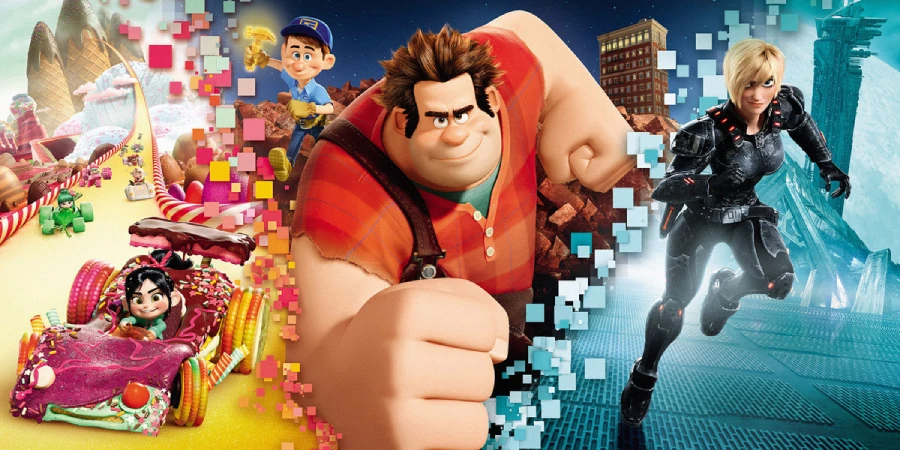

Wreck-It Ralph (2012) is one of Disney’s most creative and heartfelt animations, blending nostalgia, video-game culture, and a strong emotional core.
Detailed Summary
Ralph’s Identity Crisis and Life at Niceland
Ralph is the villain of the classic arcade game Fix-It Felix Jr. For 30 years, he has been smashing the same building, being tossed off the roof, and living alone in the dump while Felix gets praise and medals. Ralph crashes a party thrown for the game’s anniversary but is humiliated when the Nicelanders make it clear he’ll never be considered a hero. This sparks his journey: if he can win a medal somewhere, maybe he’ll finally get respect.
Game Central Station and Ralph’s Quest for a Medal
Ralph enters Game Central Station, a hub where characters travel between arcade games after-hours. Determined to become a hero, he infiltrates the sci-fi FPS game Hero’s Duty, led by the intense Sergeant Calhoun. Despite not understanding the game’s mechanics, Ralph manages to steal a medal from the tower. Unfortunately, he accidentally launches a deadly Cy-Bug egg with him into a malfunctioning kart-racing game, Sugar Rush.
Meeting Vanellope and the Heart of the Story
In Sugar Rush, Ralph meets Vanellope von Schweetz, a glitchy outcast who steals his medal to enter a race. Ralph is furious, but their dynamic gradually shifts as they discover they both share the same core desire: to be seen, accepted, and valued. They form one of Disney’s most genuine friendships, full of humor and vulnerability.
Fix-It Felix and Calhoun’s Search
Meanwhile, Felix teams up with Sergeant Calhoun to find Ralph before the arcade owner unplugs Fix-It Felix Jr. Their journey provides comedic contrast, especially Felix’s hilariously earnest nature paired with Calhoun’s action-hero seriousness.
Sugar Rush’s Dark Secret
King Candy, the ruler of Sugar Rush, appears charming but is hiding a major secret: he illegally tampered with the game’s code to erase Vanellope’s real identity as Sugar Rush’s rightful princess. He fears glitches because if the arcade is unplugged, glitches cannot escape to Game Central Station. This is why he prevents Vanellope from racing at all costs.
Their confrontation sets up the climax of the movie.
Movie Ending
The truth is revealed: King Candy is actually Turbo, an infamous arcade character who abandoned his own game decades earlier and tried to take over other games, causing chaos. In his latest attempt to survive, he hacked into Sugar Rush, stole Vanellope’s role, and rewrote the game’s code to crown himself king.
The Cy-Bug Ralph brought into Sugar Rush hatches, multiplying uncontrollably. Turbo is consumed by a Cy-Bug and mutates into a terrifying hybrid.
Vanellope tries to escape, but because she’s a glitch, she cannot leave the game. The entire world is collapsing into a Cy-Bug apocalypse.
Ralph realizes the only solution is to create a beacon that attracts Cy-Bugs like moths to a flame. In a powerful moment of self-sacrifice, he dives toward Diet Cola Mountain to trigger an eruption. Turbo attacks midair, trying to stop him, but Ralph chants Vanellope’s words back to himself: “I’m bad, and that’s good… I’m not good, and that’s not bad…” It gives him the courage to break free and finish the mission.
Vanellope races in at the last second and saves him, restoring the game’s code and revealing her true form: the rightful princess of Sugar Rush. She chooses to keep her glitch—her uniqueness—because it’s part of who she is.
Ralph returns to Fix-It Felix Jr. with newfound confidence. The Nicelanders appreciate him at last, and Ralph realizes he never needed a medal to feel valued. Seeing Vanellope succeed each day makes him proud of who he is.
Are There Post-Credits Scenes?
Yes. The film features several fun, quick video-game parody gags during and after the credits, referencing games like Pac-Man and Sonic. However, there is no major plot-related post-credits scene that sets up a sequel.
Type of Movie
Wreck-It Ralph is an animated adventure-comedy with strong emotional themes and a nostalgic focus on retro gaming. It blends heartfelt storytelling with energetic humor and clever world-building.
Cast
- John C. Reilly as Ralph
- Sarah Silverman as Vanellope von Schweetz
- Jack McBrayer as Fix-It Felix Jr.
- Jane Lynch as Sergeant Calhoun
- Alan Tudyk as King Candy / Turbo
- Ed O’Neill as Mr. Litwak
Film Music and Composer
The score was composed by Henry Jackman, who blends orchestral themes with electronic, arcade-inspired beats. The soundtrack also includes songs from AKB48 and Owl City, enhancing the film’s upbeat tone and game-like atmosphere.
Filming Locations
While animated, production took place mainly at Walt Disney Animation Studios in Burbank, California. The significance lies in the collaboration between animation, lighting, layout, and effects teams to build the distinct visual identity of three major game worlds:
- Hero’s Duty – dark, metallic, sci-fi textures
- Sugar Rush – pastel candy landscapes inspired by Japanese kart racers
- Fix-It Felix Jr. – retro 8-bit aesthetics recreated with modern animation
Each world intentionally uses a unique visual and animation style to honor its gaming genre.
Awards and Nominations
- Won: Annie Award for Best Animated Feature
- Nominated: Academy Award for Best Animated Feature
- Won: PGA Award for Outstanding Producer of Animated Theatrical Motion Pictures
- Multiple nominations across sound, animation, and writing categories
Behind the Scenes Insights
- The character animation team studied real arcade games to mimic different frame rates for each world.
- Vanellope’s glitch required a unique animation algorithm to create unpredictable pixel distortion.
- Alan Tudyk modeled King Candy’s voice after Ed Wynn, the classic Mad Hatter actor.
- Disney secured licensing for dozens of iconic characters, from Street Fighter to Pac-Man.
- Ralph originally had a sidekick character, later removed to make the Ralph–Vanellope bond stronger.
Inspirations and References
- Inspired by the classic arcade culture of the 1980s.
- Loosely draws from the idea of “Toy Story but with video games.”
- Sugar Rush’s design was influenced by Japanese pop culture, Mario Kart games, and candy commercials.
- King Candy’s arc references real-life “game crashers,” characters who appear in wrong games due to glitches or hacks.
Alternate Endings and Deleted Scenes
- An early draft revealed Vanellope’s princess identity much earlier, but it reduced the emotional payoff.
- A darker ending originally showed Turbo spreading beyond Sugar Rush, but it was replaced to maintain a family-friendly tone.
- Ralph’s medal quest went through several rewrites: he originally tried multiple games before Hero’s Duty, which was later shortened.
Book Adaptations and Differences
While not based on a single book, several tie-in novels were released. Differences include:
- More backstory on Sugar Rush racers.
- Expanded details on Turbo’s history before he invaded Sugar Rush.
- Extra emotional moments between Ralph and Vanellope that didn’t make the film.
Memorable Scenes and Quotes
Key Scenes
- Ralph entering Game Central Station for the first time.
- The chaotic Hero’s Duty mission.
- Vanellope building her kart with Ralph.
- The truth reveal: King Candy is Turbo.
- Ralph’s sacrifice at Diet Cola Mountain.
Iconic Quotes
- “I’m bad, and that’s good. I will never be good, and that’s not bad.”
- “I’m not leaving you here. That’s what heroes do.”
- “I’m not a glitch, Taffyta. I just have pixlexia.”
Easter Eggs and Hidden Details
- Sonic, Bowser, and Zangief cameo early in the film.
- The Konami Code appears on a gate in Sugar Rush.
- The graffiti in Game Central Station includes references to classic cheat codes.
- King Candy’s code room resembles vintage debugging interfaces used in early game development.
- The “Game Over” screen in Hero’s Duty mimics old arcade CRT distortion.
Trivia
- Ralph originally looked more monstrous, but animators redesigned him to be more lovable.
- Vanellope’s glitch effect required new software tools built specifically for the movie.
- The Nicelanders’ jerky movement was created by animating on twos to mimic 8-bit game frames.
- The film was almost titled High Score.
Why Watch?
Because Wreck-It Ralph delivers a clever blend of nostalgia, humor, and heartfelt storytelling. It celebrates being different, challenges stereotypes, and builds a richly layered world full of charm. For fans of video games or emotional animated stories, it’s a must-watch.
Director’s Other Movies
- Zootopia (2016)
- Futurama: Bender’s Big Score (2007)
- Ralph Breaks the Internet (2018)