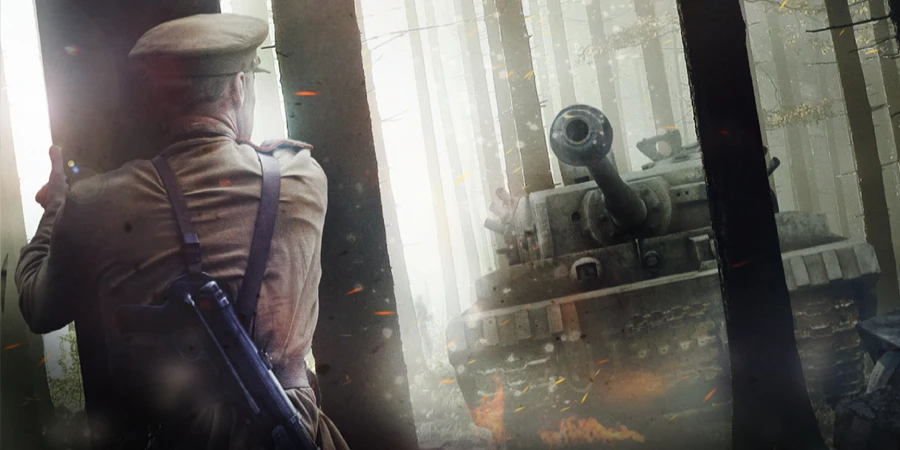

White Tiger (2012) is a haunting Russian war film directed by Karen Shakhnazarov that blends historical realism with mysticism. Set during the final days of World War II, the movie explores war not only as a physical conflict, but as an eternal, almost supernatural force that refuses to disappear.
Unlike traditional WWII films, White Tiger is less about strategy or victory and more about obsession, trauma, and the idea that war itself may never truly die.
Detailed Summary
The Burned Soldier Who Should Not Exist
The film opens in 1943 on the Eastern Front. Soviet forces discover a tank soldier who has survived being burned alive inside his destroyed tank. His body is badly scarred, and he has no memory of his past identity. The doctors are stunned that he is alive at all.
The man is named Ivan Naydenov, meaning “the found one.” From the beginning, it is clear that something about him is different.
Ivan soon reveals an extraordinary ability: he can hear tanks speaking to him. According to him, machines have voices, memories, and intentions.
The Legend of the White Tiger
Ivan speaks repeatedly of a mysterious German tank known as the White Tiger, an indestructible prototype that appears from fog, destroys entire tank units, and vanishes without leaving tracks.
No German records mention such a tank. To most officers, it sounds like hallucination or combat trauma. But survivors keep reporting the same thing.
The White Tiger becomes less a weapon and more a mythological predator, haunting the battlefield.
The Special Tank Crew
The Soviet command assigns Ivan to a specially modified T-34 tank, designed specifically to hunt the White Tiger. A small crew is formed around him, including skeptical but loyal soldiers who gradually begin to believe Ivan’s strange connection to tanks.
Ivan insists that the White Tiger cannot be destroyed by ordinary means. He believes it represents something deeper than Nazi technology.
The First Confrontation
When the two tanks finally meet, the battle feels surreal rather than heroic. The White Tiger seems to absorb shells without damage. It moves silently, fires with impossible accuracy, and disappears once again into the mist.
Ivan survives but becomes even more convinced that the enemy tank is not bound by normal reality.
War Nears Its End
As Germany collapses in 1945, Soviet commanders begin questioning whether the White Tiger even matters anymore. Berlin is falling. Victory is imminent.
But Ivan refuses to stand down.
He believes the White Tiger is not connected to Hitler, the Reich, or even Germany itself. He insists it is the embodiment of war, waiting patiently for humanity to call upon it again.

Movie Ending
In the final act, the war officially ends. Germany surrenders. Celebrations erupt across Europe.
However, the White Tiger is never found or destroyed.
Ivan continues searching for it even after hostilities cease. The military attempts to reassign him, but he refuses. His mission, he believes, is not over.
The most chilling moment comes in the closing scene.
Adolf Hitler is shown alone in a bunker, delivering a quiet monologue. He claims that even though Germany lost, the idea of war will never vanish. Humanity, he says, will always return to violence.
The film then cuts back to Ivan, still patrolling empty fields in his tank.
The implication is powerful and disturbing:
The White Tiger has not been defeated. It is simply waiting.
The tank symbolizes war itself. It cannot be killed because humans will always recreate it.
The movie ends not with victory, but with unresolved tension, reinforcing the idea that World War II may have ended, but war as a concept did not.
Are There Post-Credits Scenes?
No. White Tiger (2012) does not include any post-credits or mid-credits scenes. The film ends definitively with its symbolic final message.
Type of Movie
White Tiger is primarily a war drama infused with psychological thriller and mystical fantasy elements. It avoids traditional battlefield heroism and instead presents war as a philosophical and supernatural presence.
Cast
- Aleksey Vertkov as Ivan Naydenov
- Vitaly Kishchenko as Captain Fedotov
- Valery Grishko as General Zhukov
- Dmitry Bykovsky-Romashov as Sergeant Kryuk
Film Music and Composer
The music was composed by Yuri Poteyenko, whose restrained and ominous score emphasizes silence, tension, and unease rather than emotional manipulation. Much of the film relies on ambient sound instead of constant music, reinforcing its eerie atmosphere.
Filming Locations
The film was shot primarily in:
- Moscow Oblast, Russia
- Kaluga Region
- Military training grounds using real tanks
These locations were crucial for realism. The muddy terrain, fog-filled forests, and vast empty fields enhance the film’s ghostlike tone. The environment often feels abandoned, reinforcing the idea that the battlefield itself remembers violence.
Awards and Nominations
- Nominated for Best Film at the Asia Pacific Screen Awards (2012)
- Official submission by Russia for the Academy Awards (Best Foreign Language Film)
- Winner of multiple Russian film critics awards for cinematography and sound design
Behind the Scenes Insights
- Real WWII tanks were restored and used during filming.
- The White Tiger tank was created using a combination of physical models and CGI.
- Director Karen Shakhnazarov deliberately avoided heroic music to maintain realism.
- The fog effects were mostly practical, not digital.
- Actors received military training to authentically portray tank crews.
Inspirations and References
- Inspired by the novel “The White Tiger” by Ilya Boyashov
- Influenced by Russian war philosophy and existential literature
- The supernatural elements echo Andrei Tarkovsky’s symbolic filmmaking style
- The White Tiger tank draws thematic parallels to Moby-Dick as an unstoppable obsession
Alternate Endings and Deleted Scenes
No alternate ending was filmed.
However, several dialogue-heavy scenes explaining the White Tiger’s origins were removed to preserve ambiguity. The director intentionally chose to never explain whether the tank is real or supernatural, leaving interpretation entirely to the viewer.
Book Adaptation and Differences
The film is based on Boyashov’s novel but introduces key changes:
- The novel is more satirical, while the film is darker and philosophical
- The movie places greater emphasis on mysticism
- Ivan’s connection to tanks is more spiritual in the film
- The ending is more ambiguous and symbolic in the adaptation

Memorable Scenes and Quotes
Key Scenes
- Ivan emerging alive from the burned tank wreck
- The first fog-covered appearance of the White Tiger
- The silent duel between the two tanks
- Hitler’s final monologue
Iconic Quotes
- “Tanks are alive. They just speak differently.”
- “War doesn’t end. It waits.”
Easter Eggs and Hidden Details
- The White Tiger leaves no tracks, reinforcing its supernatural nature
- Its gunfire sound is different from all other tanks
- The number markings on the tank do not match any historical registry
- Fog appears only when the White Tiger is near
- Ivan is never shown sleeping, suggesting he may not be fully human
Trivia
- The film uses fewer than 500 spoken lines total
- The White Tiger appears on screen for less than 15 minutes
- The tank’s armor thickness is deliberately unrealistic
- The script was rewritten multiple times to reduce exposition
- Many Russian historians praised the film’s atmosphere despite its fantasy elements
Why Watch?
You should watch White Tiger (2012) if you want:
- A war film unlike any other
- Deep symbolism instead of conventional action
- A haunting interpretation of WWII
- A story that treats war as an idea, not just history
- A film that stays in your mind long after it ends
This is not entertainment-first cinema. It is philosophical war horror.
Director’s Other Works (Karen Shakhnazarov)
- Courier (1986)
- Zerograd (1988)
- The Assassin of the Tsar (1991)
- Dreams (1995)
- Ward No. 6 (2009)