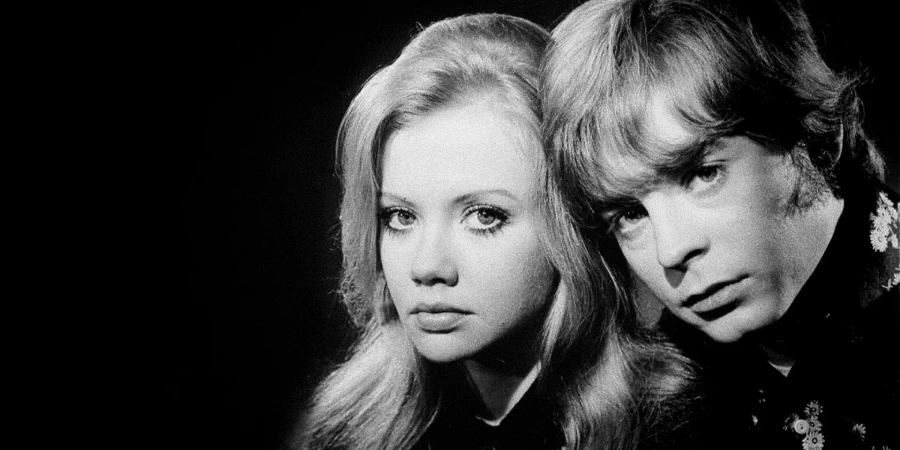

Twisted Nerve (1968) is a chiThe ending oflling British psychological thriller that quietly crawls under your skin rather than shouting for attention. Directed by Richard Fleischer, the film is best remembered for its unsettling tone, disturbed antagonist, and a haunting musical motif that later became infamous in cinema history.
Detailed Summary
A Disturbing Introduction to Martin Durnley
The film introduces Martin Durnley, a wealthy but deeply unstable young man living with his strict mother. Martin pretends to be intellectually disabled, speaking with a childlike stutter and behaving awkwardly. Very early on, the film hints that this persona is an act, not a condition. The audience is placed in an uncomfortable position: we see his manipulation before the characters around him do.
Susan Harper Enters the Picture
Martin becomes obsessed with Susan Harper, a kind and intelligent young woman who works as a librarian. Susan shows him compassion, which Martin misinterprets as affection. This emotional misunderstanding is the spark that ignites the film’s slow-burn descent into violence.
The First Kill and Escalation
When Susan gently rejects Martin’s romantic fantasies, his fragile mental state collapses. He murders her in a sudden and shocking act. This moment marks a turning point: Martin drops his fake disability whenever he is alone, revealing his true, calculating self.
Living a Double Life
Martin begins a dangerous game of deception. In public, he remains the harmless, childlike boy; in private, he grows more confident and cruel. He commits further murders, each time narrowly escaping suspicion due to society’s assumptions about disability and innocence. The tension builds as the audience waits for someone to finally see through him.
The Net Tightens
As bodies accumulate, Martin becomes reckless. His need for control intensifies, and cracks appear in his carefully constructed façade. The film shifts from quiet menace to psychological cat-and-mouse, as the police and those around him inch closer to the truth.


Movie Ending
Martin is finally exposed when his mother and authorities realize that his intellectual disability was an act all along. Cornered, Martin drops the stutter completely, speaking clearly and confidently, revealing the monster beneath the mask.
Rather than offering redemption or sympathy, the film ends by emphasizing the horror of his deception. Martin is institutionalized, not as a misunderstood victim, but as a deeply dangerous psychopath. The final moments force the audience to reflect on how easily appearances can deceive, and how society’s blind spots can be exploited. There is no catharsis, no heroic triumph, only an unsettling sense that evil often hides in plain sight.
Are There Post-Credits Scenes?
No. Twisted Nerve does not include any post-credits or mid-credits scenes. The film ends definitively, consistent with cinematic conventions of the late 1960s.
Type of Movie
Twisted Nerve is a psychological thriller with strong elements of horror and crime drama. It focuses less on action and more on mental instability, manipulation, and creeping dread.
Cast
- Hywel Bennett as Martin Durnley
- Hayley Mills as Susan Harper
- Billie Whitelaw as Mrs. Durnley
- Frank Finlay as Dave Matthews
- Barry Foster as Detective
Film Music and Composer
The film’s score was composed by Bernard Herrmann, legendary for his work on Psycho. The eerie whistling theme in Twisted Nerve became iconic and was later famously referenced in Kill Bill Vol. 1. The music plays a crucial role in creating unease, often appearing deceptively light while accompanying dark actions.
Filming Locations
Twisted Nerve was filmed primarily in London and surrounding English countryside locations. The ordinary suburban homes and quiet streets are essential to the film’s impact, reinforcing the idea that violence can emerge from seemingly safe, familiar environments.
Awards and Nominations
The film did not receive major awards at the time of release. However, it has since gained cult status and critical re-evaluation for its performances, direction, and musical influence.
Behind the Scenes Insights
- Richard Fleischer deliberately avoided over-explaining Martin’s psychology to maintain ambiguity.
- Hywel Bennett studied speech impediments but exaggerated them to make Martin’s act unsettling rather than realistic.
- Bernard Herrmann reportedly insisted on keeping the whistling theme minimal to increase its psychological effect.
- Hayley Mills took this role to break away from her wholesome Disney image.
Inspirations and References
- The film draws inspiration from real-world cases of psychopathic deception.
- Bernard Herrmann’s score echoes thematic ideas from Psycho (1960).
- Later filmmakers, including Quentin Tarantino, openly referenced the film’s music and tone.
Alternate Endings and Deleted Scenes
No confirmed alternate endings exist. Some dialogue-heavy scenes exploring Martin’s childhood were reportedly removed to preserve mystery and pacing.
Book Adaptations and Differences
Twisted Nerve is not based on a book.
Memorable Scenes and Quotes
Key Scenes
- Martin dropping his stutter when alone for the first time
- Susan’s murder, sudden and brutally understated
- The final reveal of Martin’s true voice and personality
Iconic Quotes
- Martin: “People think what they want to think.”
- Mrs. Durnley: “He’s just a child… he wouldn’t hurt anyone.”
Easter Eggs and Hidden Details
- The whistling melody subtly changes tempo as Martin’s mental state deteriorates.
- Mirrors frequently appear when Martin is about to act violently.
- Scenes involving authority figures often frame Martin as physically smaller, reinforcing false vulnerability.
Trivia
- Quentin Tarantino reused the whistling theme in Kill Bill Vol. 1 (2003).
- Hywel Bennett was praised for one of the most disturbing performances of the decade.
- The film was controversial for its portrayal of disability and deception.
Why Watch?
If you enjoy slow-burning psychological horror that prioritizes atmosphere over gore, Twisted Nerve is essential viewing. It is disturbing not because of what it shows, but because of what it suggests.
Director’s Other Works
- The Boston Strangler (1968)
- Soylent Green (1973)
- 10 Rillington Place (1971)
- Fantastic Voyage (1966)
Recommended Films for Fans
- Psycho (1960)
- Peeping Tom (1960)
- The Silence of the Lambs (1991)
- Cape Fear (1962)
- Kill Bill Vol. 1 (2003)