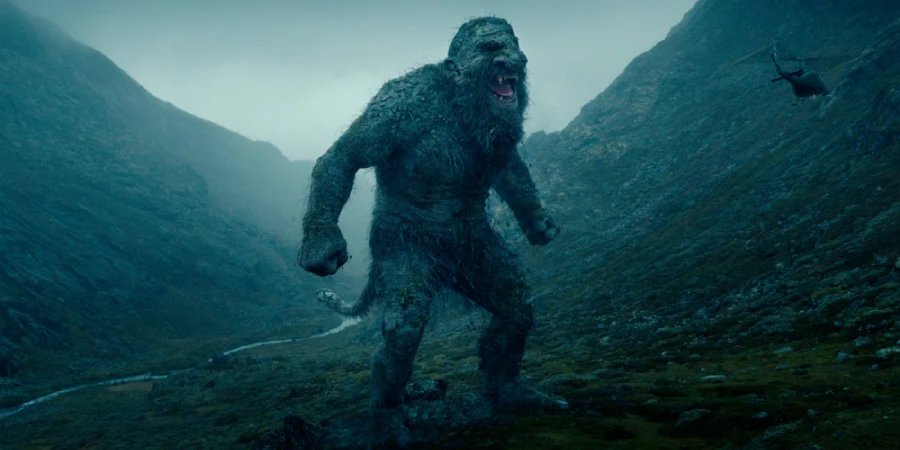

Troll (2022) is a Norwegian monster movie produced by Netflix that blends Nordic folklore, disaster cinema, and modern political drama. Directed by Roar Uthaug (Tomb Raider, The Wave), the film reimagines ancient Scandinavian myths as a very real—and very angry—force of nature.
Detailed Summary
The Prologue: Myths Are Warnings, Not Fairy Tales
The film opens with a folklore-heavy introduction explaining that trolls are not children’s stories but ancient beings connected to Norway’s mountains. This sets the core theme: what humanity calls “myth” may simply be forgotten history.
The Awakening: Blasting the Mountain
A tunnel explosion in the Dovre mountains triggers seismic activity. What seems like a geological accident quickly escalates into a national emergency. This moment is crucial because it symbolically represents modern society literally drilling into its own past.
Nora Enters the Story
Nora Tidemann, a paleontologist specializing in ancient creatures, is pulled into the investigation. Her estranged father, Tobias, is a folklorist obsessed with trolls—dismissed for years as a crackpot. Their strained relationship mirrors the film’s larger conflict: science vs. tradition.
The Troll Revealed
As the creature moves toward Oslo, the truth becomes undeniable: a giant troll, awakened after centuries of slumber, is heading straight for the capital. Military attempts to stop it fail completely, reinforcing the idea that brute force cannot defeat something born from nature itself.
Folklore Becomes the Key
Tobias’s research reveals that trolls are turned to stone by sunlight and react violently to church bells and Christian symbols—echoes of Norway’s religious colonization. The troll’s rage is not random; it is deeply personal and historical.

Movie Ending
Nora discovers that the troll is not simply attacking cities—it is following a path back to its original home, which now lies beneath Oslo’s Royal Palace. This land once belonged to the troll before humans built churches and monuments over it.
The Norwegian government devises a last-ditch plan: lure the troll into sunlight using massive UV lights, essentially forcing dawn. The plan works partially. The troll slows, begins to calcify, and ultimately turns to stone.
But the ending is not a victory.
As the troll freezes, Nora realizes it is not evil, only displaced and enraged. The creature dies standing, frozen in grief rather than fury. Oslo is saved, but at a moral cost.
In the final moments:
- The troll’s stone body remains as a monument.
- Tobias’s research is vindicated, though too late.
- The government quietly resumes tunneling projects.
- The closing shot hints that this troll was not alone.
The film ends on an unsettling note: humanity has learned nothing, and ancient forces still sleep beneath the earth.
Are There Post-Credits Scenes?
Yes. There is a mid-credits scene showing seismic activity in another mountain range, accompanied by a low, guttural sound. This strongly implies the existence of more trolls, teasing a potential sequel.
There is no full post-credits scene after the credits completely finish.
Type of Movie
Troll (2022) is a monster disaster film grounded in Nordic mythology, combining large-scale destruction with cultural and historical commentary rather than pure horror.
Cast
- Ine Marie Wilmann – Nora Tidemann
- Kim Falck – Andreas Isaksen
- Mads Sjøgård Pettersen – Captain Kristoffer Holm
- Gard B. Eidsvold – Tobias Tidemann
Film Music and Composer
The score is composed by Johannes Ringen, focusing on heavy orchestral tones mixed with subtle folk influences. The music emphasizes scale and tragedy rather than fear, reinforcing the idea that the troll is a force of history, not a villain.

Filming Locations and Their Importance
- Dovre Mountains, Norway – Central to troll mythology and the creature’s origin
- Oslo – Represents modern civilization built over ancient land
- Norwegian tunnels and highways – Visual metaphors for humanity cutting into nature
These real locations add authenticity and cultural weight to the story.
Awards and Nominations
While Troll (2022) did not receive major international awards, it gained:
- Strong critical praise for visual effects
- Recognition as one of Netflix’s most-watched non-English films of 2022
- Audience acclaim for respectful use of folklore
Behind the Scenes Insights
- The troll’s design was inspired by traditional Norwegian folk art, not Hollywood monsters
- Director Roar Uthaug wanted the troll to feel tragic, not terrifying
- Extensive research into Scandinavian myths shaped the script
- The film deliberately avoids giving the troll human speech to preserve its mystique
Inspirations and References
- Norwegian troll folklore
- Scandinavian oral traditions
- Godzilla (1954) – metaphor-driven monster storytelling
- Environmental cautionary tales
Alternate Endings and Deleted Scenes
Early drafts reportedly included:
- A scene showing villagers worshipping trolls in secret
- A more explicit reveal of multiple trolls worldwide
These were removed to keep the tone grounded and ambiguous.
Book Adaptations and Differences
Troll (2022) is not directly based on a book, but it draws heavily from oral folklore rather than a single written source, which gives it flexibility and originality.

Memorable Scenes and Quotes
Key Scenes
- The troll emerging from the mountain for the first time
- Military weapons failing against the creature
- The sunlight petrification sequence in Oslo
Iconic Quotes
- “Trolls aren’t myths. They’re memories.”
- “We built churches over their homes and called it progress.”
Easter Eggs and Hidden Details
- Carvings resembling the troll appear in early tunnel scenes
- Church bells subtly trigger the troll’s aggression
- The troll’s scars match ancient battle legends
- Map markings hint at other troll territories
Trivia
- The troll is over 40 meters tall
- Over 80% of the environments are digitally enhanced but grounded in real geography
- The film became Netflix’s most-watched Norwegian release ever
Why Watch?
If you enjoy monster movies with meaning, Troll offers spectacle, mythology, and moral ambiguity. It asks who the real monster is—the creature, or the civilization that erased it.
Director’s Other Works
- The Wave (2015)
- Tomb Raider (2018)
- Cold Prey (2006)