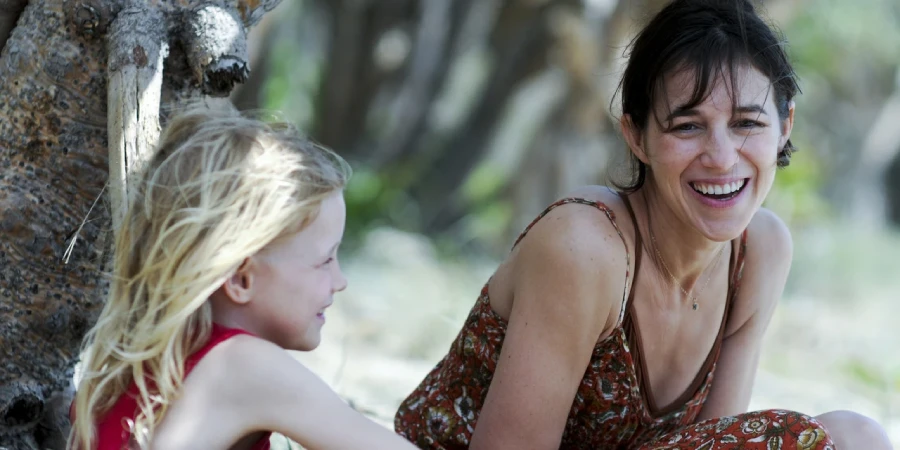
The Tree (2010) is a quiet but emotionally powerful drama that explores grief, childhood imagination, and the fragile ways people cope with loss. Adapted from an Australian novel, the film avoids melodrama and instead tells its story through atmosphere, symbolism, and deeply human moments.
Detailed Summary
A Family Shattered by Sudden Loss
The story begins in rural Australia, where Dawn O’Neil lives with her husband Peter and their four children. Their peaceful life is abruptly destroyed when Peter dies suddenly of a heart attack while swinging his daughter Simone in the backyard.
This moment defines the entire film. Death arrives without warning, and the family is left emotionally unprepared.
Simone, the youngest child, becomes convinced that her father’s spirit now lives inside a massive fig tree standing next to their home.
Simone’s Belief and the Tree as a Symbol
Shortly after the funeral, Simone begins hearing her father’s voice coming from the tree. The whispers seem to know things only he would know. She speaks to it, listens to it, and treats it as if her father is still alive.
While the audience never receives definitive proof that the voice is real, the film carefully maintains ambiguity. The tree becomes:
- a spiritual refuge for Simone
- a psychological coping mechanism
- a symbol of grief taking physical form
The roots of the tree grow dangerously close to the house, foreshadowing that unresolved grief cannot remain harmless forever.
Dawn’s Emotional Withdrawal
Dawn struggles far more than she admits. She isolates herself emotionally from her children, avoids discussing Peter, and becomes irritated by Simone’s obsession with the tree.
Her grief expresses itself through silence rather than imagination.
Where Simone refuses to let go, Dawn cannot bear to hold on.
This emotional divide creates tension between mother and daughter, each grieving in opposite ways.
The Tree Begins to Take Over
As time passes, the tree grows increasingly invasive. Its branches scrape the house. Roots push through pipes and foundations. Leaves clog gutters. The family’s home begins to deteriorate physically, mirroring their emotional decay.
Simone’s belief deepens. The “voice” grows more commanding, encouraging her dependence and subtly discouraging her from moving forward.
The tree is no longer comforting. It becomes possessive.
This is one of the film’s most important ideas: grief can begin as protection but turn into imprisonment.
Dawn’s New Relationship
Dawn meets George, a kind and emotionally stable man who slowly becomes part of her life. Their developing relationship represents healing and the possibility of love after loss.
However, Simone reacts with anger and betrayal. Accepting George feels like killing her father a second time.
The tension escalates as Dawn tries to rebuild her life while Simone clings more desperately to the tree.
The Storm Approaches
The fig tree’s condition worsens. Local authorities warn that it is unstable and dangerous. A major storm is approaching, and the tree threatens to collapse onto the house.
Dawn decides the tree must be cut down.
For Simone, this decision is devastating. To her, it means murdering her father.
This conflict drives the film toward its emotional climax.

Movie Ending
During a violent storm, the family remains inside the house as wind and rain batter the property. The massive tree begins to crack under pressure.
Simone climbs into the tree despite the danger, desperate to protect what she believes is her father’s spirit. She speaks to him one last time, pleading for him not to leave her.
In this final moment, the voice tells her goodbye.
The tree collapses, crashing violently through the house. The family narrowly survives.
When the storm ends, the tree lies destroyed.
Importantly, Simone no longer hears her father’s voice.
Rather than portraying this as a tragedy, the film treats it as a necessary release. The destruction of the tree marks the end of denial and the beginning of acceptance.
In the closing scenes, Dawn and her children leave the ruined house and move forward together. Simone plants a small sapling elsewhere, not as a replacement for the tree, but as a quiet acknowledgment that memories can remain without dominating life.
The ending suggests that grief never disappears, but it must change form in order for healing to begin.
Are There Post-Credits Scenes?
No. The Tree does not include any post-credits or mid-credits scenes. The film ends definitively with its final emotional resolution.
Type of Movie
The Tree is a psychological family drama with subtle magical realism elements. It focuses less on plot and more on emotional experience, symbolism, and the internal lives of its characters.
Cast
- Charlotte Gainsbourg – Dawn O’Neil
- Morgana Davies – Simone O’Neil
- Marton Csokas – George
- Christian Byers – Tim
- Tom Russell – Lou
- Aden Young – Peter O’Neil
Film Music and Composer
The score was composed by Grégoire Hetzel, whose minimal and atmospheric music supports the film’s emotional restraint. The soundtrack avoids manipulation and instead emphasizes silence, natural sounds, and quiet piano motifs.

Filming Locations
The movie was filmed primarily in Queensland, Australia.
The rural setting plays a critical role in the story:
- The isolation reinforces emotional loneliness
- The vast landscape emphasizes how small the family feels after loss
- The fig tree itself becomes a central “character” within the environment
The authenticity of the natural surroundings strengthens the film’s grounded emotional tone.
Awards and Nominations
- Official Selection – Cannes Film Festival (2010)
- Nominated for Best Actress (Charlotte Gainsbourg) at several international festivals
- Winner – Audience Award at the Chicago International Film Festival
While not a mainstream awards contender, the film received strong recognition in independent cinema circles.
Behind the Scenes Insights
- The film is based on the novel Our Father Who Art in the Tree by Judy Pascoe.
- Director Julie Bertuccelli focused heavily on realism, avoiding visual effects for the tree whenever possible.
- Morgana Davies was only eight years old during filming and received extensive emotional coaching for the role.
- Charlotte Gainsbourg has stated this was one of her most emotionally demanding performances.
- Many scenes were filmed chronologically to help the child actors follow the emotional progression naturally.
Inspirations and References
- The novel Our Father Who Art in the Tree by Judy Pascoe
- Psychological studies on childhood grief
- Spiritual symbolism associated with trees in Aboriginal and global mythologies
- European art-house cinema traditions emphasizing emotional realism
Alternate Endings and Deleted Scenes
No alternate endings were officially released.
However, early scripts included:
- A more explicit supernatural confirmation of the father’s presence
- Extended scenes of Simone communicating with the tree
These were removed to preserve ambiguity and avoid turning the story into literal fantasy.
Book Adaptations and Differences
Key differences between the novel and the film include:
- The book provides clearer spiritual explanations, while the film remains ambiguous
- Simone’s inner thoughts are heavily reduced for cinematic subtlety
- The film places greater emphasis on Dawn’s emotional paralysis
- The ending in the movie is more restrained and symbolic
The adaptation intentionally removes certainty in favor of emotional realism.
Memorable Scenes and Quotes
Key Scenes
- Peter’s sudden death during playtime
- Simone first hearing the voice in the tree
- The tree roots breaking into the house
- Dawn confronting Simone about letting go
- The storm and final collapse of the tree
Iconic Quotes
- “He’s not gone. He’s just… up there.”
- “If I forget him, he really disappears.”
- “You can love someone and still let them go.”
Easter Eggs and Hidden Details
- The tree’s root system mirrors the human nervous system in several shots.
- The camera frequently frames Simone below adults to reflect emotional vulnerability.
- Sound design subtly removes ambient noise whenever the “voice” is heard.
- The sapling in the final scene is a different species, symbolizing transformation rather than replacement.
Trivia
- The fig tree used in the film was over 100 years old.
- The novel’s author approved the screenplay personally.
- Charlotte Gainsbourg learned an Australian accent specifically for the role.
- The film was shot in just eight weeks.
- Many critics described the movie as “grief horror without monsters.”
Why Watch?
You should watch The Tree if you appreciate films that:
- explore grief honestly rather than dramatically
- trust the audience’s intelligence
- use symbolism instead of exposition
- focus on emotional truth over plot twists
It is not loud, fast, or comforting, but it is deeply human.
Director’s Other Works (Movies)
- Since Otar Left (1997)
- The Tree (2010)
- The Good Wife (2014)
Julie Bertuccelli is known for emotionally intimate stories centered on family, memory, and loss.
Recommended Films for Fans
- Rabbit Hole (2010)
- Blue Valentine (2010)
- Ordinary People (1980)
- A Monster Calls (2016)
- Manchester by the Sea (2016)
- After Life (1998)