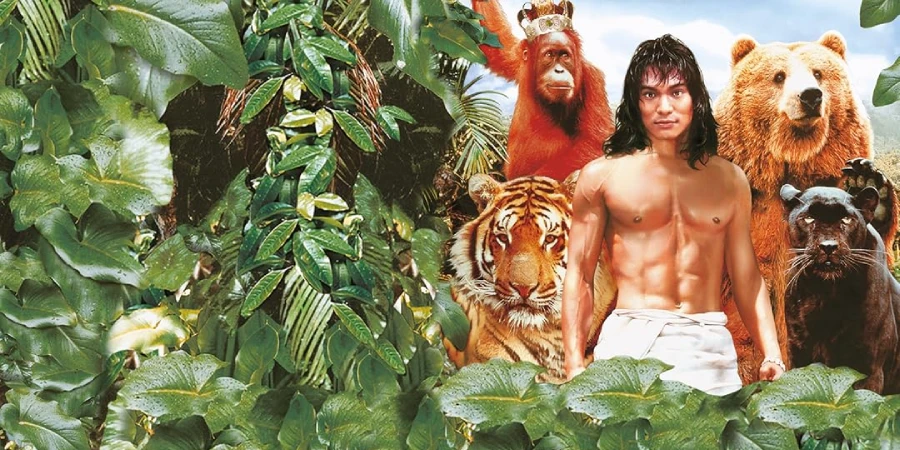

Disney’s live-action The Jungle Book (1994) is a darker, more mature reimagining of Rudyard Kipling’s classic tales. Unlike the 1967 animated musical, this version leans into romance, colonial tension, political intrigue, and swashbuckling adventure. Directed by Stephen Sommers, the film blends jungle spectacle with Victorian-era drama and a surprising amount of sword-fighting flair.
Detailed Summary
The Jungle Claims a Child
The story begins in British-ruled India, where young Mowgli survives a tiger attack that kills his father. Lost in the jungle, he is discovered and raised by animals—guided by the wise panther Bagheera. Years pass, and Mowgli grows into a wild but intelligent young man, deeply connected to the jungle and its creatures.
Unlike the animated version, this Mowgli speaks, reasons, and develops into a fully formed adult with emotional depth and romantic complexity.
Civilization Reenters the Picture
The peaceful jungle life is disrupted when a British military expedition enters the region. Among them is Kitty Brydon, Mowgli’s childhood friend, who had once met him before he disappeared into the jungle. Their reunion is awkward and charged—Kitty is now a proper Englishwoman, while Mowgli remains wild yet curiously refined.
Meanwhile, Captain William Boone, a greedy and ambitious officer, begins plotting to find a legendary lost treasure rumored to be hidden deep in the jungle. Boone sees Mowgli as a useful tool rather than a person.
Love, Jealousy, and Greed
As Mowgli attempts to navigate British society—awkwardly wearing formal clothes and trying to understand social norms—his feelings for Kitty intensify. Their relationship becomes central to the story, turning the film into part adventure, part romantic drama.
Boone grows increasingly hostile toward Mowgli, fueled by jealousy and greed. When he learns that Mowgli may know the location of an ancient treasure chamber, he manipulates events to force Mowgli to lead him there.
The Treasure Chamber and Betrayal
Boone captures Mowgli and pressures him into guiding the soldiers to the treasure site. The journey reveals ancient ruins hidden within the jungle, culminating in an enormous underground treasure vault filled with gold and jewels.
Here, Boone’s true villainy surfaces. He attempts to kill Mowgli and keep the treasure for himself. However, the jungle—loyal to Mowgli—intervenes in unexpected ways.
Movie Ending
Now we get to the satisfying payoff.
Inside the treasure chamber, Boone betrays everyone, even his own men. His greed overtakes any sense of morality. He attempts to kill Mowgli outright, but the situation spirals out of control when animals enter the chamber and chaos erupts.
In a poetic twist, Boone becomes trapped inside the treasure vault. A massive door seals shut, locking him inside with the gold he so desperately desired. The treasure that symbolized his ambition becomes his prison. He is left screaming in the darkness, surrounded by riches he can never spend. It’s a morally symbolic ending: greed literally entombs him.
Mowgli escapes with Kitty, and the immediate danger is resolved. But the emotional conclusion is just as important. Kitty chooses Mowgli over the rigid structure of British colonial life. She abandons her arranged marriage and societal expectations.
The film closes with Mowgli and Kitty riding off together—choosing love and freedom over empire and conformity. Mowgli does not fully abandon civilization, nor does he fully reject the jungle. Instead, he finds balance between the two worlds.
It’s a surprisingly mature and romantic ending compared to the animated version. The jungle remains powerful, untamed, and protective, but Mowgli’s future now includes partnership rather than isolation.
Are There Post-Credits Scenes?
No. There are no post-credits or mid-credits scenes in The Jungle Book (1994). Once the film ends, the story is complete.
Type of Movie
This is a live-action adventure drama with strong romantic and swashbuckling elements. While inspired by a children’s classic, the tone is more mature, leaning into action, political tension, and emotional conflict rather than musical whimsy.
Cast
- Jason Scott Lee as Mowgli
- Cary Elwes as Captain William Boone
- Lena Headey as Kitty Brydon
- Sam Neill as Colonel Geoffrey Brydon
- John Cleese as Dr. Plumford
Notably, this film predates Lena Headey’s later global fame from Game of Thrones.
Film Music and Composer
The score was composed by Basil Poledouris, known for grand, sweeping adventure themes. His music adds epic scale and romantic warmth, emphasizing both jungle majesty and emotional tension.

Filming Locations and Their Importance
The movie was primarily filmed in:
- India
- Thailand
Real jungle environments were crucial in grounding the film’s visual authenticity. Unlike the CGI-heavy modern remakes, this version relies heavily on practical locations, real animals, and physical sets. The lush landscapes create a tactile, immersive world that feels raw and dangerous.
Awards and Nominations
The film did not become a major awards contender but gained recognition for:
- Production design
- Costume design
- Cinematography in adventure filmmaking circles
It performed modestly at the box office but later gained cult appreciation for its darker tone.
Behind-the-Scenes Insights
- Jason Scott Lee performed many of his own stunts and trained extensively for the physically demanding role.
- Real animals were used in several sequences, increasing production complexity.
- The film was originally conceived as a more direct adaptation of Kipling before evolving into a romantic adventure story.
- Cary Elwes reportedly embraced Boone’s theatrical villainy, giving the character a larger-than-life presence.
Inspirations and References
The film is based on The Jungle Book by Rudyard Kipling. However, it diverges heavily from the episodic structure of the book.
Unlike the animated adaptation, this version does not rely on musical numbers and instead draws more inspiration from colonial adventure tales and classic swashbucklers.
Alternate Endings and Deleted Scenes
There are no widely documented alternate endings. However:
- Some extended jungle sequences were trimmed for pacing.
- Early drafts reportedly featured a darker ending for Boone, though the theatrical version already delivers poetic justice.
Book Adaptation and Differences
Major differences from Kipling’s book include:
- The introduction of a strong romantic subplot between Mowgli and Kitty (not present in the original stories).
- A centralized human villain (Boone), whereas the book focuses more on survival and jungle law.
- A greater emphasis on colonial society and treasure hunting.
The book is episodic and philosophical. The film is narrative-driven and romantic.
Memorable Scenes and Quotes
Key Scenes
- Mowgli’s first awkward appearance in British formalwear
- The tiger confrontation sequences
- The treasure chamber climax
- Kitty choosing Mowgli over colonial expectations
Iconic Quotes
- “The jungle is my home.”
- “You belong with your own kind.”
- “I am not your savage.”
Easter Eggs and Hidden Details
- Subtle visual nods to the animated 1967 version appear in certain jungle compositions.
- Boone’s costume subtly mirrors classic pirate antagonists, reinforcing his greed motif.
- Animal reactions often foreshadow danger before it occurs.
Trivia
- Jason Scott Lee was relatively unknown internationally before this role.
- The production involved extensive animal coordination teams.
- The tone surprised audiences expecting a light Disney adventure.
Why Watch?
If you want a more mature, grounded, and romantic take on the Mowgli story, this version delivers. It blends jungle adventure with sword fights, colonial intrigue, and a surprisingly satisfying villain downfall. It feels like Disney trying to make a Victorian-era adventure epic—and mostly succeeding.
Director’s Other Works (Stephen Sommers)
- The Mummy (1999)
- The Mummy Returns (2001)
- Van Helsing (2004)
- G.I. Joe: The Rise of Cobra (2009)
You can clearly see early traces of his later adventure style here.
Recommended Films for Fans
- The Mummy (1999)
- Tarzan (1999)
- The Legend of Tarzan (2016)
- Indiana Jones and the Last Crusade (1989)
- The Mask of Zorro (1998)