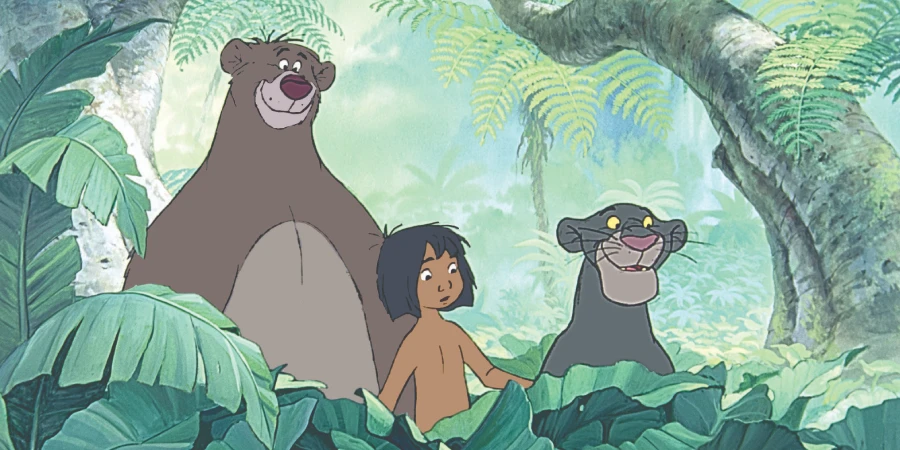

Disney’s animated classic The Jungle Book (1967) is one of the most beloved films from the studio’s golden era. Directed by Wolfgang Reitherman, this film marked the final animated feature personally overseen by Walt Disney before his death. Loosely inspired by The Jungle Book by Rudyard Kipling, Disney’s version is lighter, more musical, and far more playful than its literary source.
Detailed Summary
Mowgli Found in the Jungle
The story begins when Bagheera the panther discovers an abandoned human baby in the Indian jungle. Knowing that humans don’t survive long alone in the wild, he entrusts the child to a family of wolves. The boy, named Mowgli, grows up believing he is part of the pack.
Years later, the wolves learn that Shere Khan, a fearsome tiger who hates humans, has returned. The wolf pack fears that Mowgli’s presence will bring danger. Bagheera decides the only safe option is to take Mowgli back to the nearby man-village.
This decision sets the entire adventure in motion.
Enter Baloo – The Jungle’s Coolest Bear
On the journey, Mowgli meets Baloo, a laid-back bear who teaches him the carefree philosophy of jungle life. Their friendship forms the emotional core of the film. The song “The Bare Necessities” becomes the film’s anthem of simplicity and joy.
Mowgli is tempted to stay in the jungle with Baloo, rejecting the idea of returning to the human world. This conflict between belonging and safety becomes central to the story.
King Louie and the “Man’s Red Flower”
Mowgli is kidnapped by monkeys and taken to King Louie, who desperately wants to learn the secret of “man’s red flower” — fire. Louie believes that if he gains fire, he can become powerful like humans.
Baloo and Bagheera rescue Mowgli in a chaotic and hilarious sequence. The temple collapses during the escape, symbolizing how dangerous the pursuit of human power can be.
Kaa and Hypnotic Danger
Throughout the film, Kaa the python repeatedly attempts to hypnotize and eat Mowgli. These scenes add comic tension rather than true horror, reflecting Disney’s lighter tone compared to Kipling’s darker original stories.
The Vultures and the Approach of Shere Khan
After Mowgli runs away from Baloo and Bagheera out of frustration, he encounters four Liverpudlian vultures who resemble a certain British rock band. This sequence adds humor before the film shifts into its final confrontation.
Soon after, Shere Khan finally confronts Mowgli. Unlike other characters, Shere Khan is calm, intelligent, and terrifyingly confident. His menace feels grounded rather than exaggerated.
Movie Ending
The final act unfolds at night, heightening the tension. Shere Khan corners Mowgli and mocks him for thinking he belongs in the jungle. Baloo intervenes, sacrificing himself to protect the boy. For a brief moment, it appears Baloo has been killed after being struck down by Shere Khan.
This is one of the film’s most emotionally charged scenes. Bagheera mourns, believing Baloo to be dead. The jungle falls silent. Mowgli is devastated.
However, Baloo survives. The mood shifts from grief to relief, reinforcing the film’s preference for warmth over tragedy.
Mowgli then gains access to the “red flower” — fire — taken from the man-village. He ties a burning branch to Shere Khan’s tail. Terrified of fire, Shere Khan panics and flees into the jungle, defeated not by strength but by fear of humanity’s power.
Here’s where the emotional resolution truly happens.
After the danger has passed, Mowgli sees a young girl from the village collecting water. She sings softly and intentionally drops her water pot to get his attention. Mowgli, clearly intrigued and drawn toward his own kind, picks up the pot and follows her back to the village.
Baloo initially protests, saddened by the thought of losing his friend. But Bagheera gently reminds him that this is where Mowgli belongs.
The final image shows Baloo and Bagheera walking away together, accepting that Mowgli has found his place. The film closes on a bittersweet but ultimately optimistic note. Mowgli chooses humanity, not because he is forced, but because he is ready.
It’s a surprisingly mature ending wrapped in Disney charm.
Are There Post-Credits Scenes?
No. The Jungle Book (1967) does not have a post-credits scene. The film ends traditionally, as was standard for animated films of that era.
Type of Movie
The Jungle Book (1967) is an animated musical adventure film with strong family and coming-of-age elements. It blends light comedy with subtle emotional depth, making it both entertaining and thematically meaningful.
Cast (Voice Actors)
- Phil Harris as Baloo
- Sebastian Cabot as Bagheera
- George Sanders as Shere Khan
- Sterling Holloway as Kaa
- Louis Prima as King Louie
- Bruce Reitherman as Mowgli
Notably, Bruce Reitherman was the son of director Wolfgang Reitherman.
Film Music and Composer
The songs were written by Richard M. Sherman and Robert B. Sherman, the legendary Sherman Brothers. The score was composed by George Bruns.
Iconic songs include:
- “The Bare Necessities”
- “I Wan’na Be Like You”
- “Trust in Me”
“The Bare Necessities” was nominated for an Academy Award for Best Original Song.
Filming and Production Background
As an animated film, it wasn’t shot on physical jungle locations. It was produced at Walt Disney Productions animation studios in California.
The jungle aesthetic was intentionally stylized rather than realistic. Disney wanted warmth and color rather than Kipling’s harsher wilderness. The simplified backgrounds helped keep focus on character animation and personality-driven performances.
Awards and Nominations
- Academy Award nomination for Best Original Song (“The Bare Necessities”)
- Grammy nomination for Best Recording for Children
- Widely recognized as one of Disney’s most successful animated re-releases in theaters
Behind the Scenes Insights
- Walt Disney personally rejected early, darker script drafts for being too faithful to Kipling.
- The Beatles were reportedly considered for the vultures, but scheduling conflicts prevented it.
- Louis Prima improvised much of King Louie’s personality, influencing the animation itself.
- This was the last animated feature released before Walt Disney’s death in 1966.
- Phil Harris was cast because Disney loved his natural, relaxed speaking voice.
Inspirations and References
The film is based on The Jungle Book, but Disney dramatically softened the tone. Kipling’s original stories are darker, more philosophical, and sometimes brutal.
The vultures’ design references 1960s British pop culture, particularly the style of The Beatles.
Alternate Endings and Deleted Concepts
- Early drafts included a much darker ending with Shere Khan more violently defeated.
- King Louie does not exist in Kipling’s original book and was created specifically for the film.
- Some early story concepts portrayed Bagheera as sterner and less warm.
Disney deliberately simplified the narrative to emphasize character chemistry over plot complexity.
Book Adaptations and Differences
Compared to Kipling’s book:
- The novel features episodic stories; the film creates one continuous journey.
- The book’s tone is more serious and moralistic.
- Shere Khan is more politically manipulative in the book.
- The film eliminates many jungle characters from the source material.
- The ending in the book is more emotionally conflicted and less whimsical.
Disney’s version focuses on friendship and charm rather than law and survival.
Memorable Scenes and Quotes
Key Scenes
- Baloo and Mowgli singing “The Bare Necessities” in the river
- King Louie’s jazzy performance in the ruined temple
- The nighttime showdown between Baloo and Shere Khan
- Mowgli silently choosing to follow the village girl
Iconic Quotes
- “Look for the bare necessities.”
- “Trust in me.”
- “Now don’t try to kid me, man-cub.”
Easter Eggs and Hidden Details
- The vultures’ haircuts subtly mimic 1960s British rock style.
- Baloo’s personality inspired later Disney sidekick archetypes.
- Some recycled animation techniques were later reused in other Disney films.
- Shere Khan’s calm politeness contrasts sharply with other Disney villains, making him uniquely unsettling.
Trivia
- It became one of Disney’s highest-grossing animated films of the 1960s.
- It was re-released theatrically multiple times over decades.
- Bruce Reitherman also voiced Christopher Robin in another Disney film.
- The film helped redefine Disney animation after the studio struggled in the early 1960s.
Why Watch?
Because it represents classic Disney at its most charming. The animation is warm, the songs are unforgettable, and the characters feel timeless. It’s lighter than the source material but emotionally honest in its own way.
It’s also historically important as the last film shaped by Walt Disney himself.
Director’s Other Works (Wolfgang Reitherman)
- One Hundred and One Dalmatians (1961)
- The Sword in the Stone (1963)
- The Aristocats (1970)
- Robin Hood (1973)
- The Rescuers (1977)
Recommended Films for Fans
- The Jungle Book (2016)
- Tarzan (1999)
- The Lion King (1994)
- Bambi (1942)
- The Fox and the Hound (1981)