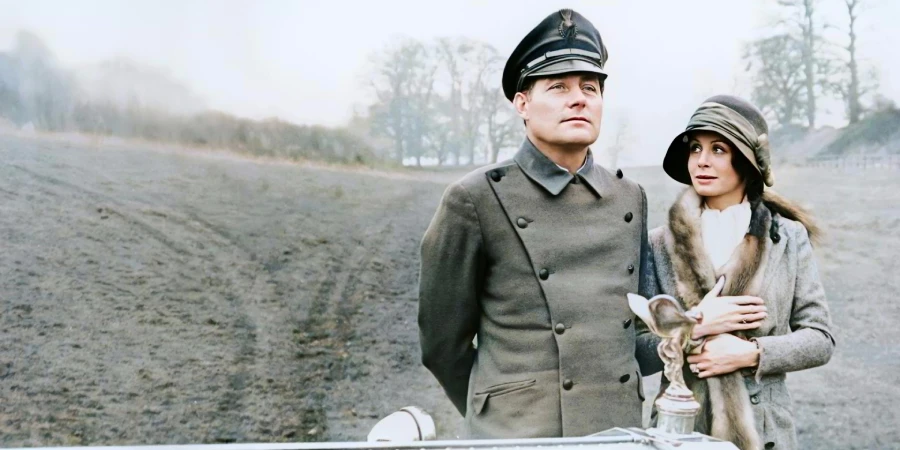

Class barriers act as invisible prison walls in Alan Bridges’ 1973 masterpiece. This film strips away the romanticism usually found in period dramas to reveal something much colder. Hardened driver Stephen Ledbetter finds himself obsessed with a woman he can never truly possess.
Detailed Summary
A Fragile Recovery
Lady Hallam leaves a mental health clinic after suffers a nervous breakdown following her husband’s death. She remains fragile and deeply isolated within her social circle. Therefore, she hires Stephen Ledbetter to drive her between her estate and the city.
Ledbetter interprets her polite conversation as a sign of romantic interest. He begins to believe that they share a deep, spiritual connection during their quiet car rides. However, he fails to realize that she merely views him as a reliable employee.
The False Hope
Ledbetter starts to spruce up his car and his appearance to impress his employer. He even helps her reconnect with the outside world by teaching her to drive. Meanwhile, Lady Hallam begins to regain her confidence and social footing.
She meets Captain Hugh Cantrip and quickly falls for his traditional upper-class charm. This budding romance blinds her to the growing resentment stewing in the front seat of her limousine. Consequently, Ledbetter watches their interactions with a mixture of jealousy and disbelief.
A Brutal Rejection
The tension reaches a breaking point when Ledbetter finally confesses his feelings to Lady Hallam. He believes his loyalty and service have earned him a place by her side. In contrast, she reacts with genuine shock and a hint of repulsion at his boldness.
Lady Hallam makes it clear that their relationship remains strictly professional. This rejection shatters Ledbetter’s carefully constructed fantasy world. As a result, his professional veneer collapses into a state of volatile aggression.



Movie Ending
Ledbetter loses all sense of restraint after realizing he is nothing more than a servant to Lady Hallam. He gets drunk and invades a high-society party to confront her and her new suitor. Specifically, he reveals the truth about Cantrip’s infidelities to humiliate her in front of her peers.
His outburst serves as a desperate act of social sabotage. He then forces her into the car for one final, terrifying ride through the foggy night. During this sequence, he mocks her vulnerability and his own subservience with savage intensity.
The film concludes with Ledbetter returning home in a state of total mental collapse. He begins to smash his beloved car, destroying the very tool that defined his life and status. Ultimately, the story ends on a note of utter despair as both characters remain trapped in their respective social cages.
Are There Post-Credits Scenes?
No post-credits scenes exist for this production. The credits roll over a silent, somber screen to maintain the heavy emotional impact of the finale. Viewers should expect a traditional 1970s ending without any additional footage.
Type of Movie
The Hireling functions as a psychological drama with strong elements of social commentary. It maintains a bleak and clinical tone that avoids the sentimentality typical of British heritage cinema. The atmosphere feels increasingly claustrophobic as the obsession grows.
Cast
- Robert Shaw – Stephen Ledbetter
- Sarah Miles – Lady Hallam
- Peter Egan – Captain Hugh Cantrip
- Caroline Mortimer – Connie
- Elizabeth Sellars – Lady Hallam’s Mother
- Ian Hogg – Davis
Film Music and Composer
Marc Wilkinson composed the haunting and minimalist score for this film. He uses strings to create an underlying sense of unease that mirrors the protagonist’s mental state. Notably, the music remains sparse to emphasize the silence between the two leads.


Filming Locations
The production utilized various locations throughout Hertfordshire and Buckinghamshire to capture the post-World War I era. These grand country houses provide a stark contrast to the cramped interior of the car. Such settings highlight the physical and emotional distance between the different social classes.
Awards and Nominations
The Hireling won the prestigious Grand Prix at the 1973 Cannes Film Festival. This victory cemented its status as a significant work of world cinema.
Behind the Scenes Insights
- Robert Shaw reportedly pushed for a more aggressive interpretation of his character to avoid audience sympathy.
- The director insisted on long takes within the car to increase the feeling of confinement for the actors.
- Production designers focused on muted color palettes to reflect the somber themes of grief and class rigidity.
Inspirations and References
The primary inspiration for the film is the 1957 novel of the same name. It draws heavily from the real-world shift in British social dynamics following the Great War. Furthermore, the narrative mirrors the tragic themes found in classic Victorian literature regarding forbidden love and social climbing.
Alternate Endings and Deleted Scenes
Public records do not indicate any filmed alternate endings. Director Alan Bridges remained committed to the original bleak vision found in the source material. Some shorter television edits exist, but they only remove minor transitional shots for time constraints.
Book Adaptations and Differences
L.P. Hartley wrote the original novel which serves as the foundation for this movie. While the book dives deeper into Ledbetter’s internal monologue, the film relies on Robert Shaw’s physical performance. Additionally, the movie ending feels significantly more violent and visceral than the prose version.


Memorable Scenes and Quotes
Key Scenes
- The driving lessons where the physical proximity creates a false sense of intimacy.
- The confrontation at the party where Ledbetter finally breaks his professional silence.
- The frantic destruction of the car in the final moments of the film.
Iconic Quotes
- “I’m not a man to you, am I? I’m just a part of the machinery.”
- “You think your grief makes you special, but it just makes you blind.”
Easter Eggs and Hidden Details
- The car used in the film is a 1920s Rolls-Royce Twenty, symbolizing the peak of luxury and division.
- Subtle changes in Ledbetter’s uniform reflect his increasing delusion of being an equal to Lady Hallam.
- Shadows often bisect the screen when the two characters talk, visually representing the class line between them.
Trivia
- This film shared the top prize at Cannes with Scarecrow starring Al Pacino.
- Robert Shaw was already a major international star when he took this experimental role.
- Critics often compare this movie to The Go-Between, another adaptation of a Hartley novel.
Why Watch?
This film offers a devastating look at human obsession and social boundaries. Robert Shaw delivers a powerhouse performance that will leave you chilled. Moreover, its sharp writing provides a timeless critique of how we perceive status and worth.
Director’s Other Movies
- The Return of the Soldier (1982)
- The Shooting Party (1985)
- Brief Encounter (1974)
Recommended Films for Fans
- The Servant (1963)
- The Go-Between (1971)
- Remains of the Day (1993)