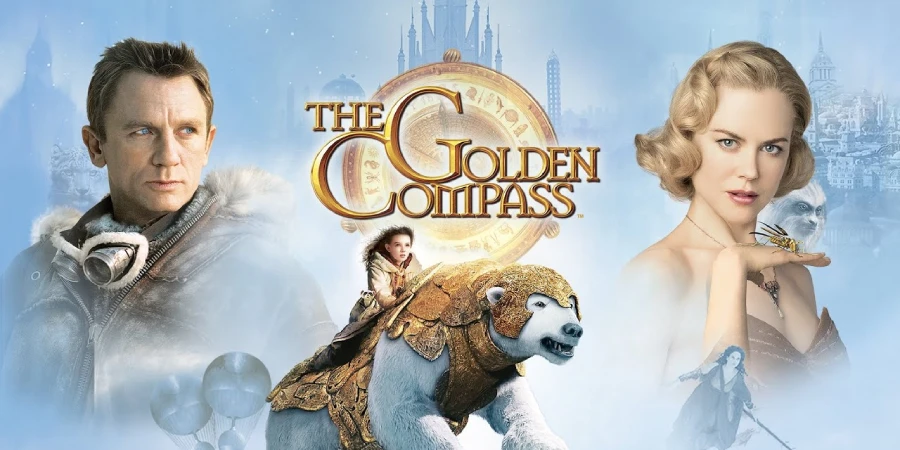
The Golden Compass is a high-fantasy adventure film directed by Chris Weitz and based on Philip Pullman’s novel Northern Lights, the first book in the His Dark Materials trilogy. The movie blends epic fantasy, steampunk aesthetics, and philosophical themes—but it also has a famously complicated legacy.
Detailed Summary
Lyra’s World and the Concept of Dust
The film is set in an alternate universe where every human has a visible animal companion called a dæmon, representing the person’s soul. Lyra Belacqua, a brave and impulsive orphan, lives at Jordan College, Oxford.
A mysterious substance called Dust becomes central early on. The ruling religious authority, the Magisterium, believes Dust is sinful and linked to free will. Their goal is control, especially over children.
The Golden Compass (Alethiometer)
Lyra is entrusted with a rare truth-telling device known as the Alethiometer, often called the Golden Compass. Only a few people can read it intuitively, and Lyra proves to be one of them. This sets her up as a chosen figure in a much larger cosmic conflict.
Child Abductions and the Gobblers
Children across the world are being kidnapped by a shadowy group called the Gobblers. Lyra’s best friend Roger disappears, pushing her to leave Oxford and begin a dangerous journey north.
Mrs. Coulter’s True Nature
Lyra travels to London with the elegant and charismatic Mrs. Coulter, who initially seems like a benefactor. Over time, Lyra discovers that Mrs. Coulter is deeply involved with the Gobblers and horrifying experiments on children.
The biggest shock comes when Lyra learns that Mrs. Coulter is actually her mother, a revelation that adds emotional weight and moral complexity to the story.
The North, Witches, and Armored Bears
Lyra escapes and journeys north, joining:
- Lee Scoresby, a Texan aeronaut
- Iorek Byrnison, an exiled armored bear
- Serafina Pekkala, a witch queen
Here the story becomes more epic, revealing a looming war between witches, bears, and the Magisterium.
Intercision: The Cruel Experiment
The Gobblers’ true goal is revealed: separating children from their dæmons in a process called intercision. This is meant to stop Dust from settling on them, effectively stripping away their humanity.
Lyra witnesses the emotional and physical devastation caused by these experiments, making this one of the film’s darkest and most disturbing elements.


Movie Ending
The final act takes place at Bolvangar, the Gobblers’ research station. Lyra successfully sabotages the intercision facility, causing chaos and rescuing imprisoned children. Mrs. Coulter flees after failing to stop Lyra, and her internal conflict becomes clearer—she is torn between ambition and maternal instinct.
Meanwhile, Lord Asriel, Lyra’s father, is imprisoned by the Magisterium for his heretical beliefs about Dust and parallel worlds. Lyra believes she is rescuing him, but the truth is far more tragic.
Lord Asriel uses Roger, Lyra’s kidnapped friend, as part of a massive experimental device. By forcibly separating Roger from his dæmon, Asriel generates enough energy to tear open a bridge to another universe. Roger dies in the process.
This moment is crucial:
- Lyra realizes that the adults she trusted have manipulated her
- Lord Asriel accepts the cost, believing the destruction of innocence is necessary to challenge divine authority
The film ends with Lyra, devastated but determined, choosing to follow Asriel into the newly opened parallel world. She resolves to stop him and uncover the truth about Dust, setting up the events of the remaining books.
Notably, the ending is more hopeful and less bleak than the novel, as a darker final chapter was intentionally removed by the studio.
Are There Post-Credits Scenes?
No. There are no mid-credits or post-credits scenes in The Golden Compass. Once the credits roll, the story is over.
Type of Movie
The Golden Compass is a fantasy adventure film with strong elements of steampunk and philosophical science fiction, aimed at both younger audiences and adults interested in deeper thematic material.
Cast
- Dakota Blue Richards – Lyra Belacqua
- Nicole Kidman – Mrs. Coulter
- Daniel Craig – Lord Asriel
- Sam Elliott – Lee Scoresby
- Eva Green – Serafina Pekkala
- Ian McKellen – Iorek Byrnison (voice)
- Freddie Highmore – Pantalaimon (voice)
Film Music and Composer
The score was composed by Alexandre Desplat. His music balances wonder and melancholy, reinforcing the sense of destiny and loss. The main theme is especially memorable for its quiet sadness beneath the adventure.
Filming Locations and Their Importance
- Oxford, England – Used to represent Jordan College, grounding the fantasy in a recognizable academic world
- Norway and Switzerland (exteriors) – Inspired the icy northern landscapes
- Shepperton Studios, UK – Major indoor sets including Bolvangar and Magisterium interiors
These locations helped contrast warm intellectual spaces with cold authoritarian ones, reinforcing the film’s themes visually.
Awards and Nominations
- Academy Award (2008) – Won Best Visual Effects
- BAFTA nominations for visual effects and production design
- Multiple nominations from the Visual Effects Society
Despite mixed reviews, the film was widely praised for its technical achievements.
Behind-the-Scenes Insights
- The studio demanded significant rewrites to remove overt religious criticism
- The original darker ending was cut to make the film more family-friendly
- Philip Pullman publicly supported the cast but criticized the studio interference
- Nicole Kidman filmed many scenes with a real ferret on set to perfect dæmon interactions
Inspirations and References
- Based directly on Philip Pullman’s Northern Lights (1995)
- Inspired by Paradise Lost by John Milton
- Draws thematic parallels with Narnia, but with a deliberately opposing worldview on authority and innocence
Alternate Endings and Deleted Scenes
- A much darker ending faithful to the book was filmed but removed
- Deleted scenes included extended Magisterium debates about Dust
- These changes are often cited as a reason the franchise stalled
Book Adaptation and Key Differences
- The book ends with Roger’s death and immediate emotional fallout; the film softens this
- Religious themes are heavily diluted in the movie
- Lyra is more mischievous and morally ambiguous in the novel
These differences significantly altered the story’s impact.

Memorable Scenes and Quotes
Key Scenes
- Lyra reading the Alethiometer for the first time
- The armored bear duel between Iorek and Ragnar
- The intercision chamber sequence
- The opening of the bridge between worlds
Iconic Quotes
- “The alethiometer tells the truth.”
- “I’m going to change destiny.”
- “There are worlds beyond ours.”
Easter Eggs and Hidden Details
- Alethiometer symbols are accurate to the book illustrations
- Mrs. Coulter’s dæmon never speaks, hinting at her emotional repression
- Background Magisterium architecture references real-world religious imagery
Trivia
- This was Dakota Blue Richards’ first acting role
- Over 400 visual effects artists worked on the film
- The bears were entirely CGI but animated using real animal movement studies
Why Watch?
Watch The Golden Compass if you enjoy rich fantasy worlds, morally complex stories, and visually ambitious filmmaking. While flawed, it remains a fascinating “what could have been” adaptation and a strong standalone fantasy experience.
Director’s Other Works (Movies)
- About a Boy (2002)
- The Twilight Saga: New Moon (2009)
- A Better Life (2011)
- Rogue One: A Star Wars Story (2016) – co-writer