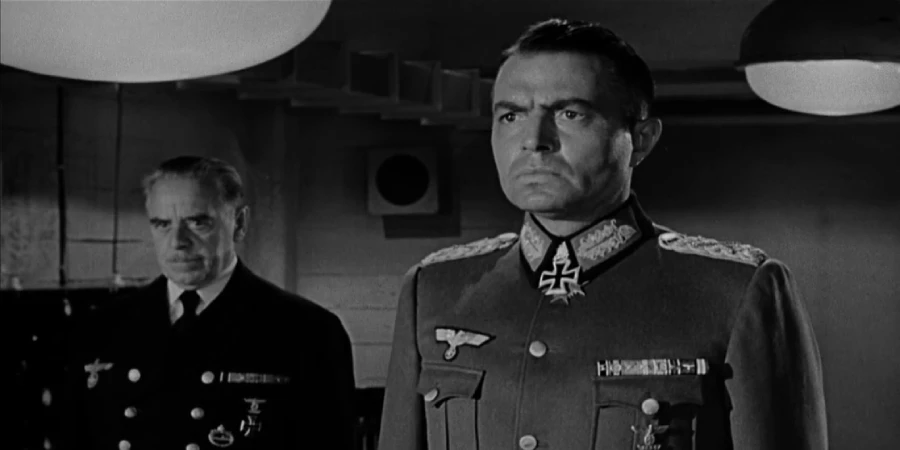

The Desert Fox: The Story of Rommel is a classic World War II biographical war drama directed by Henry Hathaway. Released only six years after the end of the war, the film was controversial for its time because it portrayed a German field marshal with nuance rather than simple villainy. The result is a thoughtful, dialogue-driven war film that focuses less on battlefield spectacle and more on morality, loyalty, and resistance under dictatorship.
Detailed Summary
The North African Campaign Begins
The film opens during World War II as Field Marshal Erwin Rommel is sent to North Africa to lead the German Afrika Korps. Despite limited supplies and constant pressure from Hitler’s high command, Rommel quickly proves himself to be a tactical genius.
Through swift tank maneuvers and unexpected attacks, he repeatedly outsmarts British forces. These early sequences establish why Rommel earned the nickname “The Desert Fox.”
Rommel’s Leadership and Moral Code
Unlike stereotypical portrayals of Nazi officers, Rommel is shown as a disciplined and honorable soldier. He treats prisoners of war humanely and openly criticizes the Nazi Party’s brutality.
The film makes an important distinction early on:
Rommel serves Germany, not Hitler.
This moral separation becomes the central conflict of the movie.
Growing Conflict With Hitler
As the war intensifies, Rommel begins to clash with Hitler’s increasingly irrational commands. He is ordered to fight to the last man, even when defeat is inevitable.
Rommel openly questions:
- suicidal military orders
- the refusal to retreat
- the cost of blind obedience
His popularity among both German troops and Allied commanders begins to worry the Nazi leadership.
The Tide Turns Against Germany
Following major defeats in North Africa, Rommel is recalled to Europe. He is placed in charge of defending the Atlantic Wall against an expected Allied invasion.
As he inspects the defenses, Rommel realizes that Germany cannot win the war. He becomes convinced that Hitler must be removed to save the country from total destruction.
Contact With the German Resistance
Rommel is quietly approached by officers involved in the German resistance movement. They are planning to overthrow Hitler.
Although Rommel refuses to participate in assassination, he agrees that Hitler must be arrested and removed from power. This distinction later becomes tragically important.
The July 20 Plot Fails
After the assassination attempt against Hitler on July 20, 1944 fails, the Gestapo launches a massive investigation.
Rommel’s name appears repeatedly in interrogations. Though he was not directly involved, his opposition to Hitler becomes known.
The regime now faces a dilemma:
- executing Rommel would destroy morale
- sparing him risks exposing Nazi crimes


Movie Ending
Hitler’s representatives arrive at Rommel’s home and present him with an ultimatum:
- Stand trial before the People’s Court, which would lead to execution and persecution of his family
- Or commit suicide in exchange for protection of his family and a state funeral
Rommel is given only minutes to decide.
Understanding that a public trial would disgrace his family and be used as propaganda, Rommel chooses death. He says goodbye to his wife and son, enters the car with the officers, and takes poison.
The film does not show his death directly. Instead, it cuts to:
- a grand Nazi funeral ceremony
- Hitler publicly praising Rommel as a fallen hero
- the truth of his forced suicide concealed from the German people
The narrator concludes by stating that Rommel was neither traitor nor fanatic, but a soldier who ultimately chose conscience over blind obedience.
The ending reinforces the film’s central idea:
even within a criminal regime, moral resistance was possible—but rarely survivable.
Are There Post-Credits Scenes?
No. There are no post-credits or mid-credits scenes. The film ends definitively with narration and fades out in traditional early-1950s style.
Type of Movie
The Desert Fox is a historical war drama and biographical film that emphasizes political tension, ethical conflict, and character study rather than battlefield action.
Cast
- James Mason as Field Marshal Erwin Rommel
- Cedric Hardwicke as Winston Churchill (narration)
- Jessica Tandy as Lucie Rommel
- Luther Adler as Adolf Hitler
- Gerald Mohr as General Wilhelm Keitel
- Leo G. Carroll as Field Marshal von Rundstedt
Film Music and Composer
The score was composed by Paul Sawtell, whose restrained orchestral music avoids heroic bombast. The soundtrack emphasizes seriousness and inevitability, supporting the film’s somber tone rather than glorifying war.



Filming Locations
The movie was filmed primarily in:
- California desert regions (standing in for North Africa)
- Studio sets in Hollywood
The desert locations were essential in visually conveying the scale and isolation of the African campaign, reinforcing Rommel’s tactical brilliance in harsh terrain.
Awards and Nominations
- Nominated for several international film honors in the early 1950s
- Widely praised by critics for James Mason’s performance
- Notable recognition came more from historical and academic circles than formal award ceremonies
Behind the Scenes Insights
- The film was produced only six years after WWII, causing public controversy upon release.
- Some Allied veterans protested the film for portraying a German general sympathetically.
- The U.S. government quietly supported the film as part of postwar reconciliation with West Germany.
- James Mason conducted extensive historical research before portraying Rommel.
- Winston Churchill personally approved the film’s message of moral distinction between Nazism and German soldiers.
Inspirations and References
- Based primarily on the biography “Rommel: The Desert Fox” by Desmond Young
- Influenced by postwar Allied efforts to document internal German resistance
- Historical military records from both British and German archives
Alternate Endings and Deleted Scenes
No alternate endings were filmed.
However, several scenes were removed that:
- expanded Rommel’s battlefield tactics in Africa
- showed more explicit Gestapo brutality
These were cut to keep the focus on moral conflict rather than action.
Book Adaptations and Differences
While closely following Desmond Young’s biography, the film simplifies certain historical debates:
- Rommel’s involvement in the resistance is portrayed more positively
- His awareness of assassination plans is intentionally ambiguous
- The movie avoids discussion of Rommel’s earlier loyalty to Hitler
These choices were deliberate, aiming to emphasize ethical awakening rather than political complexity.


Memorable Scenes and Quotes
Key Scenes
- Rommel walking alone through the desert battlefield after victory
- His confrontation with Hitler over retreat orders
- The quiet dinner scene where Rommel admits Germany cannot win
- The final ultimatum scene at his home
Iconic Quotes
- “I have served Germany, not the Führer.”
- “Obedience is not the same as honor.”
- “A soldier may follow orders, but a man must answer to his conscience.”
Easter Eggs and Hidden Details
- Rommel’s map markings match authentic Afrika Korps documents.
- The funeral speech closely mirrors real Nazi propaganda transcripts.
- Churchill’s narration quotes from actual wartime speeches.
- Rommel’s uniform insignia subtly changes to reflect his demotions and recalls.
Trivia
- The film was banned temporarily in some European countries.
- It was one of the first Hollywood films to portray a German officer sympathetically.
- James Mason later called this one of his most meaningful roles.
- The movie directly influenced later WWII films focused on internal resistance.
Why Watch?
You should watch The Desert Fox if you appreciate:
- historically serious war films
- morally complex storytelling
- performances driven by dialogue rather than action
- early cinema that dares to challenge propaganda narratives
It remains one of the most thoughtful WWII films ever made.
Director’s Other Works (with Years)
- Niagara (1953)
- The Sons of Katie Elder (1965)
- True Grit (1969)
- Circus World (1964)
- Call Northside 777 (1948)
Recommended Films for Fans
- The Young Lions (1958)
- The Bridge on the River Kwai (1957)
- Patton (1970)
- Valkyrie (2008)
- Das Boot (1981)
- Downfall (2004)