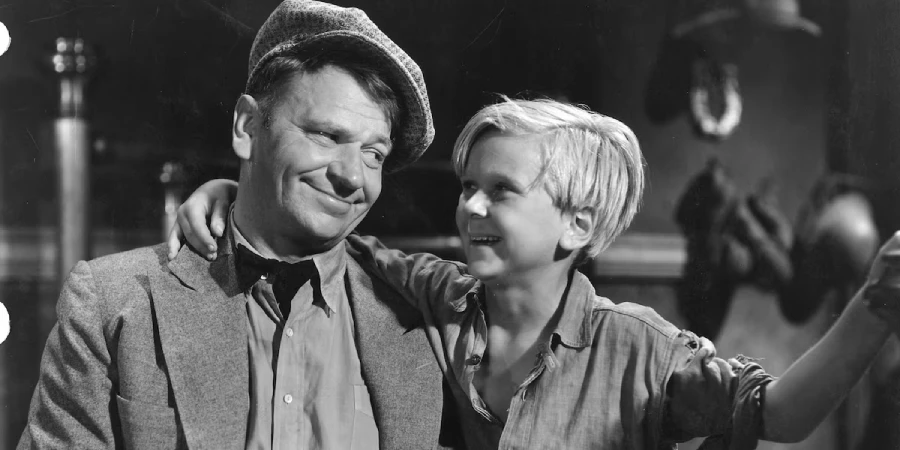

Wallace Beery delivers a performance of raw, alcohol-soaked desperation that remains one of the most heartbreaking portraits of fatherhood ever filmed. This 1931 classic strips away the glitz of old Hollywood to reveal a gritty world of gambling debts and broken promises. Most viewers remember the sobbing child, but the real power lies in the tragic cycle of redemption and relapse.
Detailed Summary
The Bond Between Father and Son
Andy “Champ” Purcell lives in Tijuana with his devoted young son, Dink. Champ was once a world heavyweight boxing champion, but his glory days have long since faded into a blur of whiskey and horse racing. Consequently, Dink acts as the adult in their relationship by managing his father’s meager winnings and keeping him out of trouble.
Champ surprises Dink by gifting him a racehorse named Little Champ as a reward for his unwavering loyalty. The boy cherishes the horse, seeing it as a symbol of their future success. However, Champ loses all their money in a late-night gambling session, proving he cannot escape his self-destructive habits.
A Fateful Encounter
Linda, a wealthy socialite, encounters Dink at the racetrack and feels an immediate, unexplainable connection to the child. She quickly realizes Dink is the son she lost years ago during her messy divorce from Champ. While Linda now leads a stable life with a new husband, she becomes determined to give her son the education and comfort he lacks with his father.
Champ initially refuses to let her near the boy. Eventually, his guilt over his own failures and a stint in jail convince him that Dink deserves a better life. He deliberately pushes the child away by hitting him and acting cruel, hoping Dink will choose to live with Linda for his own safety.
The Final Chance
Dink returns to his father after failing to adjust to his mother’s upper-class world. His reappearance inspires Champ to train for a massive comeback fight against the current Mexican heavyweight champion. This match offers Champ one last shot at providing for his son and restoring his dignity in the ring.

Movie Ending
The comeback fight turns into a brutal, bloody war of attrition that pushes Champ far beyond his physical limits. He refuses to stay down despite taking a vicious beating from a much younger, stronger opponent. Ultimately, Champ summons a final burst of energy to knock out his rival and secure the victory.
The celebratory mood disappears instantly in the dressing room when Champ collapses from a massive heart attack. Dink screams for his father to wake up in a scene that remains one of the most famous tear-jerkers in cinematic history. As Champ dies, the realization hits Dink that his hero is gone forever.
Linda arrives at the arena to comfort her grieving child. Dink finally accepts her presence and agrees to live with her, leaving his father’s corpse behind. This tragic conclusion highlights the high cost of a father’s love and the brutal reality of the boxing world.
Are There Post-Credits Scenes?
No post-credits scenes exist for The Champ. Modern credit sequences did not become standard practice in the film industry until decades later. Viewers should expect the film to end abruptly after the final fade-out of the grieving Dink.
Type of Movie
This film is a quintessential sports drama with heavy tragic elements. It focuses on the emotional bond between a parent and child rather than just the mechanics of boxing. Notably, the tone shifts between gritty realism and sentimental melodrama throughout the runtime.
Cast
- Wallace Beery – Andy “Champ” Purcell
- Jackie Cooper – Dink Purcell
- Irene Rich – Linda
- Roscoe Ates – Sponge
- Edward Brophy – Tim
- Hale Hamilton – Tony
Film Music and Composer
The score features work by several uncredited composers, which was common practice at MGM during this era. Specifically, the music emphasizes the emotional peaks of the father-son relationship through swelling orchestral themes. Most of the soundscape relies on diegetic noise from the stadium and the bustling streets of Tijuana to build atmosphere.

Filming Locations
Production took place primarily at the MGM Studios in Culver City, California. The crew also filmed segments at the Caliente Track in Tijuana to capture authentic racing footage. These locations provide a stark contrast between the dusty, sun-drenched sports arenas and the cold, sterile luxury of Linda’s world.
Awards and Nominations
Wallace Beery won the Academy Award for Best Actor for his portrayal of the crumbling boxer. Additionally, Frances Marion received the Oscar for Best Original Story, while the film earned a nomination for Best Picture.
Behind the Scenes Insights
- Wallace Beery and Jackie Cooper reportedly did not get along well during the rigorous production process.
- Director King Vidor insisted on a realistic boxing style that left Beery physically exhausted after filming.
- The script underwent several revisions to ensure the audience remained sympathetic toward an alcoholic gambler.
Inspirations and References
Frances Marion wrote the story specifically as a vehicle for Wallace Beery. She drew inspiration from real-world stories of washed-up athletes struggling to maintain custody of their children during the Great Depression. Furthermore, the harsh realities of 1930s poverty inform the desperate financial stakes of the plot.
Alternate Endings and Deleted Scenes
No major alternate endings were filmed for this production. MGM executives believed the tragic conclusion was essential for the emotional impact of the movie. Some international markets reportedly requested cut-down versions of the more violent boxing sequences to satisfy local censors.
Book Adaptations and Differences
The Champ is not based on a book. It originated as an original screen story penned by Frances Marion. Consequently, the film lacks the typical literary source material found in other 1930s dramas.
Memorable Scenes and Quotes
Key Scenes
- The painful moment where Champ hits Dink to force him to leave.
- The intense, slow-motion capture of the final knockout in the boxing ring.
- Dink’s iconic, gut-wrenching breakdown in the dressing room after Champ’s death.
Iconic Quotes
- “I want the Champ!”
- “Aw, we’re just a couple of big palookas, ain’t we?”
- “I’m gonna be the best fighter you ever saw, Dink.”
Easter Eggs and Hidden Details
- Many of the extras in the crowd scenes were actual boxing fans recruited from local gyms.
- Jackie Cooper’s tears were reportedly real because a crew member joked about taking his dog away.
- The poster for the final fight features names of real-life local pugilists from the early 1930s.
Trivia
- This film made Jackie Cooper the youngest person ever nominated for a Best Actor Oscar at the time.
- Wallace Beery had to wear a heavy prosthetic to make his face look battered during the final scenes.
- The movie was so successful that it saved MGM from financial trouble during a difficult year.
Why Watch?
This masterpiece defines the sports-drama genre through its raw emotional power. Wallace Beery delivers an unforgettable performance that earned him an Oscar. Ultimately, it provides a timeless look at sacrifice and the complicated love between a father and his son.
Director’s Other Movies
- The Big Parade (1925)
- The Crowd (1928)
- Hallelujah (1929)
- Duel in the Sun (1946)
Recommended Films for Fans
- The Champ (1979)
- Raging Bull (1980)
- The Kid (1921)
- Bicycle Thieves (1948)