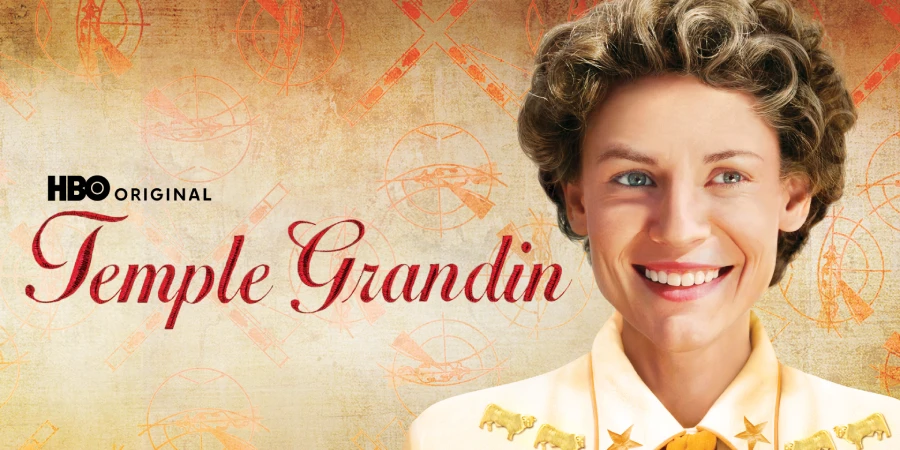

Thinking in pictures is not a metaphor in Temple Grandin; it is the entire visual language of the film. This HBO biopic brilliantly rejects convention, consequently inviting us into the literal mind of its autistic protagonist. As a result, viewers do not just watch Temple’s story, we experience her world firsthand through a cascade of memories, blueprints, and anxieties.
Detailed Summary
A Summer on the Ranch
The film opens with a teenage Temple Grandin (Claire Danes) arriving at her aunt’s Arizona cattle ranch for the summer. Overwhelmed by new sounds and people, she experiences severe anxiety. Interestingly, she finds solace observing the cattle, noting how they are calmed when placed in a squeeze chute for vaccinations. Inspired by this, and longing for the pressure of a hug which she cannot tolerate from people, Temple invents her own “squeeze machine” to calm her senses. This invention becomes a cornerstone of her self-regulation throughout the story.
College and a Key Mentor
Temple subsequently enrolls at Franklin Pierce College, where her social awkwardness makes her an outcast. Her professors and peers misunderstand her behavior, such as her literal interpretation of language and her vocal tics. However, her science teacher, Dr. Carlock (David Strathairn), recognizes her extraordinary visual intelligence. He becomes her mentor, therefore encouraging her to pursue science and helping her channel her unique way of thinking into academic projects. Thanks to his support, she stays in school and builds a new, improved squeeze machine for a science fair project.
From Academia to the Feedlot
After graduating, Temple pursues a master’s degree in animal science. For her thesis, she decides to study the behavior of cattle in feedlots and slaughterhouses. Stepping into this brutish, male-dominated world, she faces immediate and aggressive sexism from the ranch hands and managers. Nonetheless, her unique perspective allows her to see what they do not: the cattle’s world is full of fear triggers. For instance, she notices that shadows, clanking chains, or even a dangling coat can cause the animals to panic.
Revolutionizing an Industry
Temple’s insights are initially dismissed as the ramblings of an eccentric woman. Her persistence, however, is relentless. She lies down in the cattle chutes to see the world from their perspective, sketching out her observations and ideas. A key breakthrough occurs when she designs a curved cattle chute system. This design utilizes the animals’ natural tendency to circle, consequently keeping them calm and moving forward without force. Moreover, she designs a revolutionary dip vat system that allows cattle to swim through the insecticide bath rather than being violently dunked, which significantly reduces their stress and risk of injury.
Acceptance and Advocacy
Despite proving the efficacy of her designs, Temple continually battles for respect. She uses her intelligence and tenacity to win over skeptics, one feedlot at a time. She eventually earns her Ph.D. and becomes a leading consultant in the livestock industry. The film culminates with her attending a national autism conference at the urging of her mother, Eustacia (Julia Ormond). Initially terrified, Temple finds the courage to speak about her experiences, becoming a powerful advocate for the autistic community.


Movie Ending
The ending of Temple Grandin is a powerful moment of synthesis for her personal and professional life. At the 1981 National Autism Convention, Temple is initially too anxious to go inside. From the car, she sees people entering, and her mind visually transforms them into a herd of cattle moving through one of her chute systems. This visual metaphor is a breakthrough; for the first time, she understands a large group of people not as a chaotic threat, but as a manageable system she can navigate.
Consequently, she walks into the convention and, after some encouragement, takes the stage. She speaks to the audience, explaining how her autism gives her a unique perspective that she has channeled into her career. In this moment, she fully embraces her identity as “different, not less.” The film closes with a touching scene where Temple willingly gives her mother a real, heartfelt hug—something she was unable to do for most of her life. This act signifies her immense emotional growth and her newfound ability to connect with people on her own terms.
Are There Post-Credits Scenes?
No, Temple Grandin has no post-credits scenes. The credits roll over footage of the real-life Temple Grandin discussing her work and life, which serves as a poignant epilogue.
Type of Movie
Temple Grandin is a biographical drama. Its tone is deeply empathetic, inspirational, and refreshingly honest. Director Mick Jackson employs a unique visual style, using on-screen text, animated diagrams, and quick-cut flashbacks to simulate Temple’s thought processes. The film, as a result, avoids sentimentality, instead focusing on the pragmatic and intellectual journey of its extraordinary subject.
Cast
- Claire Danes – Temple Grandin
- Julia Ormond – Eustacia Cutler (Temple’s mother)
- David Strathairn – Dr. Carlock (Temple’s science teacher)
- Catherine O’Hara – Ann (Temple’s aunt)
- Barry Tubb – Randy
Film Music and Composer
The score for Temple Grandin was composed by Alex Wurman. The music is generally understated, skillfully supporting the emotional and intellectual beats of the story without overpowering them. For example, Wurman often uses minimalist, rhythmic motifs to reflect Temple’s methodical thinking. The score effectively captures both her moments of intense anxiety and her flashes of brilliant insight, acting as an auditory window into her mind.

Filming Locations
The film was primarily shot in and around Austin, Texas. The production used various ranches and feedlots in the region to authentically replicate the settings of Temple’s early career in Arizona and other parts of the American Southwest. These real-world locations were crucial; in fact, they lend a gritty realism to the film’s depiction of the cattle industry, powerfully contrasting with the clean, schematic diagrams of Temple’s mind.
Awards and Nominations
Temple Grandin was a critical powerhouse, especially at television awards ceremonies. It dominated the 62nd Primetime Emmy Awards, winning seven awards, including Outstanding Made for Television Movie and acting awards for Claire Danes, David Strathairn, and Julia Ormond. In addition, Danes won the Golden Globe Award for Best Actress and the Screen Actors Guild Award for Outstanding Performance by a Female Actor in a Miniseries or Television Movie.
Behind the Scenes Insights
- The real Dr. Temple Grandin was heavily involved in the film’s production. She spent extensive time with Claire Danes and the screenwriters to ensure the portrayal of her life and her way of thinking was accurate.
- Claire Danes meticulously studied hours of footage of Grandin to capture her voice, posture, and mannerisms. Grandin herself praised Danes’ performance, stating it was like watching her past self in a time machine.
- Director Mick Jackson and his team designed the film’s unique visual effects to represent how Grandin thinks. They used her own drawings and descriptions from her books, like Thinking in Pictures, as a direct blueprint.
Inspirations and References
The film is directly inspired by the life and work of the real Dr. Temple Grandin. The screenplay draws heavily from her autobiographical books, including Emergence: Labeled Autistic (1986) and Thinking in Pictures: My Life with Autism (1995). These books provided the filmmakers with not only the story’s plot points but also the crucial first-person insight needed to visually and narratively represent her unique cognitive experience.
Alternate Endings and Deleted Scenes
There are no known alternate endings or officially released deleted scenes for Temple Grandin. As an HBO film, the final cut presented by director Mick Jackson is considered the definitive version of the story.
Book Adaptations and Differences
The film is an adaptation of Temple Grandin’s life story, primarily sourcing from her memoirs Emergence and Thinking in Pictures. It remains remarkably faithful to the source material. However, for narrative cohesion, the film condenses timelines and composites some minor characters. For instance, Dr. Carlock is a composite of two of her real-life mentors. The core themes, her key inventions, and the emotional arc of her journey, on the other hand, are presented with exceptional accuracy and respect for her life’s work.


Memorable Scenes and Quotes
Key Scenes
- The Squeeze Machine: Temple, overwhelmed at her aunt’s ranch, observes cattle being calmed in a squeeze chute. She then builds a human version for herself, a powerful scene that visually establishes her unique way of solving deeply personal problems with engineering.
- The Dip Vat Design: After witnessing cattle drown in a poorly designed dip vat, Temple has a flash of insight. The camera follows her mind’s eye as she lays on the ground, visualizing a new, safer circular system, perfectly illustrating her problem-solving process.
- The “Doorway” of Perception: Temple explains to Dr. Carlock that she thinks of knowledge as a series of opening doors. When a person says a word, like “shoe,” she sees a slideshow of every shoe she has ever seen. This conversation is a brilliant piece of exposition explaining her cognitive function.
Iconic Quotes
- “My name is Temple Grandin. I’m not like other people. I think in pictures, and I connect them.”
- “Different, but not less.”
- “Nature is cruel, but we don’t have to be.”
Easter Eggs and Hidden Details
- Visual Wordplay: Throughout the film, when people speak, key words often appear as text on screen (e.g., on a door, a cabinet, or a wall). This visual device represents how Temple’s mind processes and categorizes verbal information literally.
- The Opening Doors Motif: The film frequently uses imagery of doors opening and closing. This is a direct visual reference to Temple’s own description of her thought process, where each concept is a “door” that opens into a library of images.
- Authentic Attire: Claire Danes‘ western-style shirts are exact replicas of the shirts the real Temple Grandin famously wears.
Trivia
- The real Temple Grandin was present on set for much of the filming, offering real-time feedback to the actors and director.
- Catherine O’Hara, who plays Temple’s Aunt Ann, wears a wig in the film that was designed to perfectly match the hair of Grandin’s actual aunt from photographs.
- The cattle chute systems featured in the movie are fully functional replicas of Grandin’s actual designs.
Why Watch?
This film is a masterclass in empathy and innovative filmmaking. Claire Danes delivers a transformative performance, moreover, the movie’s visual storytelling provides a profound look into a brilliant mind. It is a must-watch for its powerful message of celebrating neurodiversity.
Director’s Other Movies
- L.A. Story (1991)
- The Bodyguard (1992)
- Volcano (1997)
- Denial (2016)