
Submergence is a romantic drama-thriller directed by Wim Wenders, adapted from J.M. Ledgard’s novel. The film weaves together two distant worlds through the emotional and psychological connection of two people separated by geography, danger, and time. It is quiet, contemplative, and deeply atmospheric rather than plot-driven, leaning heavily on mood, memory, and inner monologue.
Detailed Summary
A Chance Encounter in Normandy
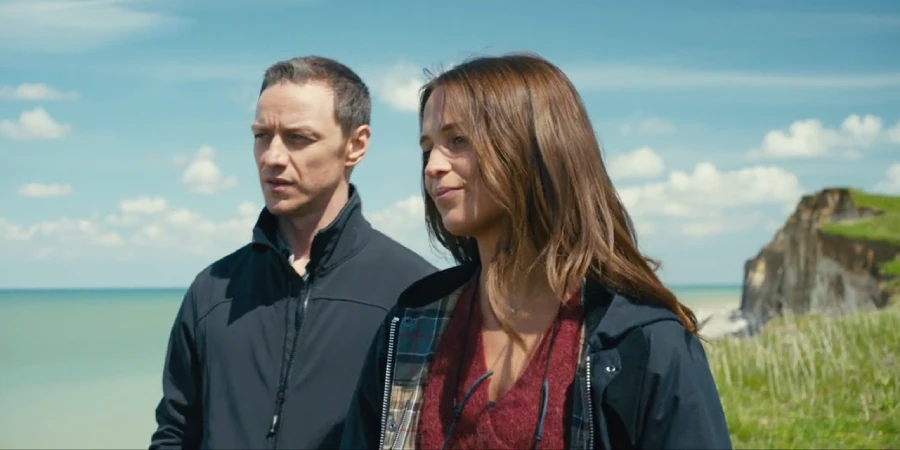
The story begins in a secluded hotel on the coast of Normandy, France. James More (James McAvoy), a British intelligence officer, and Danielle “Danny” Flinders (Alicia Vikander), a bio-mathematician, meet by chance while both are staying there before embarking on separate missions.
Their connection is immediate, intense, and intimate. Over the course of a few days, they fall deeply in love. The film presents these moments with warmth and stillness, establishing the emotional foundation that will carry the rest of the narrative.
Two Separate Journeys
After their brief but profound romance, they part ways.
Danny heads to the North Atlantic to lead a deep-sea research mission, diving into the ocean to study life in the deepest parts of the sea. Her work is scientific, methodical, and filled with curiosity about the origins of life.
James travels to Somalia under the cover of water engineering consultancy, but in reality, he is on an intelligence mission to infiltrate extremist networks.
The film constantly cuts between these two environments: the crushing depths of the ocean and the suffocating tension of a conflict zone. The parallel is deliberate and symbolic. Both characters are entering spaces where humans do not naturally belong.
James’ Capture in Somalia
James’ mission quickly goes wrong. He is captured by jihadist militants and held hostage in a remote desert compound. His interrogations are psychological rather than overtly violent. His captors try to understand his motives, his background, and his beliefs.
Confined to a small room, James begins to mentally retreat into memories of Danny. These memories become his only refuge from fear, isolation, and uncertainty. The film spends considerable time inside his head, blurring present suffering with recollections of love.
Danny’s Descent Into the Ocean
Meanwhile, Danny prepares for and eventually undertakes her dive into the ocean’s abyss in a submersible. Her mission is to reach previously unexplored depths where sunlight has never touched, searching for microbial life that may resemble the origins of life on Earth.
Her journey downward mirrors James’ psychological descent into captivity. Both are isolated in hostile environments and surrounded by darkness and silence. Both think constantly of the other.
The Psychological Connection Across Distance
Throughout the film, there is a persistent emotional thread: James and Danny thinking of each other across impossible distances. The narrative structure suggests that their bond transcends physical separation, almost as if they are spiritually connected.



Movie Ending
As James remains imprisoned, his captors begin to suspect he is not who he claims to be. The pressure mounts, and his situation becomes increasingly hopeless. He realizes that escape is nearly impossible and that his fate is likely sealed.
Rather than wait for execution or further suffering, James makes a quiet but decisive choice. He escapes his confinement briefly and walks into the desert, accepting death on his own terms. The film strongly implies that he dies there, alone, under the vast sky. There is no rescue, no last-minute intervention. His end is quiet, ambiguous, and deeply tragic.
At the same time, Danny is deep in the ocean in her submersible. During her descent, she experiences a moment of emotional intensity where she seems to sense James’ presence or absence. The film leaves this deliberately abstract, suggesting an emotional or metaphysical connection rather than a literal one.
Danny completes her dive and returns to the surface, unaware of James’ fate but visibly changed. She carries the memory of their love and the emotional weight of a connection she feels has shifted. The ending emphasizes that their love was brief but transformative, and that both characters were forever altered by those few days together.
There is no reunion. No confirmation. Only memory, longing, and the sense that love can exist even when lives diverge permanently.
Are There Post-Credits Scenes?
No. Submergence does not include any post-credits or mid-credits scenes.
Type of Movie
Submergence is a romantic drama with thriller elements, told in a slow, reflective, and highly atmospheric style that prioritizes emotion, symbolism, and introspection over action.
Cast
- James McAvoy as James More
- Alicia Vikander as Danielle “Danny” Flinders
- Alexander Siddig as Dr. Shadid
- Reda Kateb as the jihadist leader
Film Music and Composer
The score was composed by Fernando Velázquez, known for emotionally rich orchestral compositions. The music in Submergence is subtle and restrained, enhancing the film’s introspective tone rather than dominating scenes.



Filming Locations and Their Importance
The film was shot across several countries to reflect the geographical and emotional scale of the story.
- Normandy, France for the opening romantic sequences, representing warmth, stillness, and intimacy
- Djibouti and parts of Africa to recreate the harsh Somali environment, emphasizing isolation and danger
- Germany and Spain for controlled studio work, especially for the underwater and submersible scenes
These locations are essential because they visually reinforce the emotional contrast between love, danger, and isolation.
Awards and Nominations
The film premiered at the Toronto International Film Festival. While it did not receive major awards, it was recognized for its cinematography and performances at several European film festivals.
Behind the Scenes Insights
- Wim Wenders was drawn to the philosophical themes of the novel rather than its thriller aspects
- Much of James McAvoy’s performance relied on long monologues and internal acting due to the confined setting
- The underwater sequences required extensive technical planning and controlled tank filming
- Alicia Vikander spent time with marine researchers to understand the mindset of deep-sea scientists
Inspirations and References
The film is based on the novel Submergence by J.M. Ledgard. Wenders emphasized the book’s existential themes about love, science, faith, and isolation rather than its geopolitical aspects.
Alternate Endings and Deleted Scenes
There are no publicly known alternate endings. Some deleted scenes reportedly included longer conversations between James and his captors, which were cut to keep the pacing more meditative and less political.
Book Adaptations and Differences
The film simplifies several political and philosophical discussions from the book. The novel spends more time exploring James’ intelligence background and Danny’s scientific theories in depth. The movie focuses more on the emotional connection and less on technical or political detail.



Memorable Scenes and Quotes
Key Scenes
- James and Danny’s first conversations in the Normandy hotel
- James’ quiet mental escape into memories while imprisoned
- Danny’s descent into total ocean darkness in the submersible
Iconic Quotes
- James: “Love is the only thing that makes sense in this world.”
- Danny: “We are all searching for where life began.”
Easter Eggs and Hidden Details
- The parallel between ocean depth and psychological depth is visually repeated throughout the film
- Frequent use of reflections and glass symbolizes separation and memory
- The recurring theme of silence mirrors both captivity and deep-sea isolation
Trivia
- The film took several years to move from production to release due to distribution issues
- Wim Wenders described the film as one of his most personal projects
- Much of the dialogue was intentionally sparse to emphasize mood
Why Watch?
If you appreciate films that are emotionally introspective, visually poetic, and thematically rich rather than plot-heavy, Submergence offers a deeply reflective experience about love, memory, and human isolation.
Director’s Other Works (Wim Wenders)
- Paris, Texas (1984)
- Wings of Desire (1987)
- Buena Vista Social Club (1999)
- Pina (2011)
- Perfect Days (2023)
Recommended Films for Fans
- The English Patient (1996)
- A Bigger Splash (2015)
- Arrival (2016)
- The Light Between Oceans (2016)