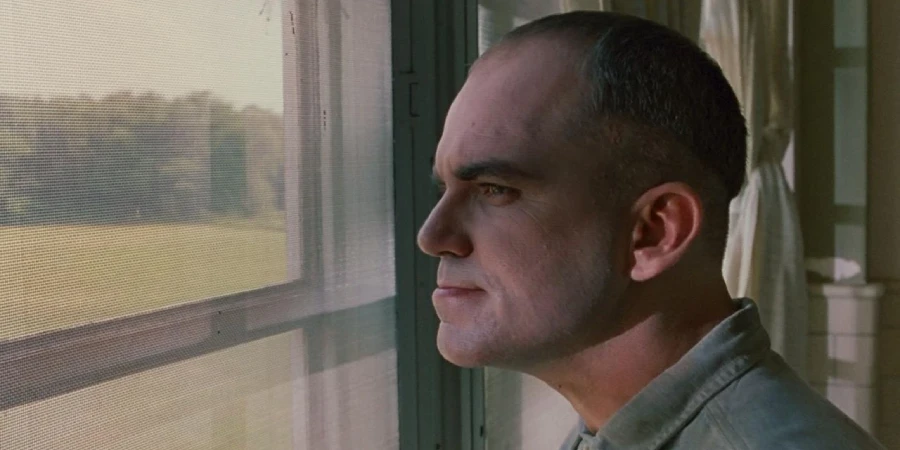

Sling Blade is one of those rare films that feels quiet on the surface but devastating underneath. Written, directed by, and starring Billy Bob Thornton, this 1996 drama is a character study about trauma, morality, and whether redemption is truly possible. It is slow, uncomfortable, and intentionally restrained — and that’s exactly why it still resonates.
Detailed Summary
Karl Childers and the Weight of the Past
The film opens in a mental institution, where Karl Childers, a man with intellectual disabilities, recounts the childhood crime that placed him there: he killed his mother and her lover with a sling blade after witnessing years of abuse. This confession is delivered in a flat, almost emotionless tone, immediately establishing the film’s unsettling atmosphere.
Karl has spent decades institutionalized, learning basic skills and living a highly structured life. When doctors determine he is no longer a threat, he is released into the outside world — a world that has changed far more than he has.
Re-entering Society
Karl is taken in by Linda, a kind but emotionally worn-down woman, and her young son Frank, with whom Karl forms an innocent and deeply touching bond. Frank sees Karl not as “damaged,” but as someone gentle and trustworthy.
At the same time, Linda’s boyfriend Vaughn Cunningham enters the picture. Vaughn is loud, abusive, racist, and volatile — the kind of man who dominates a room through fear and humiliation. His behavior toward Linda and Frank mirrors the violence Karl witnessed as a child, slowly triggering something buried deep inside him.
The Slow Burn of Moral Conflict
As Karl adapts to life outside the institution — working small jobs, attending church, and maintaining a rigid routine — Vaughn’s abuse escalates. The film does not rush this tension. Instead, it lets it simmer, forcing the audience to sit with every uncomfortable interaction.
Karl begins to understand that doing nothing is also a choice, and not always a moral one. His simple worldview clashes with a complex reality where legal justice and ethical justice don’t always align.
Movie Ending
The ending of Sling Blade is quiet, tragic, and morally devastating.
Karl ultimately decides that Vaughn is a danger to Linda and Frank, and that no one else will stop him. In a moment of grim resolve, Karl confronts Vaughn while he is alone and kills him with — fittingly — a sling blade. The act is swift, unemotional, and disturbingly calm.
Afterward, Karl ensures that Linda and Frank are safe. He leaves town without explanation, knowing exactly what comes next. Rather than flee permanently, Karl turns himself in and returns to the mental institution voluntarily.
In the final scenes, Karl is shown back in confinement, calmly accepting his fate. He has knowingly sacrificed his freedom to protect others. There is no triumphant music, no validation, no absolution — only the understanding that Karl believes he has restored balance in the only way he knows how.
The ending raises haunting questions:
Was Karl right?
Was it justice or murder?
Did he regress, or did he make the most moral choice available to him?
The film offers no clear answers — and that ambiguity is its greatest strength.
Are There Post-Credits Scenes?
No. Sling Blade does not include any post-credits or mid-credits scenes. The story ends definitively and intentionally with its final image, leaving the audience alone with its implications.
Type of Movie
Sling Blade is a psychological drama with strong elements of Southern Gothic storytelling. It focuses on character, moral ambiguity, and emotional realism rather than plot-driven momentum.
Cast
- Billy Bob Thornton as Karl Childers
- Dwight Yoakam as Vaughn Cunningham
- Natalie Canerday as Linda Wheatley
- Lucas Black as Frank Wheatley
- John Ritter as Jacob
- J.T. Walsh as Dr. Mead
Film Music and Composer
The score was composed by Daniel Lanois, whose minimalist, atmospheric music perfectly complements the film’s slow pacing and emotional weight. The music is sparse, often fading into silence, allowing performances and dialogue to dominate.
Filming Locations
Sling Blade was filmed primarily in Arkansas, particularly in small rural towns. These locations are crucial to the film’s authenticity — the modest homes, empty roads, and quiet interiors reflect Karl’s internal isolation and the insular nature of the community. The setting is not just a backdrop; it reinforces the film’s themes of stagnation, tradition, and quiet violence.
Awards and Nominations
- Academy Award – Best Adapted Screenplay (Winner) – Billy Bob Thornton
- Academy Award – Best Actor (Nominee) – Billy Bob Thornton
- Golden Globe – Best Screenplay (Nominee)
- Independent Spirit Awards – Multiple nominations
Behind the Scenes Insights
- Billy Bob Thornton based Karl’s voice and mannerisms on people he knew growing up in Arkansas.
- The film was adapted from Thornton’s earlier short film Some Folks Call It a Sling Blade.
- John Ritter intentionally took a serious dramatic role to break away from his comedic image.
- The low budget forced the production to rely heavily on natural lighting and real locations.
Inspirations and References
- Inspired directly by Thornton’s short film Some Folks Call It a Sling Blade (1994).
- Thematically influenced by Southern Gothic literature.
- Draws moral parallels with films like Of Mice and Men and Taxi Driver.
Alternate Endings and Deleted Scenes
There are no known alternate endings. However, several character moments — particularly involving Karl’s institutional life — were trimmed to maintain pacing. The core ending was always intended to remain stark and unresolved.
Book Adaptations and Differences
Sling Blade is not based on a novel, but rather adapted from Thornton’s own short film. The feature-length version expands significantly on character relationships, especially between Karl and Frank, giving the story greater emotional depth.
Memorable Scenes and Quotes
Key Scenes
- Karl’s opening confession in the institution
- Karl teaching Frank how to fix a lawn mower
- The dinner table confrontation with Vaughn
- Karl’s silent return to the institution
Iconic Quotes
- “Some folks call it a sling blade… I call it a Kaiser blade.”
- “I reckon I got no reason to stay.”
- “You shouldn’t talk like that in front of a child.”
Easter Eggs and Hidden Details
- Karl’s repetitive routines subtly change as he gains agency.
- Religious imagery appears frequently but never offers clear moral guidance.
- Silence is often used instead of music during moments of violence, intensifying discomfort.
Trivia
- Billy Bob Thornton lost weight and altered his posture to physically embody Karl.
- The film was shot in just over a month.
- Many supporting actors were locals with minimal acting experience.
- The script was written with no clear commercial expectations.
Why Watch?
Watch Sling Blade if you’re interested in deep character studies, moral complexity, and films that trust the audience to think. It’s not entertaining in a conventional sense — it’s challenging, sobering, and unforgettable.
Director’s Other Works (Movies)
- Some Folks Call It a Sling Blade (1994)
- Daddy and Them (2001)