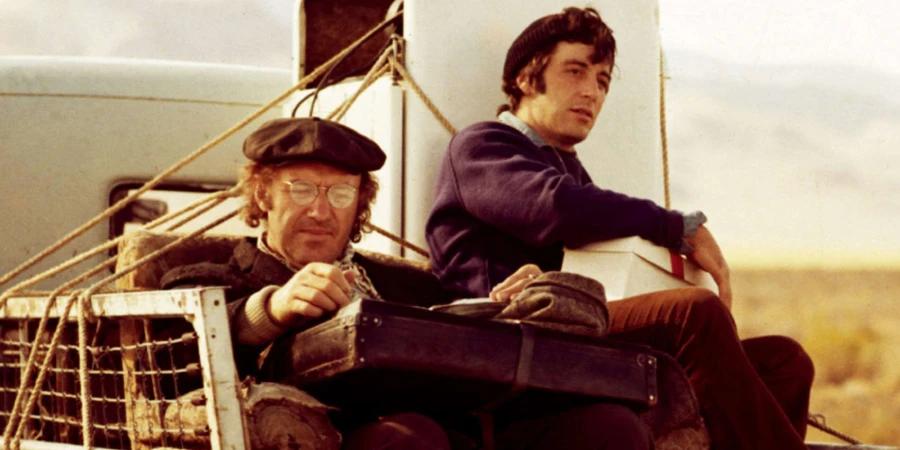

Some friendships are forged in fire, others on the dusty shoulder of a California highway. Scarecrow chronicles the unlikely bond between two drifters, Max and Lion, on a cross-country quest for a fresh start. Their journey, however, navigates a landscape of disillusionment and personal demons. It ultimately culminates not in a triumph, but in a devastating portrait of broken humanity.
Detailed Summary
An Unlikely Partnership
Max Millan, a volatile ex-convict, meets Francis “Lion” Delbuchi, a goofy and childlike former sailor, while hitchhiking in California. Max is heading to Pittsburgh to open a luxury car wash with money he saved before prison. Lion, meanwhile, is on his way to Detroit to meet the child he has never seen.
Max is initially annoyed by Lion’s constant chatter and naive worldview. Lion, however, wins him over with his charm and a peace-offering gift. They decide to become partners in the car wash business, with Lion providing the personality and Max the capital.
The Scarecrow Philosophy
Lion explains his unique philosophy on life using the metaphor of a scarecrow. He believes scarecrows do not scare crows; instead, they make them laugh. As a result, Lion embraces humor and silliness as a way to disarm the world and avoid conflict.
This cheerful outlook directly contrasts with Max’s aggressive, confrontational nature. For instance, Max constantly prepares for fights, while Lion tries to joke his way out of trouble. This fundamental difference defines their early interactions and sets the stage for future conflict.
Detour in Denver
The pair makes a stop in Denver to visit Max’s sister, Coley. Their reunion is tense and awkward, revealing Max’s strained family relationships. Lion’s gentle nature shines as he befriends Coley, offering her a kindness Max seems incapable of giving.
Things take a turn when Max’s attempt to playfully roughhouse with one of Coley’s friends escalates. Consequently, he causes a scene and embarrasses his sister. The visit ends badly, reinforcing Max’s isolation and inability to connect with others.
A Stint in Prison
Looking for a good time, Lion brings Max to a bar where he deliberately provokes a fight to make the perpetually dour Max laugh. His plan works, but their brawl lands them a 30-day sentence on a prison farm. Max’s anger at Lion for the stunt quickly fades into reluctant acceptance of their situation.
In prison, Max takes Lion under his wing, but his protection is not absolute. Lion catches the attention of a predatory inmate named Riley. The psychological torment culminates in Lion being sexually assaulted, an event that deeply traumatizes him and shatters his innocent spirit.
The Final Leg
After their release, Lion is noticeably changed and withdrawn. He has lost his trademark humor and seems haunted. Nonetheless, they press on toward Detroit so Lion can finally give his child a belated gift: an expensive lamp he won at a fair.
Lion calls his ex-girlfriend, Annie, from a payphone, excited to tell her he is coming. The conversation is a brutal blow. Annie reveals she has remarried and told their five-year-old son that his father is dead, a lie she maintains out of anger and fear.
Movie Ending
The devastating phone call triggers a complete psychotic break in Lion. He runs to a nearby park fountain in downtown Detroit, convinced he is baptizing his infant son. He joyfully splashes water on imaginary children, completely detached from reality.
Max watches in horror as Lion descends into a catatonic state, his mind finally fractured by the compounded trauma of the assault and Annie’s rejection. Paramedics arrive and take Lion to a psychiatric hospital. A heartbroken Max tells the hospital staff that he is Lion’s business partner.
In the film’s final moments, Max buys a round-trip ticket to Pittsburgh, vowing to return for Lion. He leaves his car wash savings for Lion’s medical care, completing his transformation from a self-centered brute to a deeply loyal friend. His dream is deferred, but his humanity is finally found.
Are There Post-Credits Scenes?
No, there are no post-credits scenes in Scarecrow. The film ends immediately after Max buys his bus ticket.
Type of Movie
Scarecrow is a road drama and a quintessential example of the New Hollywood cinema of the 1970s. It focuses on character development and social realism over plot mechanics.
Its tone is predominantly melancholy and gritty, exploring themes of loneliness, masculinity, and the death of the American Dream. The film uses moments of dark humor to provide brief, but essential, relief from its heavy subject matter.
Cast
- Gene Hackman – Max Millan
- Al Pacino – Francis “Lion” Delbuchi
- Dorothy Tristan – Coley
- Ann Wedgeworth – Frenchy
- Richard Lynch – Riley
- Eileen Brennan – Darlene
Film Music and Composer
The score for Scarecrow was composed by Fred Myrow. Myrow was also known for his work on the cult horror film Phantasm.
His music for Scarecrow is sparse and melancholic, relying heavily on piano, harmonica, and strings. The main theme is a gentle, sad melody that perfectly captures the film’s tone of wandering and quiet desperation, avoiding typical, bombastic Hollywood scoring.
Filming Locations
Director Jerry Schatzberg shot Scarecrow almost entirely on location in chronological order. This method allowed the actors to experience a journey similar to their characters. Filming began in Bakersfield, California and moved east.
Key locations included Cañon City, Colorado (for the prison farm scenes), and Detroit, Michigan. The use of real, often rundown, locations adds a powerful layer of authenticity and bleakness to the film’s visual style.
Awards and Nominations
Scarecrow was a critical success upon its release, particularly in Europe. Its most significant achievement was winning the prestigious Grand Prix du Festival International du Film at the 1973 Cannes Film Festival. The film shared the prize with The Hireling.
Behind the Scenes Insights
- To prepare for their roles as drifters, Gene Hackman and Al Pacino dressed in character and spent time panhandling and observing people in San Francisco before filming began.
- Director Jerry Schatzberg deliberately sought a non-star for the role of Max to keep the focus on the story but was convinced by Gene Hackman‘s passion for the part.
- Pacino remained in character as Lion throughout much of the shoot, often engaging in playful, childlike behavior off-camera, sometimes to the annoyance of the more traditionally professional Hackman.
- Schatzberg allowed his actors significant room for improvisation, which contributed to the naturalistic performances and unpredictable energy of many scenes.
Inspirations and References
The film’s writer, Garry Michael White, was inspired by his own experiences and observations of drifters and outsiders in America. The story is a direct reflection of the social disillusionment prevalent in the post-Vietnam era.
While not a direct inspiration, Scarecrow shares thematic DNA with John Steinbeck’s novel Of Mice and Men, which also features a protective, world-weary man traveling with a childlike, vulnerable companion whose innocence leads to tragedy.
Alternate Endings and Deleted Scenes
An alternate version of the ending reportedly had Max getting on the bus without any indication that he intended to return for Lion, making for a much bleaker conclusion. The studio, however, preferred the more hopeful final cut.
Several scenes were trimmed or removed. Specifically, a longer, more explicit version of Lion’s assault in prison was shot but cut down to a more suggestive and psychological sequence. A scene where Lion teaches Max how to shoplift was also deleted.
Book Adaptations and Differences
Scarecrow is not based on a book. It is an original screenplay written by Garry Michael White.
Memorable Scenes and Quotes
Key Scenes
- The Opening: Max and Lion meet on a desolate California road. Max’s gruff rejection is slowly worn down by Lion’s persistence, perfectly establishing their dynamic.
- The Bar Fight: Lion, determined to make Max laugh, performs a ridiculous striptease in a bar that successfully provokes a fight. It is a rare moment of joy before their descent into darkness.
- The Phone Call: Lion’s call to Annie is a masterclass in performance from Pacino. His initial joy dissolves into confusion and then utter devastation in one heartbreaking, continuous shot.
- The Fountain: Lion’s final, tragic breakdown in the Detroit fountain is a powerful and disturbing sequence that cements the film’s bleak outlook on hope and recovery.
Iconic Quotes
- Lion: “You know, scarecrows… they don’t really scare birds. They just make ’em laugh. They see that old guy out there, flapping in the wind, they say, ‘What the hell’s that?’ They just… laugh their asses off.”
- Max: “Hey! That’s my shirt! You call that a gift? My own shirt?”
- Lion: “Max… my baby’s a boy. And he’s five years old. He should have his lamp.”
- Max: (to the hospital clerk) “He’s my partner.”
Easter Eggs and Hidden Details
- The lamp that Lion carries throughout the movie was a real Tiffany-style lamp. It was reportedly a major hassle for the prop department to transport and protect during the cross-country shoot.
- The brand of beer Max and Lion drink through much of the film is Pikes Peak, a real regional brew from Colorado, which adds a touch of location-specific authenticity.
- In the prison farm scene, the actor playing the inmate Riley is Richard Lynch, who bore real-life facial scars from an incident where he set himself on fire while under the influence of LSD in 1967.
Trivia
- The screenplay was a hot property in Hollywood, with Warner Bros. winning a bidding war for the rights.
- Director Jerry Schatzberg had previously directed Al Pacino in The Panic in Needle Park (1971), a collaboration that helped establish Pacino as a major new talent.
- Despite its critical acclaim and Cannes win, Scarecrow was a box office disappointment in the United States, though it performed better internationally.
Why Watch?
This film is a masterclass in character-driven storytelling. Watch for the towering performances by Hackman and Pacino, whose chemistry is unforgettable. It is a powerful, melancholic journey that captures the soul of 1970s American cinema with unflinching honesty.
Director’s Other Movies
- The Panic in Needle Park (1971)
- The Seduction of Joe Tynan (1979)
- Honeysuckle Rose (1980)
- Street Smart (1987)
Recommended Films for Fans
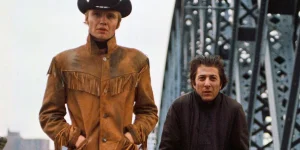
- Midnight Cowboy (1969)
- Five Easy Pieces (1970)
- The Last Detail (1973)
- Straight Time (1978)
- One Flew Over the Cuckoo’s Nest (1975)