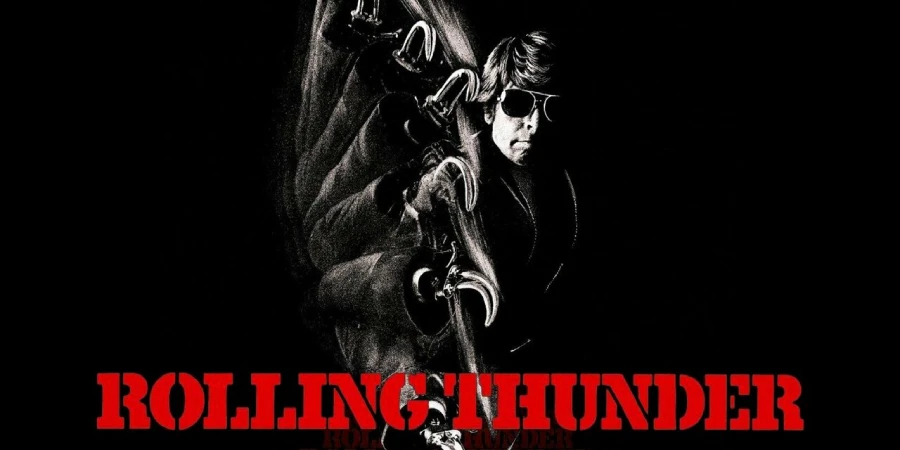

Rolling Thunder is one of the rawest revenge films of the 1970s, written by Paul Schrader and directed by John Flynn. It blends psychological damage, post-Vietnam disillusionment, and methodical violence into a story that feels disturbingly grounded rather than sensational. What begins as a homecoming drama slowly mutates into a cold, relentless revenge odyssey.
Detailed Summary
The Return: A War Hero Comes Home
Major Charles Rane (William Devane) returns to San Antonio after spending seven years as a prisoner of war in Vietnam. The town treats him like a hero. There are parades, speeches, smiles, and patriotic pride.
But Rane is emotionally hollow. He barely speaks, moves with mechanical stiffness, and seems unable to reconnect with civilian life, his wife, or his young son. The war did not end for him; it simply changed location.
He is gifted a silver dollar for every day he was imprisoned, symbolizing honor and sacrifice. This gift becomes the catalyst for everything that follows.
The Home Invasion
A group of local criminals hears about the valuable silver dollars and breaks into Rane’s home. What they expect is easy robbery. What they encounter is a man whose pain threshold and psychological detachment are far beyond their understanding.
Rane refuses to tell them where the money is hidden. They torture him by plunging his hand into a garbage disposal. They murder his wife and son in front of him.
This moment is the film’s true ignition point. The violence is not stylized. It is abrupt, cruel, and sickeningly realistic.
A Man Reforged by Trauma
Rane survives. His arm is amputated. He replaces it with a metal hook. He shows almost no visible grief. No tears. No rage. Only a quiet, methodical internal recalibration.
We begin to understand something unsettling: the criminals did not create a monster. They awakened the one the war had already built.
Rane starts gathering information about the men responsible. He does not go to the police. He does not seek justice. He seeks something far older and more primitive.
Johnny Vohden: A Brother from the War
Rane reconnects with fellow former POW Johnny Vohden (Tommy Lee Jones). Unlike Rane, Vohden seems outwardly adjusted, but beneath the surface he carries the same emotional scars.
When Rane asks for help, Vohden does not hesitate. There is no moral debate. No questioning. Just understanding. War forged a bond where revenge feels like a continuation of duty.
Together, they track the criminals to Mexico.
Crossing the Border
The journey into Mexico feels like a descent into lawlessness. Civilization fades. Justice fades. The film visually and emotionally shifts into a revenge western.
Rane and Vohden prepare for confrontation with quiet professionalism, as if they are planning a military operation rather than a personal vendetta.

Movie Ending
Rane and Vohden locate the gang at a brothel in a small Mexican town. The final sequence is not flashy. It is clinical, efficient, and brutal.
They enter the building and begin killing the men one by one in a tightly choreographed shootout. There is no dramatic music, no triumphant tone. Just gunfire, bodies dropping, and grim determination.
Vohden is shot multiple times during the firefight but keeps fighting. He collapses after killing his targets.
Rane, using his hook and shotgun, methodically eliminates the remaining gang members. His movements are calm, almost routine. This is a man operating in the only environment where he feels normal: controlled violence.
When it is over, Rane sits beside the dying Vohden. There is no celebration. No relief. No closure. Vohden dies from his wounds.
The final image is Rane sitting silently, wounded but alive, surrounded by corpses. He has achieved revenge, but the film makes it painfully clear that nothing inside him has healed. If anything, this was the only moment where he briefly felt at home again.
The ending leaves us with a haunting realization: Rane did not return from the war. He simply found a battlefield that matched his internal state.
Are There Post-Credits Scenes?
No. The film ends definitively with no post-credits content.
Type of Movie
Rolling Thunder is a psychological revenge thriller that blends elements of neo-western, war drama, and crime film. Its focus is less on action and more on the psychological consequences of violence and trauma.
Cast
- William Devane as Major Charles Rane
- Tommy Lee Jones as Johnny Vohden
- Linda Haynes as Linda Forchet
- James Best as Texan Sheriff
- Luke Askew as Automatic Slim
- Dabney Coleman as Maxwell
Film Music and Composer
The score was composed by Barry De Vorzon, whose minimalist and tense music reinforces the film’s somber, restrained tone rather than dramatizing the violence.


Filming Locations and Their Importance
The film was shot primarily in San Antonio, Texas, and locations along the Texas–Mexico border.
San Antonio grounds the film in a recognizably American, patriotic environment that sharply contrasts with Rane’s internal emptiness. The Mexican border locations contribute to the film’s descent into lawlessness, visually marking the transition from society to a personal war zone where rules no longer apply.
Awards and Nominations
While not a major awards contender upon release, Rolling Thunder gained significant cult recognition over time and is often cited in retrospectives and critical lists of influential revenge and post-Vietnam films.
Behind the Scenes Insights
- Paul Schrader wrote the script shortly after Taxi Driver, exploring similar themes of alienation and violence.
- The studio softened some of Schrader’s original darker elements before filming.
- Quentin Tarantino later helped revive the film’s cult status by promoting it through his Rolling Thunder Pictures label.
- William Devane studied real POW accounts to shape Rane’s emotionally numb behavior.
Inspirations and References
The film reflects the American cultural psyche after Vietnam and draws thematic parallels with Taxi Driver and classic western revenge narratives where the law is secondary to personal justice.
Alternate Endings and Deleted Scenes
Some early script versions reportedly included even more disturbing psychological elements and a bleaker portrayal of Rane’s detachment, but these were toned down for the final cut. No officially released alternate ending exists.
Book Adaptations and Differences
The film is not based on a book but on Paul Schrader’s original screenplay.

Memorable Scenes and Quotes
Key Scenes
- The home invasion and garbage disposal torture sequence
- Rane calmly practicing shooting after losing his hand
- The quiet conversation where Vohden agrees to help without hesitation
- The brothel shootout in Mexico
Iconic Quotes
- “I’m gonna kill them all.”
- “You’re gonna have to get used to it.”
Easter Eggs and Hidden Details
- Rane’s mechanical movements subtly mirror how soldiers are trained to suppress emotion.
- The silver dollars symbolize honor turned into the cause of tragedy.
- The hook becomes a visual metaphor for how war has permanently altered him.
Trivia
- Quentin Tarantino named his distribution company after this film.
- Tommy Lee Jones was still early in his career when he took this role.
- The film was initially marketed as a simple action movie, which confused audiences expecting something lighter.
Why Watch?
Because it is one of the most psychologically honest revenge films ever made. It shows revenge not as catharsis, but as the only language a broken man still understands.
Director’s Other Works (Movies)
- The Outfit (1973)
- Lock Up (1989)
- Out for Justice (1991)
- Best Seller (1987)