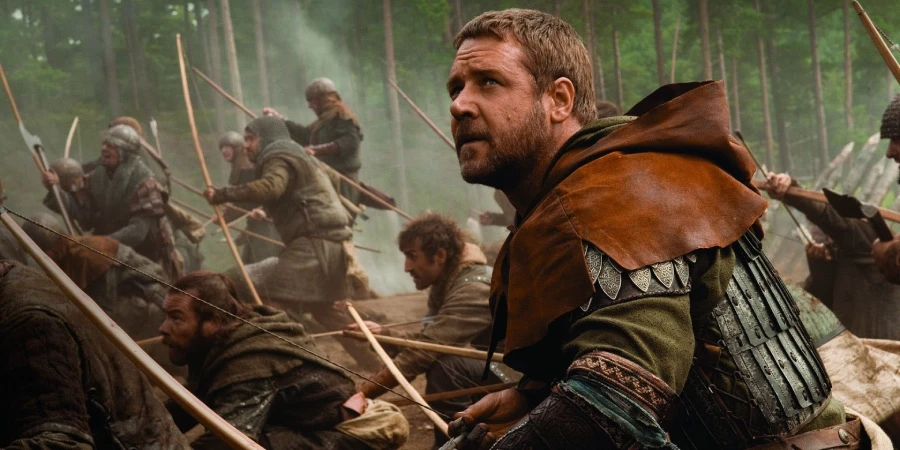

Ridley Scott’s Robin Hood (2010) takes one of the most retold legends in Western culture and strips it of folklore fantasy, replacing it with mud, blood, politics, and a surprisingly grounded origin story. This is not the green-tights, cheerful-robber Robin Hood. This is how the myth is born.
Detailed Summary
A War-Weary Archer in King Richard’s Army
The film opens during the Third Crusade, where Robin Longstride serves as an archer in King Richard the Lionheart’s army. Richard is portrayed as a brutal, tired king, more conqueror than hero. Robin is cynical, intelligent, and already questioning authority. When Richard dies during a siege in France, the power vacuum sets everything in motion.
Identity Theft with Consequences
After the king’s death, Robin and his fellow soldiers desert and encounter a group of English knights slaughtered on the road. Among them is Sir Robert Loxley, who asks Robin to return his sword to Nottingham and tell his father that he died honorably. Robin takes Robert’s identity temporarily, unknowingly stepping into a much larger political storm.
Nottingham and Marion
In Nottingham, Robin meets Lady Marion, a strong, pragmatic woman struggling to protect her people from starvation and corrupt taxation. To avoid suspicion, Robin pretends to be her husband. What starts as a convenient lie slowly turns into mutual respect and emotional connection. Their relationship is built on shared ideals rather than romance alone, which grounds the story emotionally.
The Magna Carta Conspiracy
Robin discovers that King John, Richard’s brother and successor, is weak, greedy, and easily manipulated. Sir Godfrey, one of John’s trusted advisors, is secretly working with the French to destabilize England. Robin learns that his own father was involved in an early version of what would later become the Magna Carta, a charter limiting the king’s power. This revelation reframes Robin not just as a rebel, but as a man fighting for a political idea: liberty under law.
England on the Brink of Invasion
As French forces prepare to invade England, Robin rallies commoners and nobles alike. For the first time, he becomes a symbol rather than just a soldier. The climactic battle takes place on the English coastline, where peasants fight alongside knights to repel the invasion.
Movie Ending
After the French invasion is successfully repelled, King John initially promises reform, agreeing to uphold the charter that would protect the people from tyranny. This moment teases hope: England might change without bloodshed. However, John quickly betrays this promise. Fearful of losing power, he burns the charter and declares Robin Longstride an outlaw, accusing him of treason.
Marion chooses to stand with Robin rather than return to noble safety. Together with Little John, Will Scarlett, Friar Tuck, and the rest of the group, they retreat into Sherwood Forest, where they begin living outside the law. The legend is born not in triumph, but in betrayal. The final moments explicitly state that Robin and his followers will now fight against the crown, setting the stage for the classic Robin Hood myth we all know.
This ending is deliberately bittersweet: England is saved from invasion, but doomed to internal oppression, and Robin becomes an outlaw not by choice, but by principle.
Are There Post-Credits Scenes?
No. Robin Hood (2010) does not include any post-credits or mid-credits scenes. The story ends definitively with Robin’s outlaw declaration and retreat into Sherwood Forest.
Type of Movie
Robin Hood (2010) is a historical action-adventure drama with strong political undertones. It focuses more on realism, warfare, and social injustice than romantic folklore.
Cast
- Russell Crowe as Robin Longstride
- Cate Blanchett as Lady Marion
- Mark Strong as Sir Godfrey
- Oscar Isaac as Prince John
- William Hurt as William Marshal
- Mark Addy as Friar Tuck
- Kevin Durand as Little John
Film Music and Composer
The score was composed by Marc Streitenfeld, a frequent collaborator of Ridley Scott. The music is somber, heavy, and militaristic, emphasizing moral struggle over heroic fantasy. The score supports the film’s grounded tone rather than trying to mythologize the action.
Filming Locations
The movie was shot across England and Wales, including:
- Bourne Woods (Surrey) – used for forest battle scenes
- Freshwater West (Wales) – the French invasion beach
- Dover and Pembrokeshire coastlines – representing medieval England
These real locations reinforce the film’s muddy realism and avoid the artificial look often associated with historical epics.
Awards and Nominations
The film received modest recognition:
- Nominated for Best Costume Design at various critics’ associations
- Praised for production design and cinematography, though it did not receive major Academy Award nominations
Behind the Scenes Insights
- Russell Crowe was heavily involved in shaping Robin’s character and dialogue
- Ridley Scott intentionally avoided traditional Robin Hood imagery (no green tights, no cheerful ballads)
- The film was originally conceived as a Sheriff of Nottingham origin story, later rewritten
- Extensive historical consultants were used to ground the politics and warfare
Inspirations and References
- English folklore of Robin Hood
- The historical Magna Carta (1215)
- Medieval political struggles between monarchy and common law
- Ridley Scott’s own earlier historical films like Kingdom of Heaven
Alternate Endings and Deleted Scenes
Some deleted scenes explored King John’s paranoia in more depth and expanded Marion’s leadership role among the villagers. These were cut to reduce runtime and pacing issues. No fully alternate ending was filmed, but early scripts positioned the Sheriff as the primary antagonist rather than Godfrey.
Book Adaptations and Differences
The film is not directly adapted from a single book, but from centuries of English ballads and legends. Unlike traditional versions:
- Robin starts as a soldier, not a thief
- The Sheriff of Nottingham is largely absent
- The story focuses on how Robin becomes an outlaw, not his exploits afterward
Memorable Scenes and Quotes
Key Scenes
- King Richard’s brutal death during the siege
- Robin discovering his father’s role in early constitutional ideas
- Marion leading villagers into battle
- The final betrayal by King John
Iconic Quotes
- “Rise and rise again, until lambs become lions.”
- “This is England. And it will not kneel.”
Easter Eggs and Hidden Details
- The burned charter visually mirrors historical Magna Carta illustrations
- Robin’s sword design subtly resembles later legendary depictions
- The final narration echoes medieval ballad structures
Trivia
- This was Russell Crowe and Ridley Scott’s fifth collaboration
- Oscar Isaac’s Prince John performance gained attention years before his fame
- The film underwent multiple rewrites during production
Why Watch?
If you’re interested in realistic historical epics, political origin stories, and morally complex heroes, Robin Hood (2010) offers a fresh take. It’s less fairy tale, more foundations of rebellion.
Director’s Other Works (Movies)
- Alien (1979)
- Blade Runner (1982)
- Gladiator (2000)
- Kingdom of Heaven (2005)
- American Gangster (2007)
- The Martian (2015)